What Do They Know and How Do They Know It?

“What is real? How do you define real? If you’re talking about what you can feel, what you can smell, what you can taste and see, then real is simply electrical signals interpreted by your brain.”

 Last week we were discussing whether those who control America’s elite institutions are aware that the policies they promote are destructive of the ends they claim to cherish. The context was my claim that they can be brought around on marriage by appeals to their values on helping the poor, protecting women and children, preventing a two-class society, etc.

Dan wrote:

 They unquestionably know what their favored policies do.  How could they not?

Let’s quibble over epistemology!

Dan seems to me to have a very excessive faith in human reason. No one examines every one of his beliefs carefully, and very few examine more than a handful of their beliefs carefully. That is not a lamentable state into which our particular society happens to have fallen at this point; it is the permanent condition of humanity in all times and places. Locke wrote great stuff on this.

The great majority of human behavior does not consist of rationally evaluated decisions based on objective information-gathering and deliberation over setting priorities. It consists of only briefly examined, very imperfectly informed responses to “cues” from centers of cultural authority.

This is as much true of our cultural elites as of anyone else. We see millions of people following the cues of the dinosaur media and we sometimes think of those media as shrewd manipulators. In fact, they are not much more awake than those who follow them. They are only following each others’ cues.

And it’s also true of the elites within the conservative subculture. The conservative media world is not much more thoughtful than the “mainstream” one. Ditto the world of Christian leaders, who are to a large extent just following one another’s cues.

Obviously I’m not saying no thought goes on, or that these cycles where everyone is just following everyone else in a big circle can’t be disrupted. In fact, my whole case here is precisely that real thought does go on and the circular marches can be broken.

It’s difficult and it will take a radical shift in strategy.Our first task will be to disrupt the circular marches within our own worlds (both conservative and Christian) to get them to change gears and approach the task of fighting for marriage, life, religious liberty and good stewardship of the economy in a very different way. We have to get our own house in order before we can hope to get the nation’s house in order.

But we can’t do that if we live in a false reality where we imagine that our opponents are knowingly accepting the destruction of America as the price they pay for fidelity to their values. That picture strikes me as ludicrous.

Ayn Rand could believe that everyone who supported collectivism really knew in his heart that collectivism was destructive, because her Pelagian anthropology required this conclusion. Read that interminable Galt speech (if you can) and you’ll see the whole system is laid out very clearly. Starting from the classical Pelagian premises about human behavior, she demonstrates that they imply a Manichean social world. Every person without exception clearly and fully percieves the distinction between the way of living that is morally right and the way of living that pleasurable in the short term, and has deliberately chosen one or the other. This is what Whittaker Chambers correctly percieved about Rand in his notorious review of Atlas Shrugged.

I don’t have space here to explain why Pelagianism is wrong, but I hope that on Hang Together I don’t have to. Both Christian teaching and conservative beliefs about human behavior explain why we shouldn’t expect to find that our opponents are conscious of the destructiveness of their policies. And Christian belief also admonishes us to beware of our own tendencies to make ourselves into angels and our opponents into demons.
LifeChain

Yesterday I stood with 1,000s of other fellow Wisconsinites in the annual LifeChain, where we stood along major roads in the greater Milwaukee area holding signs protesting abortion. The signs read “Abortion Kills Children,” or “Adoption: the Loving Option,” or “Abortion hurts Women.” During the hour and a half that we stood along the roadside I reflected on ‘moral consensus’ and the realities of a land that lives post Roe vs. Wade.

We live in a land that constitutionally (and if you have followed the debate and comments on Karen’s recent post) and morally believes in ‘life, liberty, and the pursuit of happiness,’ it is ironic that we also live in a land that denies life to unborn children. There seems to be quite the similarity between saying that babies in the womb are really fetuses and slaves aren’t human (well, maybe 3/5th human). We change the definition of who the constitution protects so as to create a moral loophole. Unborn babies are not babies, therefore not protected by the constitution, our declaration of civil moral consensus. It took constitutional amendments to make slaves human, and that seems to be the only way to get abortion ended in this country.

The other thought I had as I stood silently protesting was the similarity between standing on the side of the road and voting against gay marriage. I’m not suggesting that gay marriage and abortion are similar, the murder of unborn children is completely different than one’s sexual preference. But I thought about the effectiveness of holding a sign on the side of the road. In many ways, it is about as effective as trying to vote against gay marriage. Is it successful in accomplishing it’s goals? Slightly, but there are better methods. Yet, I still stood there because it is effective, if only slightly. A slight effectiveness does not mean that I should not do it. A slight effectiveness of voting in the issue of gay marriage does not keep me from voting. But I have to confess that the annual LifeChain is about the only time I get involved in the pro-life movement. Just like casting my vote is about the only time I take a stand against gay marriage. I’ve become content to be involved in only ‘slightly’ effective means of social change. Slavery did not change because once a year people stood on the side of the road and protested. Maybe they did that, but social change took place through social debate and discussion and action.

The abortion debate also has a bearing on the debate of law and morality. The majority in this country seem to support abortion, but does that make it right and ‘moral?’ Does government have a responsibility to ignore the masses and do what is ‘moral?’ When it comes to gay marriage, I confess that I often think ‘no,’ but when it comes to abortion, I resound with a definite ‘yes,’ which really serves to muddy the waters even more. Where is that line between government being reflective of the masses and doing what is moral?

In this instance, the out is provided by the constitution. My pursuit of happiness is limited by another’s liberty. Currently, a woman’s happiness trumps a baby’s life and liberty. “It’s my body” sounds similar to “that slave is my property,” both of which are constitutionally wrong. A gay man’s happiness in marrying his lover is fine constitutionally unless tax rates have to be raised on everyone because he now gets a tax break for his sexual preference of marrying a man. Now his happiness is encroaching on my liberty. I could even make the same case against abortion. Killing off part of the next generation of workers and tax payers makes my taxes go up, again affecting my liberty.

All of which, I believe, shows that we have a good standard of moral consensus in the constitution. With that as our guide, it seems that moral consensus on many of these issues could be handled. So, I throw this question out to my fellow bloggers…how does the constitution apply to gay marriage?

“Hullo. We’re talking about law.”

In this delightful sketch from A Bit of Fry & Laurie, Stephen Fry asks whether the qualities of the English language are a function of the characteristics of the English people, or whether those qualities “come extrinsically, extrinsically, from the language itself? It’s a chicken and egg problem.” So today, we’re talking about the chicken-and-egg problem of law and moral consensus.

Greg writes that “Law can’t be legitimate if it’s not grounded in a moral consensus. All law presupposes a moral framework. You can’t ban public nudity without some implied judgment on the moral status of public nudity.” It seems to me that there are (at least) two disparate claims set forth here: a) that law must be grounded in moral consensus, and b) more subtly, that law implies moral judgment.

But the two don’t entail each other necessarily. The legislature can issue laws that reflect society’s moral consensus without passing judgment on whether that consensus is good, i.e., without making a moral judgment. (Of course, we are then presupposing a moral judgment on whether that particular mode of issuing laws is a good one, but I don’t think that’s what Greg is talking about.) On the flip side, the legislature (or monarch, or tyrant, whatever) can issue laws that do imply a moral judgment – i.e., banning public nudity because public nudity is morally bad – but that don’t reflect anyone’s consensus.

But here comes the chicken-and-egg issue, because the law often serves an educative function as well as its commanding one, i.e., people tend to view as wrong something that the law tells them to perceive as wrong. So moral consensus can follow the law as well as it can precede it.

Still, I think that we’re encountering some confusion in the marriage debates in part because we’ve been operating with two different understandings of how law is made in democracy, but without addressing the difference between them. Law can be made to reflect societal consensus without taking a stand on the metaphysical status of the act forbidden or commanded, or it can be made as a mandate to do that which is good or avoid what is bad as determined by moral judgment. And the difference between these two modes of making law doesn’t become clear in cases of societal moral consensus, such as public nudity. In other words, when there is moral consensus, we don’t really know whether the law exists simply because of the legislator’s moral judgment or because the legislator is reflecting a broad societal moral consensus in issuing laws against public nudity.

Rather, we see the difference between these two ways of making law in cases of dissensus, such as we’re finding today with the definition of marriage. Has the state always favored traditional marriage because of societal moral consensus, or because the state/legislator has reflected a (good, in my opinion) moral judgment that traditional family structure is morally good? The answer could be “both,” in the sense described above, since societal consensus might have come in part from the practice of traditional marriage ensconced in the law. Which might be leading to some of the current confusion: “The state can’t legislate morality!” versus “The state has always legislated morality; why should it stop now?” But if the answer is only ‘societal consensus,’ we’re stuck when societal consensus shifts.

Where does this leave us? Minimally, I think it means that we need to figure out what type of government we really have, and I think conservatives have been ambiguous on this in the past. At times we want “pure democracy” in the sense of simple majoritarian rule, which maps onto the idea of reflecting societal moral consensus: i.e., “legislate what we tell you to legislate and stay out of morality. Traditional marriage is good because it’s what the people want.” At other times we want democracy with a moral standard – something that comes “extrinsically, extrinsically” from society itself. In other words, we want Congress to legislate that which is independently good, meaning either good for society or good by a moral standard higher than humans.

But if all democracy is is a reflection or function of society’s moral consensus, there might not be much left for traditional marriage.

The State and the Meaning of Life

At the risk of dwelling on a topic that it may not be edifying to dwell upon, I’m going to circle back to public nudity. (Hang Together has existed for just one month and we’re already establishing a clear brand identity!)

Replying to my argument that the moral imperatives of reproduction alone are insufficient for a shared public morality, Dan wrote that he agreed, but thought that the state specifically should only have a role where reproduction is involved. I asked whether Dan’s position didn’t imply “whole hog libertarianism on everything sexual other than actual intercourse.” After all, as long as intercourse isn’t involved, it would seem reproduction isn’t an issue and thus (by Dan’s theory) the state seemed to be excluded.

So what about banning public nudity? After some back and forth, Dan said:

The state’s interest in the presentation of sexuality in the commons is not an interest in sexuality per se, but in refereeing the interests of two competing actors who have a claim on the commons.

But how is the state to referee these conflicts if it doesn’t know anything about the subject? Suppose actor A does action X in the commons, and actor B goes to the state and makes a claim that X excludes his use of the commons, not because X does direct harm to B but because X degrades the commons in such a way that it makes our moral formation as human beings impossible, such that (as Dan himself admits) the state can exclude it. How is the state to evaluate the claim unless the state understands the moral significance of action X and its impact on the moral formation of human beings?

Law can’t be legitimate if it’s not grounded in a moral consensus. All law presupposes a mroal framework. You can’t ban public nudity without some implied judgment on the moral status of public nudity.

This judgment need not be a total judgment. The state need not decide whether sexuality is an expression of God’s loving nature and marriage is an image of Christ and the church. But it does need to know that flapping your bits around in the town square is wrong.

When the state favors the parents over the pornographers, it is not doing so because it has made an independent moral determination that the pornographer is purveying a harmful metaphysical something.  It is responding to the community’s demand that the commons’ floor be set at a certain level.

I agree the state should not make an “independent” determination, but ground its own moral knowledge in the public moral consensus. My point is that the state does need to exercise some kind of moral competence or it can’t do the job you’re asking it to do.

The state must take this role because the pornographers and the parents have mutually exclusive claims to use of the commons.  And the state can, and does, draw the line without reference to an absolute moral standard.  It simply references community standards.

Not sure what you mean by “absolute” here. But your statement does seem to imply that a moral standard (ultimately, the public’s rather than the state’s) is being codified in law. This implies a need for some level of competence in moral judgment by the state – so it can know and execute the public moral conesnsus.

That’s about all it can legitimately do.  Doing more would involve the state in determining what is orthodox.  And that it may not do.

I agree the state should not enforce a doctrinal orthodoxy. But the state simply cannot be neutral about whether it is morally OK to flap your bits around in the town square. That option just doesn’t exist.

That is why culture is so important.  On these types of questions, when both sides cannot simultaneously do as they wish, culture is the deciding factor.  The state, although a cultural actor, simply enforces the decision made by all the other cultural actors.

But how does it enforce a view unless it has some competence to understand that view and pass judgment on what particular actions do and do not conform to it?

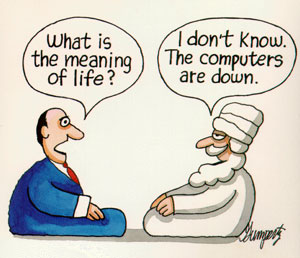
Bottom line: The state ought not enforce a total view of the meaning of life, but it cannot by any possible means avoid enforcing at least a partial view of the meaning of life. The choice to ban public nudity presupposes a moral view (ultimately, the public’s moral view) and thus requires the state to know and judge morality to some extent.

The Chaos Theory of Government

I have to chuckle whenever I here about new government programs because those in government often only see the short term effect of what they are doing. For instance, “cash for clunkers,” while supposedly great for the environment, was not great for the used car industry! The current debate between Greg and Dan is a similar example in that they  seem to be arguing over whether or not the destruction of marriage was intentional or not. While Greg and Dan continue to debate over whether or not Dan is a functionalist, I would argue that the death of marriage was not an intended result of the last forty or so years of government policies on marriage but it was the result.

Functionalism would  render what the government thought it was doing as irrelevant, but it is relevant. I’m not entirely sure that the government intended to kill marriage with lose policies anymore than they intended to reward marriage financially. What may have been well intentioned had unintended results. I have the same compassion for our government thinking it was helping that I do for natives who think dancing brings rain. What we need to be careful of is not becoming natives ourselves and assuming that government can bring marriage back. In the given climate, we might have a better chance dancing for rain.

And yet, given all that we have discussed on this blog, that does not mean that we can simply sit back and do nothing. Government policies should not be our only strategy for restoring marriage to its correct place. However, we cannot ignore government policies either. Government interaction should be part of our efforts, but we need to have reasonable expectations. It needs to be a piece, not the whole. As Greg said earlier, government is not culture, but it is a part of culture. Thus, it must be part of what we do.

Marriage may be dead, or at least in its death throes, but as Maggie Gallagher of the National Review has reminded us, we can’t stop trying to revive traditional marriage. We just need to remember that government policies are just part of a successful method of cultural change.