The Unexpected (to Me) Return of White Racism

the-most-iconic-parts-from-martin-luther-kings-i-have-a-dream-speech

Twenty or ten or even a few years ago, I thought white racism was a radically diminished factor in American life. Obviously it is not now. Was I wrong all along? Or did it decline and come back? I would argue for the latter, given that the new racism is so different from the old. But that’s not a hill I’d die on, either. I could be persuaded that I was simply insensitive to what was there below the surface.

Perhaps it doesn’t really matter. The present is never identical with the past but always grows out of it in some way.

These thoughts are prompted by Kevin Williamson’s outstanding defense today of his outstanding article on why many white working class communities are dying and can’t be saved by any possible means. He says today:

Conservatives thought so highly of Cosby for saying these things that when he was accused of rape, the New York Post protested that he was being “crucified for being conservative.” When the allegations first started coming out, Rush claimed that they were getting media play only because Cosby had enraged liberals by insisting that black men “start accepting responsibility.” Jerome Corsi, Trumpkin extraordinaire, fell over himself with praise for Cosby, whose speech had gone “against the grain of politically correct rhetoric that defines white racism as the cause and black inequality as the result.” (Conservatives of this stripe are big on being “politically incorrect” — about blacks.) Sean Hannity joined in.

Black man tells black underclass to get its act together, he’s a hero to white conservatives. White man tells white underclass to get its act together, different story. If you wanted to know whether white identity politics inspired by Donald Trump is going to be as foolish and morally reprehensible as black identity politics inspired by Al Sharpton, there’s your answer.

Houston, we have a white racism problem.

I think it really does come down to a choice between modern, liberal constitutional democracy or the abyss.

I keep coming back to Allan Bloom on this. The big question he was really posing was simply: Must liberal democracy destroy itself? And the context he sought to provide for the question was twofold. 1) If it does, we do not seem to be capable any longer of generating any other kind of humane social order; if liberal democracy does destroy itself, the only alternative seems to be totalitarianism. You can say (as I do) that this is because the great tradition culminated in modern, liberal democracy and cannot now be found outside it, or you can say (as Bloom did) that the great tradition died because we became aware that we could choose between many traditions and thus none of the traditions can now function for us as a tradition. In the end perhaps they’re two ways of saying the same thing. 2) Our minds have been shaped for a century by a radical European thought tradition that takes for granted liberal democracy must destroy itself, and we are now so deep in this thought tradition that we are not aware of the alternatives. Thus the American mind has become “closed” to even the possibility of the American experiment, and we cannot think freely again until we recover some awareness of why people found that experiment plausible in the first place, so we can evaluate for ourselves whether they were right.

Interesting times to live in. It will be fascinating, though not necessarily fun, to see what the Lord has for us next.

The True Cause of the Breakdown of Marriage Discovered at Last!

image

Behold the ravages of “material poverty”!

In his new dissemination, Frank the Hippie Pope declares that “we know” the following statement is true:

In some countries, de facto unions are very numerous, not only because of a rejection of values concerning the family and matrimony, but primarily because celebrating a marriage is considered too expensive in the social circumstances. As a result, material poverty drives people into de facto unions.

Note: “primarily.”

As Allan Bloom once said in another context, its ridiculousness quenches indignation.

Racism and Liberal Democracy

the-most-iconic-parts-from-martin-luther-kings-i-have-a-dream-speech

On NRO today, Ian Tuttle examines how and why Donald Trump has attracted the support of so many white racists. One thing that stands out to me as important in this article is that contemporary white racism is no longer – as I think it really was, say, twenty years ago – merely an incohate collection of instincts and attitudes. It has learned to think and speak in a new pseudo-intellectual vocabulary – one that is markedly different from the old pseudo-intellectual vocabulary that gave mental structure to white racism sixty years ago.

Gone is the claim of purely biological difference, which was the very lifeblood of white racism from the American founding to the Civil Rights era. Today the claim is not to a superior nature but to a superior second nature – a superior culture that is, allegedly, so deeply ingrained that it actually changes biology, creating racial differences where none existed prior to human action. The superiority of culture over nature established by advanced or “post” modernity now extends even to racism, formerly the most atavistic pro-natural form of thought.

Our liberation from ancient superstitions into a real knowledge of nature has led, among other things (many of them good), to a deep dissatisfaction with the limits of nature. Locke, perhaps the key leader of the liberation from superstition, emphasized the need to accept those limits. But we have not. “Culture,” which (when divorced from God) seems infinitely malleable and responsive to our desires, was proposed as as a substitute source of ultimate meaning – leading us straight back into the loving arms of superstition.

Allan Bloom once joked that his critics, who embodied so unambiguously the rejection of reason that he had diagnosed in Closing of the American Mind, could have been sent by central casting for a Hollywood adaptation of the book. So could the pseudo-intellectuals of the “Alt Right.” It is becoming increasingly clear that Bloom was not in the least hyperbolic when he warned that America was playing with the same matches Germany had been playing with in the 1920s.

The conclusion of Tuttle’s article struck me particularly as one Bloom – or Martin Luther King – would appreciate:

They also seem to think that liberal democracy itself was an abstraction tyrannically imposed on an unwilling populace. It wasn’t. It was a slowly and painfully forged response to centuries of challenges. The Western, liberal-democratic order is wracked with problems, of course; but it always has been. The question is, Has it been more fruitful, more liberating, more constructive in promoting the common good than have the various orders that came before it? And if so, is there a compelling reason for throwing it over in favor of the ancient belief that some men are, indeed, born with saddles on their backs, and a favored few born booted and spurred, entitled to ride them?

This is the question the Alt-Right poses. As it happens, it’s an old question, and one to which our forebears gave powerful answers. But every generation has to relearn them. The larger the Alt-Right grows, the clearer it is that ours hasn’t.

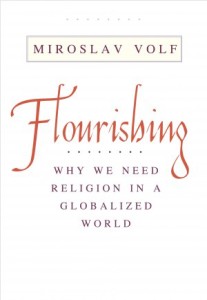
How Miroslav Volf Learned to (Sort Of) Stop Worrying and (Kinda Sorta) Love Globalization (Not Really)

Flourishing_300_434_90

My review of Miroslav Volf’s Flourishing is up at TGC. Characteristically for Volf, when it’s good, it’s really, really good . . .

Volf untangles the big bunches of theological threads that have become badly snarled up in the modern church, then weaves them into coherent and very affecting theological tapestries. I was moved by his simple and powerful application of the Great Commandment to globalization, distilling the key questions we need to ask about where globalization is helping or hindering love of God and neighbor.

The introduction also lays out six excellent theses on religion and globalization. Here Volf expresses the enormous possibilities for human flourishing that could come from bringing these forces together, while carefully hedging against the possibility that we might reduce either one into a mere tool of the other. It says something about the state we’re in that merely seeing the key issues set out in this clear and coherent way produces such a sense of relief and appreciation.

. . . and when it’s bad . . .

The most frustrating problem with Flourishing for me is an unresolved conflict at the heart of Volf’s approach to religion and globalization. He sometimes acknowledges the interdependence of religion and globalization; more often, though, he indulges in false narratives that describe globalization as an autonomous force with no moral origin or end (telos).

The most shocking instance is when he holds up a set of passages from the Communist Manifesto as describing globalization “better than anyone before . . . and, for at least a century, better than anyone after” (29). He apparently doesn’t see how the rejection of God and the seeds of mass murder—the reduction of human beings to mere tools of class interests, the dehumanization of the “bourgeois,” the materialistic understanding of economic desires, and the assertion of a basic opposition between economics and religion—are represented in the very passages he praises so highly.

My takeaway? “You can only reform what you love.”

Parent “Partners” by Law

image

Helen Alvare offers a fascinating discussion—with links to other people’s fascinating discussions—of Merle Weiner’s proposal for an involuntary “parent partner status” in the law. (Give that it’s involuntary, “partner” may be stretching things.) Parents of children conceived outside marriage already have child support obligations to their offspring; Weiner’s idea is to also impose obligations to the other parent. It’s a complex proposal, not adequately summarizable in a blog post, but part of the idea is to create at least a minimal level of parental cooperation and some overlap between the parents’ interests, to the extent that we can. Another goal (putting on our moral realist hats) is to disincentivize non-marital childbearing—to take away from the non-caretaker parent a Get Out of Family Free card that he shouldn’t be allowed to play.

The details of the proposal are less important than the big-picture question. Some of the obligations Weiner proposes make sense—heightened protections against domestic abuse, heightened obligations to look out for the other’s interests in contractual agreements. Others are less likely to work—requiring “relationship work” with a counselor, sharing the child care “fairly” or incurring a debt to the parent doing “dispropotionate” care. It has also been asked how successful we are going to be at enforcing these requirements when when we are not yet highly successful at enforcing child support requirements—although that argument would not apply to some of the burdens Weiner proposes, such as heightened legal obligations in contracts.

But far more interesting is the general question of how we can think creatively to devise new legal tools to force recalcitrant parents to recognize the duties they have taken on by creating a child. The law must find some way to say to unmarried parents, “you make it, you bought it!” And not just with money for child support.

Weiner’s proposal, while addressed to a different immediate question, is in some ways complementary to ideas that have been recently proposed to make it easier for people who either can’t get married or don’t want to do so to join their civil interests—get each other’s health coverage, etc. Such proposals seek to provide an alternative to changing the definition of marriage in order to provide for those (whether same-sex romantic couples or any other pair—siblings, etc.) who seek some of the legal benefits that are currently associated only with marriage but could be extended to others without redefining marriage. Weiner’s proposal addresses non-marital childbearing rather than the definition of marriage. And it takes a different approach in that it seeks to impose duties involuntarily upon those who have sired children, rather than offering an additional legal option. However, the proposals are complementary in that they recognize the inadequacy of existing legal tools to deal with the current state of our civilization.

No matter how things go, we are going to need new legal arrangements surrounding marriage and family. That’s nothing new; marriage and family law have varied considerably over the past two thousand years. It’s not a good sign; the primary reason we need these new arrangements is our moral failure. And these new arrangements are going to be used to facilitate cruel and exploitative treatment. But the alternative, refusing to create any new legal tools to deal with new cultural situations, will probably be worse in that regard.