And so the games begin. May the odds be ever in your favor!
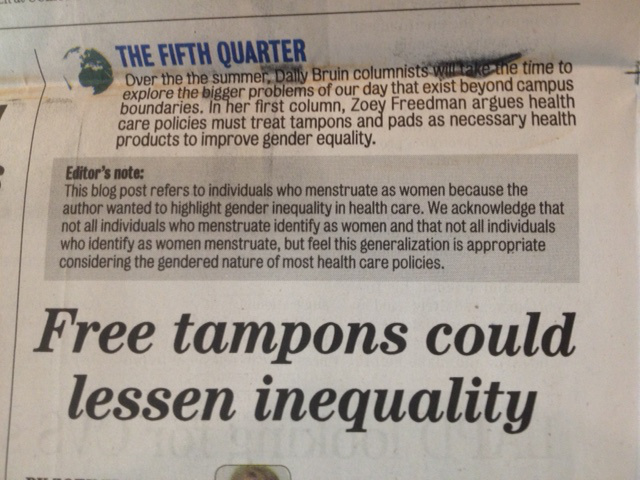
From the Daily Bruin; HT Kausfiles

Regarding the now-notorious “a lot of people want liver” video, revealing that the sale of organs from unborn humans killed at Planned Parenthood affiliates is commonplace, one blogger writes:
If the First Lady of the United States could say 8 years ago that for the first time in her adult life she was proud of her country, then I suppose I can say that for the first time in my adult life I’m ashamed of my country. If the price of being publicly loyal to it pretending that I’m basically okay with sharing a national identity with the people who have allowed this monstrosity to continue unchecked since 1973, or that my disagreements with people who are okay with the sale of baby parts are “mere politics,” then count me out of this ridiculous charade. [ea]
Here is where Christians will have to show a more excellent way. We must say, not “count me out,” but “count us in.”
There is nothing in America today that even comes close to the darkness and evil of the first-century Roman Empire. Killing babies? Check! They killed them not only in the womb but out. “Exposure” of infants for any and every purpose, including if you got a girl when you wanted a boy, was routine. Selling human flesh? Check! We call that “slavery” and it was also routine, including the most barbarous mistreatments.
Yet Paul did not say “count me out.” He said, “I am a citizen by birth.” We must say the same.
Confronted by a mob seeking approval for its own evil, he said, “We also are men, of like nature with you.” We must say the same.
We must keep our holiness, but God’s holiness is a loving holiness, just as his love is a holy love. God was not ashamed to join himself, in the person of his son, to this dark and evil world. He did it at the cost of literally infinite suffering. Shame on us if we are ashamed to join ourselves, at the cost of far less suffering, to our own civil communities.

Greg Forster for the defense, your honor.
Following my annual tradition, I offer my Independence Day case for hopeful realism about moral consensus in America. Last year I remarked that it was time to start tempering the hope and offering concessions to the realists. This year I offer no such tempering or concessions. The key question at this moment is not how to balance hope and realism, but whether there is any place for hope.
I start by recalling the thought that inspired me in my initial Independence Day reflection:
Ladies and gentlemen of the jury, I defy you to show me any nation in the whole history of this world where that blind, black son of sharecroppers grows up to be Ray Charles….If it’s the good, true and beautiful you’re looking for, a country in which Ray Charles can grow up to be Ray Charles has a lot to offer.
But now it is we who are increasingly the blind ones. As I wrote while my daughter was in surgery:
American culture has a way of defying pessimistic expectations…We expect the sources of tomorrow’s strength to be the same as yesterday’s sources. But yesterday’s sources are always in decline – that’s just how it is in the fallen world. Meanwhile, in the places where we’re not looking, entrepreneurs are inventing new sources of cultural strength and vitality. The signs of decline are always right where you expect to find them; the signs of hope spring up in the last places you expect.
So while we spend all our time debating how a Supreme Court decision is going to destroy the world, we fail to notice that the Walt Disney Corporation – an organization whose power to influence American culture is, frankly, greater than that of the Supreme Court – has become a highly effective purveyor of moral edification.

I’m not pretending that we aren’t in for a rough ride. The recent decisions of the court are going to hurt a lot of people, mostly those they are intended to help. That sucks and it’s going to be hell. But that’s not the question. The question is whether the whole culture moves together in one direction, or if there are also countervailing winds – winds that might actually turn out to be more important.
If you had told me a few years ago that Disney – the great high citadel of Romantic individualism! – would conquer the whole world with a devastating attack on Romantic individualism (a movie whose moral is “love is putting other people’s needs ahead of yours”) and then conquer the whole world again just a year and a half later with yet another devastating attack on Romantic individualism (a movie whose moral I have summarized as “Joy is Life, Sadness is Wisdom”) I’d have said you were bonkers. But there it is.
The bad news is always right where you expect to find it. The good news never is.
Culture is not simple; it defies uniform categorization. And of all the complex interlocking systems that make it up, law is not the most important. Otherwise, why do seemingly “sound” judges keep going the wrong way? If the law were at the top of the culture heap, judges would not show such a pronounced tendency to, as they say, “grow in office.” We’re fools if we think the problem is individual lack of virtue on the part of the judges. They are responsible for their own choices, of course, but that can be true and yet at the same time there can also be valid systemic explanations for their choices. Or, to put it another way, we need to ask not only “did the judges fail?” but “given that judges fail, why do so many fail in this particular, specific way?” The answer is that other forces are more culturally powerful than the law.
Or consider, as we have noted several times on HT, the striking consensus that has emerged among cultural elites that divorce and illegitimacy are destroying the poor. Now, there are two ways people who believe what we believe can respond to that. One is to say, “those elites have adopted a Romantic individualist understanding of what marriage is, and until they repent from that no progress can be made; culture is simple and unitary and straightforward and it all interlocks neatly and there is never, absolutely never, any space for internal contradictions. Therefore this new consensus is of no value.” Or we can say, “here’s an opportunity we can seize upon. Without giving any ground on our principles regarding the definition of marriage, let’s work together with these elites to enact reforms that curtail divorce and illegitimacy. When they discover that these reforms are beneficial, we will then be in a much stronger position to explain to them why those reforms had the effect they had – and thus, over time, destabilize their commitment to a Romantic individualist understanding of what marriage is.”
The real problem is not that the enemies of justice and mercy are enemies of justice and mercy. The real problem is that the friends of justice and mercy are too busy cursing the darkness to seize the candle-lighting opportunities that are right in front of their noses.
I close with a reflection I offered last year in my review of Joseph Bottum’s book, which advocates despair:
Bottum himself—unconsciously, perhaps—shows us again and again why we need hope and how we can live it out…You can especially see it in his magnificent chapter on John Paul II. Bottum takes us from the days Karol Wojtyla spent in January 1945 helping clear a gigantic pile of frozen-solid human excrement out of an abandoned seminary building in Cracow, using nothing but a trowel, to his triumphant return to Poland as pope, and beyond. As Bottum emphasizes time and again, John Paul refused to accept the narrow constraints of what appeared, superficially, to be possible—because of his hope. John Paul saw the unseen layer of the world, and that is why he knew with certainty that the counsels of despair were wrong. By bearing witness to hope, he made the impossible possible.
He was willing to spend days on end chiseling human waste out of an abandoned seminary because that was what it took to prevent Soviet troops from marching in and claiming the building. His Christian hope told him that the structures of a culture will ultimately be occupied not by those who have more guns, but by those who do the hard and undignified work of clearing out the excrement. That hope did not put him to shame…
Perhaps Bottum hasn’t fully internalized his own critique of those narrow-minded sociologists of religion. Perhaps he lacks a strong enough faith to have hope. Or perhaps he just feels it’s beneath his dignity to join those of us who will spend the coming generation chiseling gigantic piles of excrement out of the abandoned buildings of American culture. But if God ever does kindle the spark of hope in Bottum’s heart, we’ve got a trowel waiting for him.
Yes, it’s going to suck. But the shit is not going to scrape itself off the floor of American culture.
Trowel’s waiting. Get to work or get out of the way.
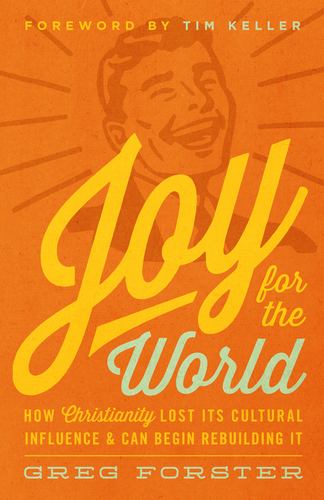
I recently had a great time discussing the problem of “grumpy moralism” in a radio interview with Jerry Bowyer. A partial transcript of the interview is now up on the Forbes website:
DR. FORSTER: I would connect it to what we were saying before about many people having overinvested in rationalism. Because when arguments fail to work, people don’t know what to do. If you can’t argue with somebody, you begin to see them as subhuman. And so this sort of grumpy moralism arises from a sense of impotence — powerlessness — that ‘our argument is clearly right, but why is nobody seeing it? Look how terrible the world is becoming (when it goes the wrong way) yet why is nobody seeing it?’There’s an anger and frustration I think that –
JERRY: I know, I’ll yell louder.
DR. FORSTER: Yeah, yeah, that will do it.
He had some very kind words about my book:
JERRY: Your book is “Joy for the World.” It’s interesting, when I read it, if you were here with me, I would show you that I wrote a two-word summary of the book in the inside cover. Two-word summary was “More singing!” with an explanation point.
DR. FORSTER: I love it.
JERRY: And I’m going to stick with that.
My 21 word review of Inside Out on JPGB.