Modernity Forces Us to Ask What We Hold Most Dear

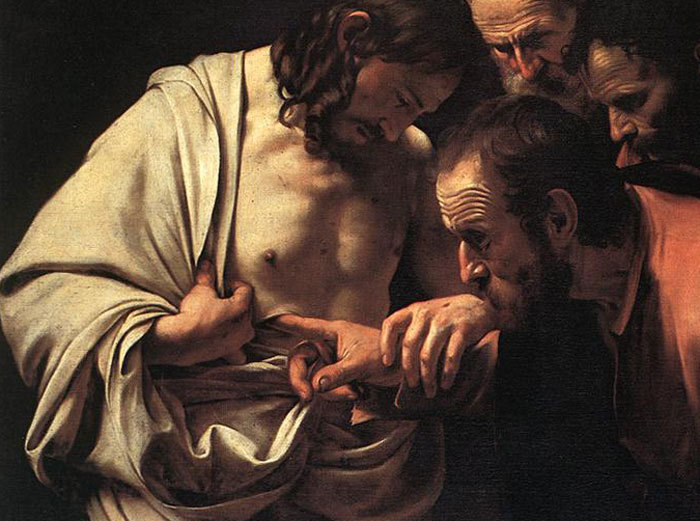
Thomas touching Jesus

Image HT

This afternoon, I am regretting that I did not sooner discover this outstanding Peter Berger post from two weeks ago:

Pluralism, the co-existence of different world-views and value systems in the same society, weakens the certainty with which people had previously held their religious and moral convictions. Minimally, one becomes aware of the fact that other people, who do not seem obviously demented, do not share these convictions—and nevertheless manage to get along in their lives. This awareness makes it difficult to take one’s convictions for granted; now, one must stop and reflect about them. Pluralism has become a global reality. All those “others” keep obtruding…

In religious communities this has led to a quest for the core of the tradition, which is non-negotiable, as against more peripheral aspects which, if really pressed, I might modify or give up. I have used the term “cognitive bargaining” to describe this process…

I think that such a process of reflection is very useful. It has been broadly repudiated as “essentialism” by postmodern theorists. I disagree. Of course some alleged “essences” are poorly chosen, or are devices to avoid the immense complexities of reality. But reflection about core convictions is a healthy, and in some situations an inevitable exercise. Emile Durkheim proposed that the survival of a society depends on the willingness of its members, if necessary, to die for it. This implies that the core of what the society is, that for which one may be prepared to die, can be distinguished from more peripheral or even immoral items (the ideals of liberty and equality, as against the excesses of French colonialism). Every curious child will ask about this or that newly encountered phenomenon: What is this really all about?

the equivalent of “hear, O Israel, the Lord our God is one” or “there is only one God and Mohammad is his prophet” or the Buddhist four noble truths, “what he thinks Christians actually do hold to be essential, rather than what he himself thinks ought to be held essential.

Some of the evidence he brings for this is fascinating:

He spoke about religious pluralism along the Silk Road, the great trade route between Europe and Asia, which had its heyday in the first millennium CE. Not only were so many religions present and active in the region, but there was a lot of so-called syncretism—mixing of ideas, practices and symbols from these traditions: Manicheism, Christianity (mostly Nestorian), Buddhism, Confucianism, and yet others. I remember that the lecturer showed a depiction of Jesus dressed as a Confucian scholar, one hand raised in Christian blessing, the other in a sign of Buddhist Enlightenment. Often a text begins full of Confucian ideas, then goes on to end as a Buddhist message. The lecturer made the point that there is one item in a text that occurs only in an originally Christian one—mention of physical resurrection.

His point about pluralism is incredibly important. Christian intellectuals are increasingly losing sight of the real origin, nature, and value of religious freedom. “Modernity” has become a swear word in fashionable intellectual circles. Leave it to Peter Berger, as always, to remind the cultured despisers of the bourgeoisie that the 14th century was not the pinnacle of human civilization.

That said, I would add two caveats to Berger’s comments about the resurrection as the (sociological) essence of Christianity.

One, when it comes to the mainline, he is having his cake and eating it, too. It’s clear from what he says that he regards the Protestant oldline as part of Christianity, and even though I’m one of Machen’s Warrior Children I can certainly go along with that for sociological purposes. But the mainline has never treated the resurrection as non-negotiable. As I understand it, this is an essential divide between Rome and “evangelicals” on the one side, and the mainline with its “critical scholarship” on the other.

Two, shouldn’t the crucifixion be in there along with the resurrection? I mean, not merely its occurrence as a historical event, but as the act that secured salvation. If the Buddhists get four essential truths, can’t we at least have two?

I would submit that the Christian focus on the resurrection stems from two sources. One is apologetic. It has long been recognized that if you can get someone to acknowledge the resurrection as a historical fact – to acknowledge that Jesus is currently alive and not dead – it becomes extremely difficult for them to resist all the other claims of Christ and the church. The other is that the crucifixion is implied by the resurrection more easily than the other way around. That Jesus died for your sins does not immediately suggest (except to the well-catechized) that he rose from the dead. But to say that he rose from the certainly dead implies that something momentous was going on in his death, that his death had a profound meaning and purpose.

Go read it.
Is the Church “Sacred”?

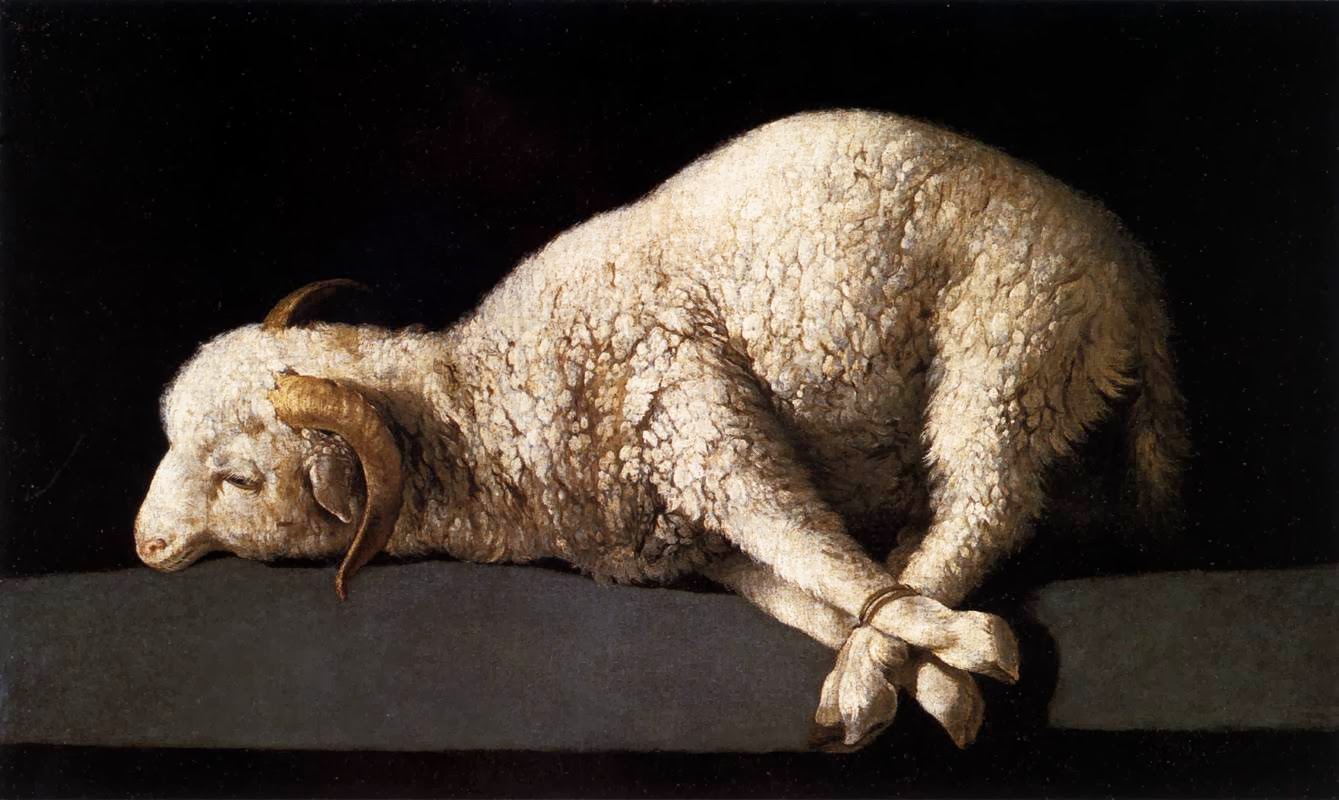
Lamb

Image HT

One of the most common themes you hear in the faith and work movement is that we must oppose “the secular-sacred divide.” At a superficial level, if you take this in the spirit in which it’s intended – “every square inch” and all that – it’s almost impossible to object. All domains of life are “sacred” in the sense that they are ordered by God, they are places where God is present and active, and they are places where the Spirit calls us and equips us to use our gifts in service for the life of the world. Certainly this is a non-negotiable Protestant commitment, and even Rome has moved very significantly in this direction over the last century.

And yet . . . and yet . . . I sympathize strongly with those who want to emphasize the distinctiveness of the church from the world, and in particular the unique role of the institutional church. How do we uphold the unique supernatural operation of the Holy Spirit through means of grace inside the church building without making the church building “sacred” in a dualistic sense – implying that life outside its walls is “secular” (i.e. detached from God, autonomously operating on naturalistic principles)?

Recently I was reviewing Keith Mathison’s outstanding book Given for You and rediscovered (I had seen it before, but had forgotten it) the threefold division of ceremonial status under the Old Testament: holy, clean and unclean. I’m no theologian, but this challenged my thinking about whether there might after all be something to “the secular-sacred divide.” After some thought, however, I now see that it need not imply a return to such thinking.

In the OT system, people and things that are clean can be made holy – “sanctified,” a word of titanic theological importance – by coming into contact with things that are holy. However, if you are unclean, coming into contact with what is holy will not sanctify you, it will destroy you! Systems of cleansing were therefore necessary, so that unclean things could be made clean, and therefore fit to come into contact with the holy. The OT law provided temple rituals for both cleansing and sanctification, centered on animal sacrifice.

These were of course “types” or pictures of our salvation in Christ. To my mind, the typology is obvious: ceremonial cleansing represents justification and adoption, and ceremonial sanctification represents . . . well, sanctification. You cannot be sanctified before you are justified and adopted as a child of God, because the only way to be sanctified is to come into direct contact with God (i.e. with what is already holy) and if you come into direct contact with God while you’re still in your sins, you die. Justification and adoption first, to cleanse us and make us fit to come into contact with God, then sanctification follows as a result of our coming into contact with God.

Now, if we view the NT institutional church as the equivalent of the OT temple, I can see how we might have to view the church building as “sacred” in the dualistic sense. It is the place where the rituals of cleansing and sanctification are performed. At worst, the unspoken assumption takes hold that the world outside the church building (i.e. temple) is profane and unclean, and you come into the church building to get the means of grace (i.e. sacrificial rituals) that can make you clean and holy. Even those who avoid such an extremely crude dualism can never quite avoid secularizing the world outside the church building – if they think of the church building in terms defined by the temple.

This leads us to the obvious question: is the institutional church in fact the NT equivalent of the OT temple? The presence of preaching and sacraments in both might seem to suggest yes, but I think this is too simple.

While there is great continuity between preaching in the OT and NT, the sacraments are dramatically transformed by the coming of Christ. This in turn fundamentally changes the nature of the building where we meet to worship. While the OT and NT sacraments are both sacraments, they are not doing the same thing. Baptism and communion do not make you clean and holy the way the OT sacrificial system did.

This is the whole reason churches are called “churches” and not temples, yes? If they were still places of ritual cleansing in anything like the OT mode, would it not have been much simpler to keep on calling them temples?

Only God is holy, and the only way to get holy is to be cleansed and sanctified by God. The function of the OT temple was to picture this for us. In the NT era, the church proclaims this truth but does not picture it, or at least not in anything like the same way.

The OT temple is a picture of salvation, but it is not a normative standard of social organization. In the NT era, we should not continue to divide our cultural spaces into sacred and profane simply because the picture of salvation provided by the OT temple required this.

The whole tone and tenor of the NT seems to be against such separation. Consider Jesus’ contrast between OT and NT worship when speaking to the Samaritan woman at the well (John 4:20-24) or his terrible pronouncements of judgment on the temple.

Even in the OT, we find this prefigured. The prophets and wisdom literature stress over and over again that the cleansing function of the temple is not its essence. One of the most shocking and baffling things to me when I first began to read the Bible with serious attention was the frequency with which the prophets declare that God hates temple sacrifices. “But isn’t that exactly what God told them to do, bring sacrifices to the temple?” I asked myself. Now I see that God was denouncing people for using the temple sacrifices as a substitute for godliness.

How, then, can we understand the unique role of the institutional church and the means of grace within it? It might help to think in terms of relationships rather than spaces.

Applying the OT ceremonial terms, we can say that unbelievers are unclean while Christians are clean and becoming holy – clean, because they are justified and adopted; becoming holy, because by the power of the Holy Spirit they are constantly in contact with God, the only originally holy thing. Likewise, whatever the unbeliever does is unclean because he is unclean (Isaiah 29:13-14) while whatever believers do in God’s name (alone or with each other) is clean and becoming holy (Hebrews 13:20-21). This is not the same as the distinction between what is inside and outside the institutional church, because believers do a great deal outside the institutional church that is nonetheless distinctively Christian life and service.

The truly distinct thing about the institutional church comes into view when we consider that the greatest volume of cultural activity does not fall into either of the two categories “what believers do” and “what unbelievers do.” Most of what is done in the world falls into a third category: “what people of all types do together.” Christians and unbelievers work on the same assembly line or school council; where does the cultural activity of believers end and that of unbelievers begin?

I am told that “the plowing of the wicked is sin” is actually a mistranslation, but it is still sound doctrine. So let us imagine three situations:

  1. A plow is operated by two unbelievers cooperating.
  2. A plow is operated by two believers cooperating.
  3. A plow is operated by a believer and an unbeliever cooperating.

Is the plowing in case #3 – the plowing of the just and the unjust together – sin?

Perhaps we could think of this mixed and ambiguous cultural space as “clean but not becoming holy,” although of course the Christians who operate in this space are becoming holy. The joint plowing of a believer and an unbeliever is clean and will receive the final benediction in Christ at the last judgment – because Christ himself is doing it, in and through the Christian plower. I expect this plowing will be blessed on the same terms as the plowing of the two Christians.

The institutional church is not distinguished by the fact that holy things happen there, but by the fact that only holy things are supposed to happen there. Whereas in the cultural world outside the walls of the church building, mixed and ambiguous activities can and should occur. They will often predominate, and perhaps they even ought to do so. The institutional church is the special place set apart where that which is not “clean and becoming holy” is supposed to be excluded.

This, at least, is as far as I have come at present in making sense of the matter.

Hope and American Culture

no-hope-beyond-point

Last week I published a decidedly mixed review of Joseph Bottum’s new book at the Public Discourse, and Bottum has now responded. He says I’m a McCarthyite and an unwitting conduit of anti-Catholic bigotry because I blamed him for failing to apply the Christian virtue of hope to contemporary American culture.

The editors of the Public Discourse have offered to let me write a full-length reply to Bottum, but the effort would be superfluous. As I wrote in my original review, Bottum himself has already provided, in his wonderful chapter on the life of John Paul II, a response to his failure to apply hope to the culture better than anything I could have written. His account of John Paul’s life demonstrates why Christian hope cannot be hyper-spiritualized – separated from our participation in our culture, including its political life as well as all the rest of culture – in the way that Bottum seems to desire. The origin of our hope is in the eternal life that only Christians possess, but if that hope is true, it must have implications for the life of culture. Christopher Brooks, a pastor in Detroit – where they know a thing or two about daunting cultural challenges – has said that if you don’t think your culture can change, your real position is “Jesus can transform people, but not in this ZIP code.” Nuts to that.

Bottum wants to have his cake and eat it, too. In this response, he writes as though his book had only said there was no hope for American politics. But the book was quite clear from beginning to end that Bottum saw no path forward for American culture as a whole, not just for the political section of American culture. If he is now recanting that view, wonderful – but let him say so clearly.

Most amazingly, Bottum tries to transform me into an advocate of the culture war. That is really funny, given that I’ve spent years resisting the culture war mentality. I’ve gotten into a lot of trouble with some of my friends for arguing that Christians need to greatly increase their investment in non-political modes of cultural participation. But I do insist that human beings are created to be political creatures and Christian hope therefore has application for politics – and I’ve gotten in trouble with some of my other friends for saying that!

As C.S. Lewis said, if the Lilliputians think me a giant and the Brobdingnagians think me a dwarf, perhaps my stature is not after all so remarkable.

Love Is Our King

Marcher with flag

Today Canon and Culture carries my article on the need to “de-institutionalize enmity,” entitled “Love Is Our King.” Readers who have complained to me about the alleged naivete of this might want to have a look. I’m not naïve about evil; for ten years I’ve tangled with teacher unions – people who make their living by destroying children’s lives. For supporting school choice, I’ve been portrayed as a white supremacist who wants to bring back Jim Crow. Guess what? You have to love them anyway.

And one of the hardest parts about loving your enemies is maintaining the judgment of charity. You have to believe that they’re as good as the evidence allows you to believe they are. I appreciate Joe Carter drawing our attention to this, but let’s not fall into the trap of assuming that everyone who stands against us does so out of hate.

In the C&C article, among other things, I share a little more than I have in the past about the close friend who permanently cut me off after I became a Christian:

The point is that there was nothing about either me or her that forced us into this position. I have asked myself time and again whether I said or did something that could have come across like it was me rejecting her as a person, rather than me changing my mind about how people in general should live their lives (which was the kind of thing we’d always disagreed about before). But I honestly don’t think there was. Nor do I think she, on her end, lacked the emotional strength to stand up for herself in an honest way—as if my withdrawing approval for this aspect of her life was such a crushing blow that she had to tell herself I was a bigot to avoid facing it.

No, this happened because of deep structures in our culture. All day, every day, she had been immersed in a culture (especially in the subcultures to which she belonged) where it is simply assumed that there is no such thing as honest disagreement about this issue. There is only hatred, period. And on my part, I lacked the wisdom to anticipate this problem and take steps to preempt it.

If you’re out there, drop me a line and let’s talk about how we can not hate each other.

We can share this country.

JFTW in Credo

Credo

The good folks at Credo Magazine have published an interview with me on my new book (why yes, it is on sale now at fine bookstores, thanks for asking).

Readers of HT may find this of particular interest – click over to read the rest of my answer:

I found your discussion of religious freedom quite fascinating. What are the blessings and problems of this arrangement? Can religious freedom be consistently upheld without the majority influence of the Christian tradition?

The greatest blessing is the space it creates for virtue and conscience. I think most people have forgotten that it’s very rare in human history to have a culture where people are expected to shape their lives according to an understanding of what is right. In most civilizations historically, 98% of the population was simply told how to live, and that leaves no space for people to be moral creatures. One challenge this creates is that religion and even morality can come to seem optional. Another is the fragmentation of our moral language – if you and I have different religions, we may still agree that murder and theft are wrong, but we’re likely to disagree about what actions should count as murder or theft. It becomes very challenging to hold a society together without returning to the old way of just having the elites at the top simply tell everyone how to live. Can we uphold religious freedom over time if Christianity remains a minority view? …

By far my favorite question was on the opportunities and challenges of economic growth. This is an issue on which I have no strong views whatsoever:

In the Old Testament, God warns his chosen nation that they are going to get rich and it’s going to tempt them to evil – but the reason he gives this warning is because it is his intention to bless them with fabulous wealth! Israel becomes wealthy in the promised land, we are told over and over again, because it was given the law of God and it learned virtuous behavior. So does that mean God is responsible for Israel’s sin, because he taught them virtue and made them wealthy? Do we think God was just kidding when he wrote the Proverbs? The command to do honest work that creates wealth and increases the well-being of our households and communities is repeated in the New Testament. We have to avoid a prosperity gospel that says faith creates wealth by some automatic process, but at the same time, we have to avoid saying that God doesn’t care if people starve to death or die of polio. And unfortunately, the prevailing current in Christian intellectual life these days is very anti-growth. I guess I’m just not as smart as the people who take that view, because unlike them, I simply don’t know how to love my neighbor while hoping that my neighbor loses his job. In general and on the whole, virtuous behavior tends to create wealth and health for most people. God is in favor of that.