
Good Reasons for both Pessimism and Optimism

optimist and pessimist

Great stuff this week from two of my favorite authors. Holman Jenkins takes a pessimistic view of the coming years:

We said it four years ago: A lost decade was coming, though not as some mechanical inevitability of the housing bust. Rather, that financial crisis put politics in charge in a way that would burden the economy’s growth for years to come.

“Lost decade” is tough stuff, but we’d be fools to avert our gaze from the possibility.

Meanwhile, Kevin Williamson has a great article on how better economic ideas can succeed if we just get over our pessimistic determinism and learn to see that we do share common moral principles with those on the other side:

Conservatives are rightly feeling a little glum after the 2012 election, but Americans are not fools, we do not want to be poor and vulnerable, and we have the resources to address even our most pressing economic concerns. In the end, good policies will win out. Consider:

Over the past 15 years a coalition of liberals and conservatives has brought in for-profit free schools in education, has sliced welfare to pay off the deficit, and has privatized large parts of the health service.

[The country’s] economy continues to grow and its pro-business coalition has remained in power since 2006.

Where? Sweden. Sweden’s reform-oriented conservatives have been able to achieve a great deal not because they are moderate — they are quite radical by Swedish standards — but in part because they took the time to really understand their rivals’ motives and, unlike unsuccessful conservatives before them, did not treat their opponents’ concerns as illegitimate.

I’m not quite that optimistic – just because the right policies do in fact align with majority values and would in fact solve our problems does not mean that they “will” win in the end. Milton Friedman predicted for years that a U.S. state would enact a universal school voucher before he died. He continued making that prediction even when he had seen the far side of 90, and was making jokes about having “outlived the actuarial tables.” He was a great economist, and like many great economists he was too optimistic that the right policy would win because it deserved to (in both the moral and political sense).

But Williamson’s optimism is a needed reminder. We need to think entrepreneurially and look for opportunities, not assume that events will continue to unfold as they have. People’s choices are not mechanistically determined by narrow calculations of self-interest or by ideological path dependence.

Williamson concludes on this very valuable note:

Republicans who are concerned about winning the loyalty of the middle class should try to understand the many legitimate reasons many middle-class voters may have had for backing Obama again, as hard as that is to understand. The despair caucus holds that everybody who voted for the Democrats in 2012 did so for a bad reason, and that the resentment-and-redistribution vote now commands a permanent majority. If I thought that were the case, I’d be learning Swedish. But I do not think that is the case.

Image xkcd

Business as Culture Making: Starbucks Comes Together

US-POLITICS-ECONOMY-BUSINESS

Hope you all had a merry Christmas and are getting a good start to the New Year! The Forster household travelled to Virginia to visit relatives over the break, as part of a critical new Juvenile Viral Infection Exchange Program. We were all sick with our kids’ diseases when we arrived, and by the time we left the kids’ playing together ensured we went home with new and totally different viruses. This helps cultivate biodiversity by moving the infections across state lines more efficiently. We’re doing our part!

Let’s pick up the discussion of religious institutions and modern society. Starbucks isn’t a religious institution, but it did something over the break that illustrates the basic point: it asked employees in its Washington, DC area stores to write “Come Together” on drink cups during the fiscal cliff negotiations.

Starbucks come together 2

One of my favorite bloggers, Mickey Kaus, was made uncomfortable by this – he calls it “corporate smarm.” His objections illustrate the problem that we’re dealing with in our discussion of religious institutions: in modern society, we are developing the expectation that “normal” institutions don’t stand for moral values or a cultural agenda. If an institution does represent such values, it is abnormal in some way – not necessarily wrong, just an exception to the rules – and one that must be kept sequestered from the normal, ordinary process of business.

Kaus asks, provocatively, “Is Starbucks a Cult?”

Did Schultz take a poll of his employees–sorry, “partners,” he calls them–before ordering pressuring asking them to join in this lobbying effort? What  if he were, say, the CEO of Chick-fil-A and he “asked” his “partners” to  write “Preserve the Family” on the outside of cups and containers?

You see how even the simplest affirmation of a moral value leads directly to fear of religion? The claim that Christians must embody their faith in institutions is profoundly disturbing to the dominant mindset, embodied here by Kaus.

What makes this especially noteworthy is that Kaus is better than most. He recognizes that businesses are not all going to conform to the model of his expectations, and wants – in principle – to have a “live and let live” model. But he expects those institutions to be special exceptions. He thinks there’s something wrong if “ordinary” institutions start taking on moral missions:

There’s a good vegan restaurant chain in L.A. that’s run by what seems  to be a cult of sorts–they offer little uplifting messages, and the dishes have  names like “I Am Awesome.” Presumably their cooks and servers knew  what they were getting into. Similarly, Schultz notes that

our[**] friends at AOL and Patch who are joining  us in activating their hyper-local network of websites to share the “Come  Together” message

which is also fine, because if you go to work for a HuffPo outfit  like AOL or Patch, that’s the sort of thing you’d expect. But Starbucks?  Maybe Schultz’s baristas came for the (admirable) health benefits, not because  they wanted to join him in some mushy Tom Brokawish corporate budget crusade.

You see the attitude about work that’s embodied here? People take a job because it pays the bills, not because they’re making the world a better place by doing their work. That’s exactly the cultural signal that’s destroying the working class by dehumanizing work as an activity.

Kaus demonstrates the seamless connection between a dehumanizing view of work and the militant secularization that threatens to destroy religious liberty. The most basic reason why businesses like Chick-Fil-A should be free to affirm marriage and Hobby Lobby should be free not to pay for employees’ contraceptives is because economic work is human action, and all human action is moral and cultural. Therefore businesses are moral and cultural institutions whether we like it or not.

Given that business is and must be culture making, we should set businesses free to be culture makers rather than try to force them to conform to an impossible model of moral and cultural neutrality. That means you can’t make the businesses’ moral/cultural identity hostage to any one employee who objects to something. A commenter here on HT illustrated the problem quite well by making the statement that things like the HHS mandate should be OK because it just means “employees who don’t believe are not forced to adhere to the same strictures” as the business owners. On this view, the only rights that matter are those of the owners (considered in some kind of highly restricted personal capacity) and those of the employees. The right of the business itself to be what it is – a moral and cultural institution – is simply not on the radar.

Starbucks come together 3

Granted, businesses don’t currently do a good job of stewarding their cultural role. In a follow-up post, Kaus lists some of the other recent attempts by major corporations to connect to basic values:

Move On! Before Howard Schultz’s “Come Together” stunt, I’m reminded, there  was CNBC’s “Rise Above” stunt, also  apparently an attempt to push for some sort of fiscal cliff Grand  Bargain. And CNBC’s sister network, MSNBC, has its own “Lean Forward” slogan, of course. Can you Rise Above and Lean Forward and Come Together at the  same time? I’ll look it up in the kama sutra of corporate smarm.

OK, that’s pretty funny. But to a large extent companies are bad at this because we have forced them to try to deny what they are. We’ve spent more than half a century trying to teach businesses to pretend they’re not moral and cultural. We’ve ruthlessly driven out every practice and principle that used to provide some structure and direction for this aspect of corporate life. Of course they do a lousy job of it!

We have a lot of relearning ahead of us. My guess is that Christian business leaders are going to be the key players in figuring out how to re-humanize companies.

The God of Battles

david-and-goliath-r

Karen, I hear you. Here is where I would press you for further clarity. You’re talking about the capax dei exclusivley with reference to the conscience, then saying that the conscience requires institutions for its formation. I think that’s insufficient, because you make the conscience an intermediary between the capax dei and institutions. Without relating the capax dei to institutions directly, you’re unable to provide an answer for how to resolve conflicts between individuals and institutions when they arise.

For every Thomas More, there’s a Martin Luther. “Conscience requires institutions for its formation” has become quite a slogan in some quarters. Whenever I hear it, I ask people what they would have told Luther to do. Suppose he submits to institutions at Worms instead of taking a stand for conscience. When he stands before the eternal judgment seat, what’s he supposed to say? “Well, you see, Lord, the human self is situated in a dense web of relationships and institutions that constitute its personhood…”

I think we can’t establish the need for freedom of religion alongside freedom of conscience without confronting this problem. Although Luther and the 16th century Reformation did not represent a revolt against institutions, they did put the problem of relating institutions to conscience front and center. Romantic individualism rose to prominence by exploiting this opportunity. As long as every individual has an unlimited-use trump card, we’re not going to solve this problem.

We need to press the point even further – get even more radical – and locate the capax dei in action rather than just in contemplation. Aristotle was right that the contemplative life is insufficient by itself; action and contemplation must be integrated. God is the God of truth and beauty and goodwill and rest and the beatific vision, but he is also the God of justice and abundance and marriage and battles and skyscrapers and little screaming babies that poop their diapers. The biblical narrative begins in a garden and ends in a city; God did not create the universe in its final state but in an initial state. It was always supposed to grow and develop. That was the original plan.

The late church fathers absorbed from their Neoplatonist rivals the pagan idea that the good is eternal and unchanging, so motion and change are bad. (It’s actually a pretty common problem in theology – theologians battling unbelievers on some major point will absorb their thinking on some of the more minor points in order to meet them on their own ground, then those compromises fester and stink within the theological tradition until later theologians root them out.) On this basis they instilled in Christian theology a view of creation and history and ethics that privileges contemplation over action. We are still struggling today to get over this problem. This discussion is only one example.

If we locate the capax dei in action as well as contemplation, institutions themselves become direct expressions of the capax dei alongside individual belief and behavior. Now you’re prepared to wrestle with the question of how individuals and institutions relate. How the conversation goes from there will depend on other factors we don’t have time to get into, but without acknowledging the capax dei in institutions you’re never going to get on the right track.

By the way, what I’m advocating here does not imply a compromise of the Reformation understanding of the sovreignty of the conscience. Far from it – in my view, what I’m saying here is implied in Luther’s claims and actions. If the capax dei is located in institutions, then institutions are accountable to God. This by itself does not get you the whole Reformation doctrine, but it is at least a necessary part of it. On this view, the individual and the institution are equally subordinate to God, so neither one is subordinate to the other. Individuals and institutions must learn to coexist symbiotically rather than one demanding that the other submit. Luther treated Rome as though he thought it ought to be an expression of the capax dei, and was failing in that capacity, and could legitimately be held to account. Whereas it seems to me that the attempt to solve this problem without relating the capax dei directly to institutions (“the conscience requires institutions for its formation”) really arises out of Catholic attempts to answer the challenge of Protestantism by subordinating the individual conscience to institutions.

Evangelical Awe at TGC

awe_child

Over on TGC this morning, I respond to Rod Dreher’s claim that evangelicals are less hospitable than Roman Catholics or Eastern Orthodox to awe and wonder at God. Dreher bases his article on what he feels are unfounded accusations of New Age heresy aimed at an evangelical author – accusations that he found on the web, more or less randomly, by googling.

News Flash: Harsh Criticism Found on Internet!

As I wrote at TGC:

Is this the yardstick by which Dreher would evaluate our faith tradition? Does he think that I cannot appeal to my father Google, and he will at once send me more than 12 legions of links to websites where “articulate and educated” people in his tradition also say crazy things?

I argue that evangelicals are rather a little too much given to the pastoral/devotional side of piety, and could use a little more doctrinal clarity:

If evangelical authors who focus on doctrine are anxious about the urgency of correcting theological errors in devotional writers, it’s mostly because they speak from a position of weakness, whereas the devotional writers are in a position of strength.

Check it out.

Jonathan Rauch’s (Mostly) Failed Agenda for Hurting Workers – and What Would Work

College of the Ozarks’ “Hard Work U” Program

I see lots of attention being paid to this article by Jonathan Rauch on the economic crisis of America’s working class. He’s looking at the right problem, but he’s looking at it all wrong. As a result, he misunderstands both the cause and the needed remedy.

Rauch is right that the bottom half of workers have a long-term problem: the economy still produces lots of wealth for the top half, but not so much for the bottom. Unfortunately, Rauch mostly thinks of this in terms of moving wealth from the top half to the bottom – not, to be sure, through government transfer programs, but through wages. Unfortunately for Rauch, transferring wealth from one social class to another is not the purpose of wages. The purpose of wages is to compensate workers for their work. The value of wages therefore reflects the value of their work (except where cheating, cronyism or other ethical failures intervene). The real problem is that the bottom half are not increasing their production of wealth. Rauch’s failure to think in these terms sends his whole analysis off track.

Helping the bottom half of American workers become more productive should be an urgent concern. And I don’t mean we should just stand back and scold them until they’re more productive. There is much we can do to help them recover their productivity growth! Unfortunately, we’re not going to do any of the things we need to do as long as we think about the problem in terms of transferring wealth rather than increasing productivity. Rauch’s article shows this; most (though not all) of his poilcy proposals represent a laundry list of failed nostrums. Below, I’ll propose a counter-list that I think will find significant bipartisan support and will actually be effective in helping the bottom half get back in the wealth creation game.

Rauch is only the latest person to reproduce these two graphs, brought to you by the hard-left Economic Policy Institute:
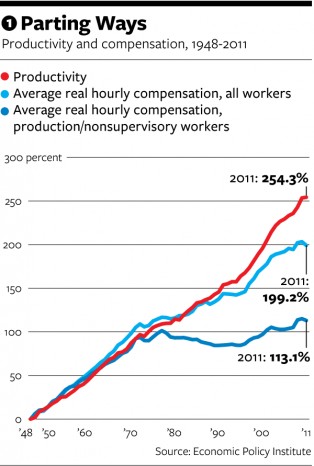
Boy, sure looks like the working man is getting the shaft from the bigshots, eh?
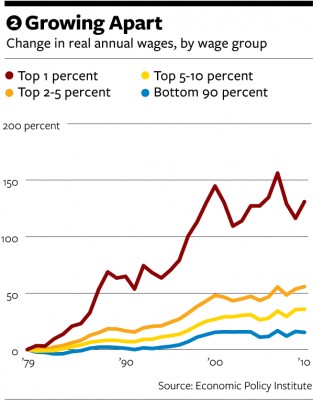
There’s lots of productivity in the economy, but those greedy one-percenters at the top are hogging it all!

Now, what’s missing from these graphs? Anyone? Anyone? Bueller?

Yes, you there in the back – Dan Kelly!

“Wages are shown separately by social class, but productivity isn’t. Moreover, even the wage line for all workers is an average, whereas the productivity line for all workers is a total figure rather than an average. This allows the graphs to mask what’s almost certainly really happening: wages are still tracking productivity just fine; the gap in wages across social classes is caused by a gap in productivity.”

Go to the top of the class, Dan! (Disclaimer: Not actually a quote from Dan Kelly.)

From start to finish, Rauch’s article frames the whole issue in the wrong terms. Productivity is something that’s just out there in the ether, like sunlight. Wages are supposed to transmit it to workers.

Buried deep in the article, Rauch briefly gestures toward what’s really happening:

A smaller share of the value that companies produce today comes from the physical goods made by people like factory workers, and a larger share comes from ideas and intangible innovations that people like software designers and marketers develop. Between the early 1980s and the mid-2000s, Shapiro says, the share of a big business’s book value accounted for by its physical assets fell by half, from 75 percent to only 36 percent.

“So the basis for value shifts,” Shapiro explains. “This is the full flowering of the idea-based economy.” Which is great if you are a brain worker or an investor; otherwise, not so much.

See Charles Murray’s new book for much, much, much more evidence of this.

So, what does Rauch want to do? Here’s his list of proposals:

• Get more people, especially men, through high school and college. (See p. 16.)The agenda includes an increase in financial aid and loans, a push for states to require that students stay in high school (as Obama has proposed), and encouragement of online learning.

The problem with financial aid is that it doesn’t help, it just drives tuition up. Virtually everyone who graduates high school with the academic qualifications to attend college actually attends college. You can’t get more kids into college without fixing K-12 schools. Requiring students to stay in high school is a non-starter; even if state legislatures passed it, which they won’t, it would just force high schools to dumb down their academic standards to keep the would-be dropouts from flunking out.

By contrast, online learning does have huge potential and we should be encouraging it. The problem here is that there’s not much we can productively do besides get out of the way. Recent efforts to use policy to promote online learning have basically amounted to attempts to create a government-protected online learning cartel – and we all know how well that works out. That said, there are some innovative proposals for how we can more effectively get out of the way.

• Expand federal support for job training and consolidate the tangle of programs. Obama wants to do this, too, as do many politicians in both parties—which doesn’t make it a bad idea.

Government job training programs are a long-proven loser. What we need to do is fix K-12 schools. School choice has improved public schools every time it’s been tried. Universal school choice would drive a radical K-12 revolution.

• Expand and improve vocational education for those not suited to college. (See p. 12.) Apprenticeship, in particular, can help prepare young men for the kinds of jobs that the economy increasingly creates. The United States does far less of this than, say, Germany does.

The insuperable obstacle to voc-ed in the existing school system is its long-term history of racism. In the 20th century, voc-ed was a code word for warehousing black students. Given the state of the schools, it’s hard to resist the conclusion that voc-ed would go down exactly the same path if we brought it back today. That’s why, every time a voc-ed proposal starts to gain momentum, it’s immediately killed by a coalition of progressive racial/ethnic activists and conservatives who view voc-ed as “the soft bigotry of low expectations” and a step away from traditional liberal arts education.

There is a way to solve this problem, though: school choice. If “the man” isn’t imposing it, it’s not racism. And if it were accountable to parents instead of to a faceless union-run bureaucracy, it would work. School choice would open the path to alternative education.

• Change Social Security disability benefits so that the program helps people keep working (and helps employers accommodate disabilities) instead of encouraging them to leave the workforce, as it does now. An analogous overhaul of welfare in the 1990s was a notable success.

Too right! Nothing but net for Rauch here.

• Liberals talk about increasing wage subsidies for low-skill jobs, raising the minimum wage, or both. Although such measures can be expensive, they may be worth it if they keep men working.

But work loses all its value if it’s not productive. Rauch’s argument here is that men need to be in jobs in order to be civilized (he especially looks at the breakdown of marriage). However, work only has this civilizing effect because it orients us toward the good of our neighbor, establishes that we are contributing to the common good, and holds us within social structures where we have to behave ourselves.Subsidized jobs won’t provide any of those benefits, because they’re not productive.

In fact, this direction would only worsen the problem Rauch is looking at. It would be (yet another) step toward severing the connection between work and productivity among the working class.

[Update: Can’t believe I forgot to mention: the minimum wage destroys jobs. Rauch wants to lift wages to lure men into work, but the minimum wage will make work harder to find. What the minimum wage does is lift wages for the most economically productive among the workers on the bottom rung, while destroying jobs for the least economically productive. So it tends to benefit those who need it less at the expense of those who need it more – particularly, those who are most likely to be already marginally attached to work. Great thinking!]

A better path was laid out earlier this year in a New York Times article co-written by economists at the conservative AEI and progressive CEPR: Reform U.S. labor law to allow companies more flexibility to respond to economic challenges in ways that radically reduce job loss.

• Conservatives talk about nudging the culture back toward stigmatizing nonwork among men. “Don’t prettify the way you talk about it,” said AEI’s Murray. “It is never rational not to take a job.” Liberals may be squeamish about stigmatizing nonwork, but some men may need tough love.

Yes, this is needed. However, it will be important that it comes from institutions with the moral and cultural credibility to deliver the message. No disrespect, but the working class wouldn’t listen to Murray – or to Rauch, or to me.

Churches are obviously going to be central here. They have the moral standing, they’re in the neighborhoods.

And most of all, they have the theological resources to do this with the right approach – with hope, not Phariseeism. No cultural message works for long if it’s negative. What’s needed is a recovery not simply of the stigma of nonwork but a lively and holistic sense that work is good – that it’s meaningful, that it provides dignity and hope. Today, sociologists mostly talk about Max Weber’s thesis that the Reformation paved the way for capitalism in terms of Protestantism restraining disorderly desires and cleaning up people’s behavior. It did do that, but more importnatly, it challenged the late-medieval ethical dualism that looked down its nose at economic work. After the Reformation, economic work was central to serving God and making the world a better place for your neighbors.

Such an approach would get to the heart of the issue: productivity. The gospel message for economic work is that human beings were made to do work that is fruitful – in other words, productive. The biblical narrative begins with a garden and ends with a city; humanity’s job, in God’s original plan, was to get the world from one state to the other through diligent, productive work. That dignity and freedom are still available to us now.

My friends in seminaries are always talking about starting a new Reformation. Well, reconnecting the gospel to the economy is the way that’s going to happen, if it happens. It worked for Luther and Calvin, and it can work again.

[Update: Profuse apologies for having misspelled Rauch’s name when this was first posted!]