On the Economist Blog, a posting from December 2012 deals specifically with the issue of falling birth rates, but also with a second falling demographic: immigration. A commenter on the first post on the Economics of Birth below suggested that Indian immigration has fallen off in recent years, and the Economist blog agrees. And it is not simply Indians who have stopped migrating, but Mexicans as well. Mexican migration is the largest contributor to US immigration, but some statistics suggest that more Mexican immigrants may be headed back to Mexico than are coming into the US. The reasons cited by the Economist are, of course, economic, but many other factors contribute as well. The commenter from India suggested that lax American morality has a part to play, and the current climate of America towards illegal (and legal) immigrants is certainly a contributing factor as well. As birth rates fall in America, down since 2007, and as immigration trails off, the Economist predicts that their will be a significant economic impact within two decades from a smaller population. The number of retirees will account for 22 percent of the population, with the working population accounting for 57 percent. What is perhaps just as worrisome is that while the working population has grow recently by 5 percent, only an additional 1 percent of new jobs were added to the economy. As the population demographics shift and shrink, the time is quickly ending where Americans can point to the demographics of other countries and laugh. Instead, the problems will be here at home. Christians need to be cognizant of these issues as they relate to immigration reform and to social issues affecting birth rates. There is now an economic conversation piece available to Christians when talking about birth and immigration.
Category Archives: Uncategorized
The Economics of Birth?
As Greg has pointed out in his article below on the similarities between America and Rome, something is wrong with American society. A recent book review on the Gospel Coalition shows that this ‘something wrong’ is not only seen in the decline of moral values, the bitterness in Washington D. C., or the ‘serve me’ mentality in the average American, but also in falling birth rates. Kevin DeYoung’s review of the book What to Expect When No One’s Expecting: America’s Coming Demographic Disaster points out the economic troubles that occur when birth rates fall. The review and the excerpts from the book are both intriguing and worrisome, but the problem with low birth rates should not really be a surprise to anyone who has been paying attention.
The United States is on the brink of a Social Security nightmare, when more Americans will be in retirement than working. Some politicians have claimed that the solution lies in raising the age of eligibility for social security payouts. What is noteworthy is that no one has suggested that this might current financial crisis might be the fallout from removing 50 million people from our population due to abortion.
I find it quite ironic that many historians will point to the Pre-Civil War Confederacy and suggest that slavery was economically unsustainable in the long term. And yet, no one seems to be examining the economic ramifications of our own social decisions. There is no self-examination or global examination of the results of American social policy; instead, social policy seems to be viewed as completely separate from economic policy, as though the two had absolutely no bearing on one another. As the emphasis shifts socially to what we want without regard for the national good or the good of others, social decisions that divorce procreation from marriage, create taxation that no longer promotes having children, and that undermine the family unit through abortion, no fault divorce, and legalized homosexual marriage will continue to be made without the thought of the economic results.
The most worrisome fact about the falling birth rates is not that very few have noticed that it is an economic concern, but that almost no one can connect the dots to see that our national social policies have created a climate where having children is no longer promoted. The birth rates will continue to drop until the connection is seen. Which gives yet another opportunity for Christians to engage their culture, both when asked why Christians have so many kids (statistically Christians have more children than non-Christians), and when talking to secular thinking Americans about social issues. Because to use the wise thoughts of Bill Clinton, everything in America about economics, (apparently even morality!)
Happy July 4, Egypt!
While the American media slept, the people of Egypt pulled off the Havel maneuver (mass protests bring down a dictator without firing a shot) for the second time in an amazingly short period. I wonder if anyone in the dinosaur media are embarrassed they ignored this story for days – presumably because there was no appealing ideological storyline, and they’re no longer interested in news for any other reason.
When the Mubarak regime fell, the smartest person I know said “it’s hard to see how the Muslim Brotherhood doesn’t wind up in charge.” He was proved right, and quicker than usual even for him. But to my knowledge he never predicted they’d also leave power just as quickly! Good riddance.
Naturally, the administration is once again lining up with the dictators against the community he terrorizes, on grounds that the dictator was elected. Because it turns out a naive belief that democracy alone is all-sufficient to ensure freedom and justice was not, after all, merely the idiosyncratic fixation of the previous administration. In fact, we have been making this mistake consistently for almost a quarter century, since the Berlin Wall fell and we prioritized democracy in Russia and Eastern Europe with no attention to other values like the rule of law, freedom of speech/religion, property rights, etc. We made the same mistake in Iraq and who knows how many other places in between. This is a long term, bipartisan problem; it’s discouraging that we haven’t even begun to learn.
What comes next after this revolution may well end up being worse than what came before. But one could have said the same on July 4, 1776, and that revolution would still have been as just and as wise as this one. The early signs are hopeful – the military spokesman announcing the revolution was flanked by the Coptic pope (that is, I gather, the man’s title) and the head of a Muslim university. Am I romantic for seeing resonances here of that unity in diversity achieved among such contrasting figures as Adams, Jefferson and Franklin?
God bless the people of Egypt. Today, Lord, please forget the wicked pharaoh; remember the good pharaoh who listened to Joseph and sheltered your people when they were in need. Send them another like him!
What Does It Mean to “Save” American Civilization?
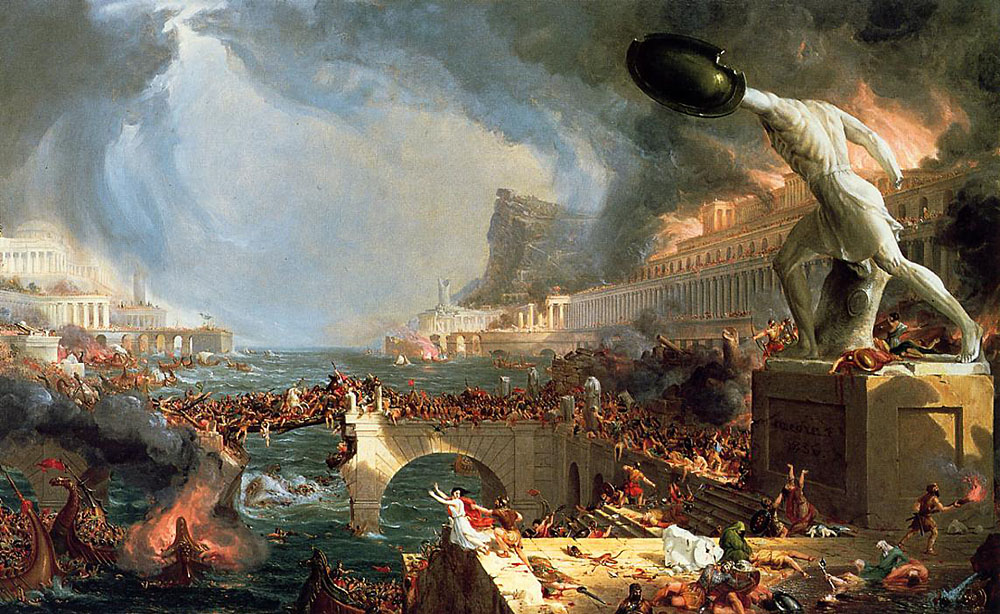
Over on NRO, Victor Davis Hansen points to the example of Rome to argue that after the central governing institutions of a civilization have lost their founding virtues, it can be held together for centuries merely by inertia in the outlying institutions and a common popular culture.
DC is no longer serious, just as Rome was no longer serious. But very little of the “Roman empire” was directly governed by Rome; similarly, much of American civilization is surprisingly insulated from the center:
About half of America and many of its institutions operate as they always have. Caltech and MIT are still serious. Neither interjects race, class, and gender studies into its engineering or physics curricula. Most in the IRS, unlike some of their bosses, are not corrupt. For the well driller, the power-plant operator, and the wheat farmer, the lies in Washington are still mostly an abstraction.
Get up at a.m. and you’ll see that your local freeways are jammed with hard-working commuters. They go to work every day, support their families, pay their taxes, and avoid arrest — so that millions of others do not have to do the same. The U.S. military still more closely resembles our heroes from World War II than it resembles the culture of the Kardashians.
To the extent that we need some kind of common language, pop culture may turn out to be surprisingly able to supply it:
Like diverse citizens of imperial Rome, we are united in some fashion by shared popular tastes and mass consumerism. The cell phones and cars of the poor offer more computing power and better transportation than the rich enjoyed just 20 years ago.
Youth of all races and backgrounds in lockstep fiddle with their cell phones as they walk about. Jeans are an unspoken American uniform — both for Wall Street grandees and for the homeless on the sidewalks. Left, right, liberal, conservative, professor, and ditch digger have similar-looking Facebook accounts.
If Rome quieted the people with public spectacles and cheap grain from the provinces, so too Americans of all classes keep glued to favorite video games and reality-TV shows. Fast food is both cheap and tasty. All that for now is preferable to rioting and revolt.
It is not, of course, a happy picture VDH is painting. Because the obvious question (which he does not raise in this column, but given what we know, he must be thinking it) is whether a civilization is even worth saving on these terms. What makes the history of Rome romantic and glorious for so many people is everything it accomplished before the state of corruption in those long, slow later years. Nobody looks back to sixth-century Rome with admiration. So suppose America does last several more centuries – what would it matter?
But of course it is far from clear that we could last that long, because VDH’s comparison is of limited application. History moves a lot faster these days; inertia wears down sooner. And the center has a much, much longer reach than it used to – as all those virtuous tech schools and businesses are going to be finding out in the coming decades.
On the other hand, VDH is giving us space for hope. The collapse of American civilization may not take as long as Rome’s, but it will also not happen overnight. What we need is not an eternal prolonging of the present moment – some sort of indefinite delay of the otherwise inevitable reckoning – but just enough time and space for a real cultural renewal. For real cultural renewals do happen, and that is our hope. What VDH is pointing out is that we may have a long enough runway for it after all.
True Consensus
This past week I was at my denominations national assembly where we deal with issues that impact our entire denomination. Midway through the assembly, there was a point of contention regarding a series of charges brought against a pastor for teaching improper doctrine. I will try not to bore you with all of the details, but the real point of contention involved a Minority Report that had been filed in response to a decision made by one of the denominational committees regarding the case. The only problem is that the main motion was ruled Out of Order, and according to Robert’s Rules of Order, Minority Reports cannot be issued on motions Out of Order.
As I sat in my seat watching this unfold, I chuckled to myself. Presbyterians love everything to be done “decently and in order.” And yet, what they really mean is “decently and in order and I still get what I want.” I believe very few of us in the assembly disagreed with the point the Minority Report was making concerning the charges brought against that pastor, but the rules stated that minority reports could not be filed. We love the rules of assembly and being “in order” unless that order prevents what we want.
I was reflecting upon this phenomena as I stood in line with my family at the county waterpark. When our waterpark is at capacity for visitors, guests have to wait in line to enter until someone leaves. I told my wife how annoying I thought it was that if you left the waterpark for any reason, even to run to your car, you had to wait in line again to enter. My wife responded that she hated that rule as well, unless she was in line waiting to enter, then she loved the rule!
Again, when we think of morals and creating moral laws and rules for our governance, we often think of rules and laws which hold other people in check. Very rarely does a politician stand up and argue for a rule which would prohibit their own behavior. There are very few proponents of guns arguing for gun control. We most often want laws to keep our neighbor in line. We want waterpark rules to get us into the waterpark faster, Rules of Order to allow us to pass the motions we want in assembly yet prohibit other motions we oppose, and moral consensus to restrict what other people do.
But for moral consensus to truly function, each person must be willing to compromise for the greater good. Those on one side of the issue must be willing to give up as much as those on the side. This means that a liberal (using dictionary definition, not political ideology) must be willing to let themselves be restricted and a conservative must be willing to allow others to be released. Consensus cannot mean that eventually comes to a conservative position. This also means that conservatives need to know what issues they are willing to relax on for the greater moral consensus and what hills to die on. Liberals need to know what issues they will not accept restrictions and where they will give up liberty.
It is only when opposing viewpoints and ideologies allow the law to affect themselves as much as others that true consensus can take place. If moral law is simply a means to get my neighbor to do what I want, then I am not truly interested in moral consensus. Then I’m simply trying to get into the waterpark faster.