The Media and Kermit Gosnell: Culture Can Be Changed

archimedes

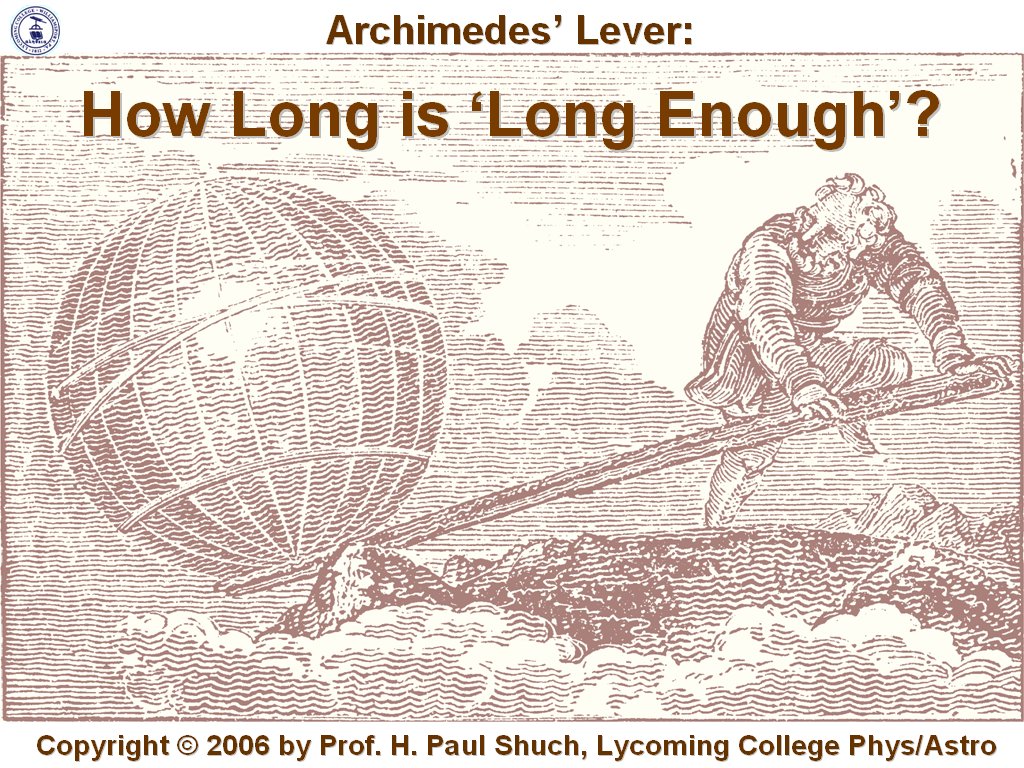
One question we’ve come back to several times on HT is how resistant to change are elite cultural institutions? Obviously the answer is “very,” but what we really want to know is whether it’s so much we have little hope of accomplishing a lot of change, or if the levers of culture change available to us are long enough to move the elites. We’ve looked at both positive and negative signs.

Before too much more time passes, I want to make the point that media coverage of the Gosnell trial is a big datum in the “hopeful” category. Pro-life activists forced the dinosaur media to cover the trial. A Washington Post editor even admitted that they were wrong not to cover it sooner. The pro-lifers had no monetary or political pressure points; what they did have was shame. They could point to the ethical standards professed by the journalistic profession and show that the journalists were not living up to them. And the journalists ended up responding to that. Of course the Boston bombing pushed it all off the front page soon after, but still – when we get smart about how cultural influence works, we can have an effect.

In general, I think the new model for how to change culture is being vindicated.

The Death of Culture Itself?

Here at Hang Together our stated goal is to create moral consensus, finding those areas of morality on which we all as Americans can agree regardless of political or religious differences. Over the last few months, many conservatives have been scrambling to find this moral consensus over the issue of gay marriage, only to discover that there is little shared ground upon which to build. Much of the country rejects the Bible and anything it has to say about sexuality. Christians especially are left scratching their heads and wondering how to talk to supporters of homosexuality. But the issue is deeper than many realize. The dividing line is not simply over gay marriage, but over the very idea of moral consensus. Most of our culture has bought into the postmodern idea of personal morality, a morality which makes no impact whatsoever on your personal morality. Morality is no longer cultural but personal.

Rod Dreher over at the American Conservative discusses this in his fabulous article Sex after Christianity. In his article, Mr. Dreher points out that American culture does not simply disagree on sexuality but on the very idea of a transcendent authority that has the right to tell me what to do. Most Americans do not believe such an authority exists. And that transcendent authority does not even have to be a ‘god.’ Instead, the only authority is self. Americans reject anything other than the self and the supreme authority of the self to tell me what is ‘moral.’ The very idea of a moral consensus is ridiculous to many Americans because you have to listen to yourself as I listen to myself. We are own authorities and it matters very little if we agree or disagree! You cannot tell me what is ‘moral’ and I cannot tell you what is ‘moral.’ The only ‘immoral’ act is for you to declare what my self has declared ‘moral.’

Sadly, much of Dreher’s article is a review of book by Philip Rief from 1966. This is sad because Rief saw the pattern decades ago which would eventually lead to gay marriage today. Both Dreher and Rief are correct that the issue of gay marriage is not one of sexuality, but as they put it, cosmology. The American view of the world is one of extreme individualism which denies anyone the right to say anything to anyone else about morality. Most of American culture rejects the idea that anyone can say anything about the morality of homosexuality except those who are homosexual! Dreher and Rief is stating that American culture has become an ‘anti-culture.’ Culture has no ability or authority to declare what is right or wrong, only the self. We must engage the discuss of homosexuality, not just on the level of morality and sexuality but also cosmology and issues of who is the authority.


Riddle Me This: What Is Equality?

Riddler target
Nice try, Bat-Dan – YOU MISSED ME!

I’m encouraged to hear that Bat-Dan doesn’t consider himself a libertarian. However, given the arguments he’s making in our exchange over transfer programs, it’s hard for me to make out how that’s the case. I’d be interested to hear how he’d differentiate his position from libertarianism.

Dan argues that my support for “the existence of some transfer-type programs as circumstances permit” violates what he calls “the equality mandate” and therefore also excludes “the foundational concept that there are both prudential and jurisdictional limits on government authority.” He appeals to the Declaration of Independence’s declaration that “all men are created equal” and argues that my view is inconsistent with it.

The first problem with Dan’s argument is that he permits only two possible positions:

  1. Support for “the equality mandate” as he understands it.
  2. Opposition to all limits on government authority.

This seems odd to me, both in theory and empirically. On the theoretical side: Why can’t I support limits on government authority, just not the same ones Dan does? Suppose I believe government has the right to do whatever it wants, except that it must never pass laws against eating bananas, because bananas are sacred to Mongo the Martian Monkey God. Would I not then be rejecting the equality mandate, but supporting limits on government authority? On the empirical side: Does Dan think that the overwhelming majority of Americans who do support the existence of at least some transfer programs in some cases are opposed to all limits on government authority? Dan himself has described support for such programs as a moral consensus in contemporary America, so he must agree that it’s a large majority. Are Americans absolutists?

Come to think of it, none of the great political philosophers before the modern era supported “the equality mandate” as Dan interprets it, yet all of them (without exception) articulated a belief in some limits on government authority. Were they all confused? Deluded? Dishonest?

And so, today’s riddle: What is equality?

Let’s take the Declaration’s meaning of equality as the subject of our discussion. For the founders, is “equality” by itself an ultimate principle for limiting government action? Or do the founders invoke “equality” within a larger philosophical framework, such that the proper standard for limiting government is that larger framework, of which equality makes up only one component?

I think that should be obvious from their language:

We hold these truths to be self-evident, that all men are created equal, that they are endowed by their Creator with certain unalienable Rights, that among these are Life, Liberty and the pursuit of Happiness.–That to secure these rights, Governments are instituted among Men, deriving their just powers from the consent of the governed…

Here we have not just the stark, naked assertion of a single gaseous, abstract noun (“equality”) as the basis of all political philosophy, but numerous principles working together:

  • Political philosophy should begin with “self-evident” truths.
  • One such truth is that all men are created by God.
  • Another is that God has created them equal.
  • Another is that he has endowed them with rights.
  • Another is that these rights (or at least some of them) are inalienable.
  • Another is that one of these inalienable rights is to life.
  • Another is that a second of these inalienable rights is to liberty.
  • Another is that a third of these inalienable rights is to the pursuit of happiness.
  • Another is that governments are instituted.
  • Another is that it is men who institute governments.
  • Another is that securing these inalienable rights is the purpose for which men institute governments.
  • Another is that governments have just powers.
  • Another is that these just powers are derived from consent.
  • Another is that it is the governed whose consent these powers derive from.

It is this larger framework of ideas that gives meaning to the concept of equality. This is the answer to all those facile, shallow people who think they can dismiss the Declaration’s declarations on grounds that “people obviously aren’t equal – some are smarter, some are more virtuous,” etc. The Declaration is not declaring that people are equal in all and every respect. It is declaring that they are equal in one critically important respect. And the larger framework of ideas surrounding “equality” in the Declaration shows us what that respect is.

So what is it? Dan writes, offhandedly: “I don’t think you can derive wealth-transfer programs from the protection of life, liberty, and property (otherwise known as the pursuit of Happiness).” But he does not elaborate. This is odd, because in my original post I argued that the protection of the rights to life and liberty is precisely the ground on which my argument rests.

Government protection of the right to life implies a duty to rescue:

With Locke, I hold that the proper justification for government is the moral imperative (ultimately rooted in the divine ordering of the universe) to preserve human life…The imperative to preserve life implies a positive duty on the part of all people to rescue those in dire need. If we think we have no duty to rescue, we don’t really believe in an imperative to preserve life; we only believe in an imperative not to murder. And the imperative not to murder is insufficient to justify the existence of the state…

Government protection of the right to liberty implies a duty to rescue:

Denying the duty rescue implies absolutism. For if I can use my neighbor’s distress to offer him a choice between submission or starvation, there will be no stopping the introduction of enslavement.

The order in which the rights are mentioned represents a hierarchy of priorities for the founders – the right to life is primary, the right to liberty is derived from the right to life, and the right to property is derived from the right to liberty. So the second must be interpreted in light of the first, and the third must be interpreted in light of the first and second. I think this makes it hard to overcome my interpretation.

Dan has not, so far as I can see, offered any response to my case on these points. So, in essence, this post is really just a very long way of saying Dan has not yet engaged my argument.

Once he does, I think he will see that most of his other concerns are addressed in these points. For example, his argument that there is “no facial difference” between my formulation and that of Karl Marx will be revealed as an absurdity to anyone who sees that my case is grounded in rights-claims and, ultimately, the imago Dei and the divine intent in creation.
Theological Sexuality: Conclusion

In Theological Sexuality: Gender, Part 1, we saw that the male and female distinction has its foundation in the very nature of God. In Theological Sexuality: Gender, Part 2, we saw that the male and female distinction also has its foundation in the very nature of Christ and His church. In Theological Sexuality and the Sacraments, we saw that just as Christians demonstrate their covenant union with Christ through the sacraments of Baptism and the Lord’s Supper, so too humans demonstrate their covenant union with their spouses through sexuality. All of which leads to the question of what this teaches us deviances from Biblical sexuality.

The answers, once the above three foundations are understood, are quite simple. Biblical sexuality is two persons, one male and one female, united in covenant marital oneness, demonstrating that intrinsic covenantal oneness physically. It is quite easy then to address the deviances in our culture.

Homosexuality is out of accord with Biblical Sexuality because it involves two males or two females, destroying the foundation of God’s nature of plurality and the nature of Christ and the Church. It is not Christ in covenant with Christ or the Church in covenant with the Church, but Christ is covenant with the Church. God is not three sons, three fathers, or three Holy Spirits, but Father, Son and Holy Spirit. Thus, human sexuality reflects a unity of plurality.

Adultery is wrong because sexuality proclaims a covenant oneness between two individuals who are not covenantally one. Instead, these two individuals have broken their marriage covenants with their original spouses by declaring themselves one with someone else. Christ does not abandon the church to form a covenant with someone else. In the same way, not just anyone can participate in the covenant signs of baptism and the Lord’s supper. The covenant of grace is only between Christ and the Church.

Pornography is a lie, pure and simple. Those viewing pornography are enjoying the benefits of the covenant when in fact their is none. Pornography is nearly identical to prostitution in this regard. It is a sham of a covenant. Christ does not simply pretend to have a covenant relationship with the church or vice versa. To put it even more graphically, Christ does not simply look at pictures of the Church or fantasize about having a covenant relationship with the Church. There truly is a covenant which He died to create. Those engaged in sexual activity are declaring themselves covenantally one, but when pornography is involved, they are not actually one!

Auto-eroticism is wrong because Biblical sexuality is for husband and wife as a reflection of Christ and the church. The church does not participate in Baptism or the Lord’s Supper without Christ present! Christ does not engage the signs of the covenant without the church. It is not Christ by Himself or the church by itself, but Christ in covenant relation with the Church. Christ is a person of the Trinity, not one by Himself. Again, this deviance destroys the picture of plurality of Biblical Sexuality.

The list could go on and on, but the pattern is quite evident. Biblical sexuality is for two persons, one male and one female, in covenant union with one another, as a picture of Christ and the Church and the plurality of the Godhead. All else is a perversion and deviance from God’s created purpose.


My New Report on School Choice Research

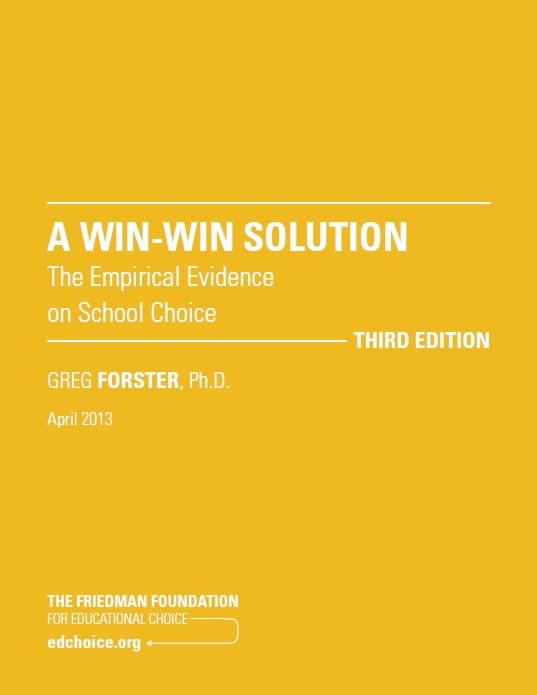
Win-Win 3.0 cover

This morning, the Friedman Foundation releases the third edition of my biannual report summarizing the research on school choice. As in previous editions, I survey all the empirical research on the academic effects of school choice programs – both for the students who use school choice and for public schools. Also, new in this edition of the report, I also survey the research on how school choice impacts the democratic polity in three ways: impact on taxpayers, racial segregation and civic values and practices (such as tolerance for the rights of others).

What does the research find? Here, I’ll spoil the surprise for you:

Win-Win 3.0 chart

That unbroken column of zeros on the right side sure is impressive!

Readers of HT may be especially interested in the impact of school choice on civic values and practices. Check out the report for more – but you may also want to peek at Pat Wolf’s classic article Civics Exam.