The TGC Catechism

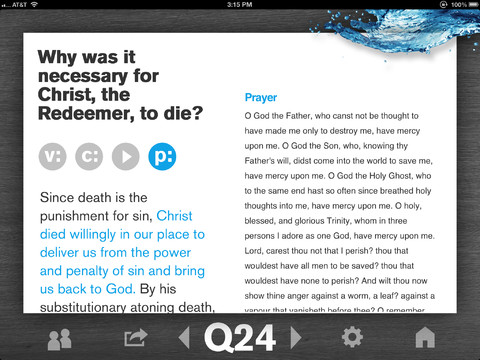
The encounter between the 21st century and American evangelicalism has reached an important turning point. The Gospel Coalition, one of the nation’s largest and most important evangelical church networks, has just unveiled its own new catechism, the New City Catechism. (Full disclosure: as readers of Hang Together already know, I publish articles on TGC fairly regularly.) The whole thing is very impressive. You download an app that not only gives you the catechism – in adult and child versions – but also explanatory videos, passages from great theologians of history, devotionals, etc. They didn’t cut corners on this.

They’ve culled material from the Heidelberg, Geneva and Westminster catechisms, relying especially on the Heidelberg. You can see why; the Heidelberg is the most pastoral of the three, making it the easiest fit for the relatively emotive and narrative mental environment of early 21st century America. The NCC follows Heidelberg in opening with: “What is our only hope in life and death?” In a culture starved for hope, that’s a powerful place to begin. But more about the significance of that in a moment.

Don’t let the continuity between the NCC and earlier catechisms fool you. Publishing a new catechism is an incredibly audacious act. Although most of the words are old, TGC is making decisions on which of the old words to use from which catechisms and how to arrange and present them. That TGC can get away with publishing the NCC demonstrates the high level of theological trust its audience feels it has earned – and, as importantly, that audience’s hunger for networks like TGC to be audacious in providing a more robust set of shared resources. But more about the significance of that, too, in a moment.

As it happens, my daughter and I recently started memorizing the Catechism for Young Children together. The CYC, first published in the 19th century, is a simplified version of the Westminster Shorter Catechism. It begins with: “Who made you? God.” Good old fashioned Presbyterian analytical method! The questions do get harder; I’m dreading when we have to memorize the whole second and fourth commandments.

It’s going very well; after just a little work each day for a couple weeks, we’ve got the first 14 questions memorized. Only 136 to go! She loves it; not only is she good at memorizing, she really wants to know more about God. And this will give her a permanent foundation of understanding to build on throughout her life.

That’s why NCC is such a heartening development. The desire for better catechesis is moving from the “evangelicals can’t think, isn’t it such a scandal” stage, where we’ve been stuck for a generation, to the “hey, let’s roll up our sleeves and actually do something about this” stage.

I’ll be sticking with the CYC, mainly because it’s easier for a seven-year-old; the NCC’s child version is more suitable for 4th or 5th grade. Another reason is the value I place on maintaining historic continuity with my Presbyterian tradition; while the Reformation taught us that traditions don’t trump everything, they’re still highly valuable in that they allow for the building up of wisdom over time in community. My hope is that when she’s older my daughter will pass from the CYC to the Westminster Shorter, which is of course what the CYC is designed to facilitate.

But a third reason brings me to the reason I think the NCC marks a turning point for American evangelicalism. I want to stick with the CYC because it affirms infant baptism, and I think that’s important. Naturally, since TGC includes churches of different beliefs about this practice, the NCC is unable to address infant baptism.

This illustrates how the future of American evangelicalism is going to do two things simultaneously: reach back to the past before the schism with liberalism in the early 20th century, while also reaching forward with entrepreneurial innovation to invent new modes of godliness for the 21st.

If you’ve been following developments in American evangelicalism, you know that church networks have been the big thing for a while now. Willow Creek is probably the biggest; TGC is the biggest Reformed network; there are plenty of others. These networks convene at huge conferences; have high-traffic websites to discuss and debate; produce and share books, videos and curricular materials; and are even beginning to serve some limited accountability functions.

They are, in short, embryonic denominations. With the NCC, TGC has taken a big step toward becoming a quasi-denomination. I expect at least some other networks to follow the same path – perhaps not with new catechisms, but with continued development of quasi-denominational functions.

I view this as a positive development. There is such a thing as human nature, and therefore some human needs (including the needs of church life) are perennial. Many of these needs used to be filled by denominations. As denominations have declined, evangelicals are increasingly seeking those needs in their networks. I am far from the first to observe this!

But while denominations are coming back, the denominations of the future are not going to be the same as the ones of the past. The two major forces that first shaped the emergence of Protestant denominations were politics (in an era when states were confessional) and doctrinal development (in an era when the ability to reason seriously about things had at least some cultural value). These factors led denominations to build up institutional power and emphasize their distinctives.

Neither of these factors – thankfully in the former case, lamentably in the latter – is a major factor just at the moment. Far more important now is the great confrontation between the Christian story of the universe and the competing stories that vie with it for allegiance in ways they haven’t since the fifth century.

So I expect the new denominations to be more tribal, in both good ways and dangerous ones, than the old denominations. I say “tribal” because that’s what you call a group that is held together more by a shared story about the universe than by shared institutions or intellectual commitments. This will allow for greater flexibility than the old denominations had, particularly in developing our networks locally rather than just nationally. It will also hopefully keep us relationally stronger and more mission-focused. (It’s hard to imagine the new denominations conducting anything like a Machen trial.) And of course it will facilitate stronger gospel unity across barriers such as ecclesiological and sacramentological differences.

On the other hand, it will be a long time before the new denominations will be able to match the old ones either in learning or in institutional development. We may never get back where we were on those measures. Don’t look for a new Westminster Assembly any time soon. And all the popular connotations of the word “tribalism” ought to give us food for sober thought.

Obviously the legacies of the old denominations will continue to matter. We are never really starting from scratch; only God creates ex nihilo. NCC’s debt to the historic Reformed catechisms makes this clear. I’m not expecting to see NCC get much traction among Pentecostal churches.

But Christianity is a religion of history; it is in fact the only world religion that truly believes in history. It says God entered time-space history and even accomplished redemption by his acts within it. No doubt he is the same God yesterday, today, and tomorrow. But we are not the same, so I see no reason to expect his work in our hearts and our world will have the same emphasis.

Watching what God does in our time, as opposed to what he did for our forefathers, will be like the difference between Shakespeare’s Roman political tragedies and his Italian romantic tragedies. The same author with the same genius, but a different setting and topic, and thus a truly different experience.
Let’s do quibble about epistemology!

I recently had the chance to introduce to a group of very sharp undergraduates the famed work of Thomas Hobbes, Leviathan. Hobbes wrote during the Scientific Revolution, the fruits of which took us straight to (inter alia) the idea of knowledge that Greg cleverly quotes from The Matrix’s Morpheus: “What is real? How do you define real? If you’re talking about what you can feel, what you can smell, what you can taste and see, then real is simply electrical signals interpreted by your brain.” Hobbes wrote during an era in which everything but knowledge that ultimately derived from empirical/sensory data seemed uncertain and scientific knowledge certain, a legacy the Scientific Revolution has handed us.

What does this have to do with political life? The import is captured by these two common expressions: “It’s just an idea” versus “This is scientific fact.” To many or most people, that which is certain is certain because science tells us so, and everything else is ideational, which comes to be synonymous with “opinion.” But there’s more to knowledge than a dichotomy of indisputable fact and mere opinion. Kyle talks of a debate between an atheist and a Christian in which he ‘knew’ that the Christian was right yet the atheist had made a better case. But the positivist and empiricist assumptions underlying not just the atheist’s but our own culture’s conception of knowledge tends to stack the deck in front of someone who can argue with “scientific fact” instead of relying on the ultimately unfalsifiable claims of religious knowledge. “Public reason”, in democratic theory, is often synonymous with “secular reasons”, because as Hobbes observed, religious knowledge doesn’t fit as well into the scientific paradigm of knowledge that has governed since his own era. Importantly, he also observed, it tends to be divisive in a way that is not easily settled (and often becomes violent).

Does this mean that we should give up on religious reason? Of course not. But in my view, we should probably do better than we’ve been doing. With apologies for the overt grad school theme of what follows, I attended a really excellent event yesterday at Georgetown’s Berkley Center in which Professor Robert Audi gave a succinct – and persuasive, I think – view of how to go about this challenge for Christians (and religious people more generally) in a democracy that embraces some form of separation of church and state. (Side note: after Professor Audi presented, Professor Ferrari gave his own presentation. I’m not making this up. I sort of wonder why Professor Ford wasn’t invited.) Audi advances the “principle of secular rationale,” which states that “one has a prima facie obligation not to advocate or support any law or public policy that restricts human conduct, unless one has, and is willing to offer, adequate secular reason for this advocacy or support.” He unpacks this principle by explaining, first, that the term “secular” need not preclude religious reasons, because the important criterion for Audi is that a reason is knowable by secular means. “A secular reason for an action (or a belief) is roughly one whose status as a justifier of action (or belief) does not evidentially depend on (but also does not deny) the existence of God; nor does it depend on theological considerations, or on the pronouncements of a person or institution as a religious authority.”

Secondly, the term “adequate” means that the reason is “is one that, in rough terms, evidentially justifies the belief, act, or other element it supports” – again, an epistemological, not ontological, criterion. Furthermore, “adequate” need not imply that the reasons are shared by everyone; rather, they must “only be in a certain way accessible to rational adults.” To help determine what constitutes such a reason, we have the category of “natural reason,” by which Audi intends “a general human capacity for apprehending and responding to grounds for belief and for action.” Reasons arrived at through the exercise of natural reason “do not preclude religious concepts from figuring in their content; they are epistemically, not contentually, independent of religion and theology.”

As I see it, Professor Audi’s proposal is helpful for enlarging the idea of what counts as knowledge and reason in democratic discourse such that religiously-based reasons, and not just those based on the unsatisfying options of science or opinion, are admitted in serious public discourse. But I’d be really interested in others’ takes on it. Is there a burden on religious believers to answer to a secular rationale, even in the qualified way Audi suggests?

No Reformation without Sanctification at TGC

An article of mine on the Reformation and sanctification appears on The Gospel Coalition this morning:

These days, we usually identify only two causes with the Reformation: the final authority of the Bible and the doctrine of justification without the works of the law. In fact, when the Reformation first began, it had almost nothing to do with either of those causes. The Reformation began as an argument over sanctification.

I’m pretty proud of the title: “No Reformation without Sanctification.”

And We Have a Winner!

I have to confess that I did not watch more than thirty seconds of the debate. Honestly, I had taped Survivor and that had my undivided attention. However, I heard the next morning from almost everyone, left and right, that Romney had won the debate. But I was caused to pause by a self-declared ‘liberal on the left’ poet on NPR. In an attempt to capture the debate in verse, this poet declared (I won’t attempt to repeat his rhyme) that Romney had clearly won, but, the poet asked, was Romney right?

Consider just for a moment what it takes to win a debate. You must present your viewpoint in the most convincing and thoughtful way. And yet, the winner of the debate does not have to be right. Debate does allow each side to point out the flaws in the other’s view, and perhaps one side wins by convincing everyone that his or her viewpoint is more right than the other’s. But does making your viewpoint seem the most right actually make it right?

Years ago I watched a debate between an atheist and a Christian. The atheist went first and threw out perhaps five or six serious questions to the Christian. The Christian responded with the classical arguments for the existence of God, but never addressed the atheist’s challenges. Clearly the Christian was ‘right,’ but I and the people watching the debate with me all agreed that the Christian ‘lost’ the debate.

I think there is an aspect of American Culture that expects a clear winner. We don’t necessarily expect perfection or even a job done well, just a win done better than they other guy. We even refer to a team that plays a crummy game but somehow manages to get the victory as ‘escaping with a win.’ Americans love winners, even winners in debates, even when they are wrong. I noticed that polls shifted slightly after the debates, with Romney gaining more traction. Of course, Romney supporters stated that was because Romney is correct in his views, but how much of it is because Romney was the winner and we vote for winners. This is a real challenge to America to stop and consider what a candidate in a debate is saying and means rather than just how they say it. Perhaps they are not the most convincing, but maybe they are right. Maybe they are the most convincing, but maybe they are wrong. In the end, does it really matter who ‘wins’ versus who is the most ‘correct.’ I suppose the real challenge is to say the most ‘correct’ information the most convincingly.

What Do They Know and How Do They Know It?

“What is real? How do you define real? If you’re talking about what you can feel, what you can smell, what you can taste and see, then real is simply electrical signals interpreted by your brain.”

 Last week we were discussing whether those who control America’s elite institutions are aware that the policies they promote are destructive of the ends they claim to cherish. The context was my claim that they can be brought around on marriage by appeals to their values on helping the poor, protecting women and children, preventing a two-class society, etc.

Dan wrote:

 They unquestionably know what their favored policies do.  How could they not?

Let’s quibble over epistemology!

Dan seems to me to have a very excessive faith in human reason. No one examines every one of his beliefs carefully, and very few examine more than a handful of their beliefs carefully. That is not a lamentable state into which our particular society happens to have fallen at this point; it is the permanent condition of humanity in all times and places. Locke wrote great stuff on this.

The great majority of human behavior does not consist of rationally evaluated decisions based on objective information-gathering and deliberation over setting priorities. It consists of only briefly examined, very imperfectly informed responses to “cues” from centers of cultural authority.

This is as much true of our cultural elites as of anyone else. We see millions of people following the cues of the dinosaur media and we sometimes think of those media as shrewd manipulators. In fact, they are not much more awake than those who follow them. They are only following each others’ cues.

And it’s also true of the elites within the conservative subculture. The conservative media world is not much more thoughtful than the “mainstream” one. Ditto the world of Christian leaders, who are to a large extent just following one another’s cues.

Obviously I’m not saying no thought goes on, or that these cycles where everyone is just following everyone else in a big circle can’t be disrupted. In fact, my whole case here is precisely that real thought does go on and the circular marches can be broken.

It’s difficult and it will take a radical shift in strategy.Our first task will be to disrupt the circular marches within our own worlds (both conservative and Christian) to get them to change gears and approach the task of fighting for marriage, life, religious liberty and good stewardship of the economy in a very different way. We have to get our own house in order before we can hope to get the nation’s house in order.

But we can’t do that if we live in a false reality where we imagine that our opponents are knowingly accepting the destruction of America as the price they pay for fidelity to their values. That picture strikes me as ludicrous.

Ayn Rand could believe that everyone who supported collectivism really knew in his heart that collectivism was destructive, because her Pelagian anthropology required this conclusion. Read that interminable Galt speech (if you can) and you’ll see the whole system is laid out very clearly. Starting from the classical Pelagian premises about human behavior, she demonstrates that they imply a Manichean social world. Every person without exception clearly and fully percieves the distinction between the way of living that is morally right and the way of living that pleasurable in the short term, and has deliberately chosen one or the other. This is what Whittaker Chambers correctly percieved about Rand in his notorious review of Atlas Shrugged.

I don’t have space here to explain why Pelagianism is wrong, but I hope that on Hang Together I don’t have to. Both Christian teaching and conservative beliefs about human behavior explain why we shouldn’t expect to find that our opponents are conscious of the destructiveness of their policies. And Christian belief also admonishes us to beware of our own tendencies to make ourselves into angels and our opponents into demons.