Shear, Shearing, Sheared, Done Been Shorn

Hear, hear!  Kevin Williamson comes through with another solid critique of “security theater.”

The scale of the intrusive, 4th-Amendment violating TSA bureaucracy is simply out of line.  It is neither just, nor necessary, nor effective–but like most fascist cooperations between the corrupt and the corruptible, assertive regime and avaricious corporation, it uses the fears of the ignorant and supine to subject us all to humiliation and extortion.

We are about a decade past the time for reforming this mess.

When he lamented the crimes of socialism in arms, George Orwell received the usual rejoinder, that one has to break a few eggs to make an omelet. Orwell, who was unique among the literary men of his generation, had the insight to ask the necessary question: “Where’s the omelet?”

We might ask the same thing regarding the Transportation Security Administration.

(source: The TSA’s 95 Percent Failure Rate: Security Theater as Farce | National Review Online)

Well said.

Why does the intolerant Left so vigilantly police speech — introducing even a Twitter “bot” to automate the scolding about the “correct” gender pronoun to use in reference to Jenner? Because they know speech — including simple pronouns — matter. Don’t consent. Laverne Cox is not a woman, and neither is “Caitlyn Jenner.” He is a man with breast implants. He’s always been a man, and he will always be a man. Yes, he’s deeply troubled. Our hearts go out to him in his pain, but the answer is not found in radical self-regard, and it’s certainly not found in surgical mutilation. He is a man created in God’s image, yet a man experiencing deep anguish about his very creation. He needs our prayers, not our applause.

(source: Bruce ‘Caitlyn’ Jenner Needs Our Prayers, Not Our Applause)

Now, how do you say “avoid undercutting” positively?

Kathryn Jean Lopez soars rhetorically in a worthwhile direction:

In response to some observations of Harvard sociologist Robert Putnam, Brad Wilcox has written: ‘The fragility of contemporary religious life in working-class and poor communities in America is rooted not only in the ‘economic hammer blows’ dealt to communities by the new economy, but also in the technological and cultural changes that have undercut the virtues, values and institutions that sustain churches, synagogues and mosques — including strong and stable marriages and families.’

Articulating policies that seek to avoid undercutting these pillars of American democracy must be the task of a presidential-election season. Everything else is a harmful distraction. Life, liberty, and the pursuit of happiness cannot be just rhetorical flourishes; they must be rigorously protected as achievable goals. Politics isn’t a savior; it isn’t the dispenser of hope. But a campaign season can revive dreams; it can help hope float to the surface of our public discourse by highlighting what works and how political leadership can help, not hurt. It might even make for an uplifting magazine cover for a change.

(source: Carly Fiorina and a Tale of Two Magazine Covers)

The “Heckler’s Stigma”

angry-mob

I’d like to return to this exchange, in which I hesitated to join Dan’s denunciation of Pam Geller. As we have discovered on HT before, when we have difficulty articulating the terms of disagreement, it’s helpful to take a step back and quibble about methodology. Now, my methodology for free speech issues is always to ask what my hero, Ahmed Aboutaleb, would do. Aboutaleb is the mayor of Rotterdam who made the following public statement to the Charlie Hebdo bombers:

It’s incomprehensible that you turn against freedom like that, but if you don’t like this freedom, for heaven’s sake, get your suitcase, and leave. There might be a place where you belong, and be honest with yourself about that. Don’t kill innocent journalists. And if you don’t like it here because you don’t like the humorists who make a little newspaper — if I may dare say so — just f*** off.

I have been helped in the past few days by reflecting on this post from The Corner by Fred Schwarz, in which he affirms his agreement with a recent public resolution by Charles Cooke to the following effect:

Up until now, I have included in all of my defenses of free speech a preamble in which I have explained what I personally thought of the person I was defending. But having watched the manner in which such qualifications have been used during l’affaire Geller, I shall henceforth do no such thing. Instead, I shall briefly establish that my personal views about a person’s character or cause cannot possibly matter one whit in such a case, and then I shall move on to the only important question at hand — which is whether we are to live as free men, at liberty to speak as we wish, or whether we are to self-censor in the hope that the crocodiles will spare us.

Schwarz adds a number of helpful observations on how, when our affirmation of someone’s free speech rights is accompanied by an execration of their speech, we can be opening the door to arguments against their free speech rights.

I think I am now ready to articulate why my methodology (What Would Ahmed Aboutaleb Do?) leads me to join Cooke and Schwarz against Dan. In free speech law we are familiar with the concept of the “heckler’s veto,” the argument that people with unpopular opinions may have an abstract right to be heard, but threats to public safety prevent our giving them the same free speech protections everyone else enjoys. This is how they used to shut down civil rights marches in the Old South, and it’s often how they shut down legitimate criticism of Islam today. Those of us who support a robust regime of free speech rights recognize the threat posed by the heckler’s veto. If the police can’t keep the peace when unpopular opinion are expressed, that is a confession of incompetence by the police; they should do their damn job. (I can’t remember if it was Mark Steyn or someone else who pointed out how discouraging it is that Salman Rushdie is forbidden to fly because any plane he gets on might be a terrorist target; apparently our security forces are openly admitting that they can’t protect a plane from terrorist attack even when they know with certainty exactly which flight will be targeted.)

I would like to propose a new rule – a corollary to the rule against the heckler’s veto. It is that there should be no “heckler’s stigma.” I formulate the corollary thus:

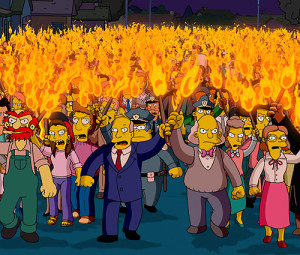
Irrational mobs that are attempting to destroy free speech rights must not be permitted to dictate which speech we shall condemn as evil, nor the time, place and manner in which we condemn it.

I think Geller and Charlie Hebdo are disgusting, but if I say that in the context of a debate over their free speech rights, I am helping create a “heckler’s stigma” that is, in my view, the next best thing to a “heckler’s veto.” It is that for two reasons: it is intrinsically bad, in that it puts our moral discourse under the control of immoral people; and it creates political and sociological conditions under which legal protections for free speech will lose their political support.

I am Ahmed Aboutaleb!

Phone, Pen, Scalpel, Cudgel

Charles Krauthammer is turning his reunion to more use than nostalgia:

I was reminded of [an earlier conversation] upon receiving my med-school class’s 40th-reunion report and reading some of the entries. In general, my classmates felt fulfilled by family, friends, and the considerable achievements of their professional lives. But there was an undercurrent of deep disappointment, almost demoralization, with what medical practice had become. The complaint was not financial but vocational — an incessant interference with their work, a deep erosion of their autonomy and authority, a transformation from physician to “provider.”

As one of them wrote, “My colleagues who have already left practice all say they still love patient care, being a doctor. They just couldn’t stand everything else.” By which he meant “a never-ending attack on the profession from government, insurance companies, and lawyers . . . progressively intrusive and usually unproductive rules and regulations,” topped by an electronic-health-records (EHR) mandate that produces nothing more than “billing and legal documents” — and degraded medicine.

I hear this everywhere. Virtually every doctor and doctors’ group I speak to cites the same litany, with particular bitterness about the EHR mandate. As another classmate wrote, “The introduction of the electronic medical record into our office has created so much more need for documentation that I can only see about three-quarters of the patients I could before, and has prompted me to seriously consider leaving for the first time.”

You may have zero sympathy for doctors, but think about the extraordinary loss to society — and maybe to you, one day — of driving away 40 years of irreplaceable clinical experience.

(source: Government Is Forcing Doctors to Spend More Time on Data Entry and Less with Their Patients)

And a trenchant punchline:

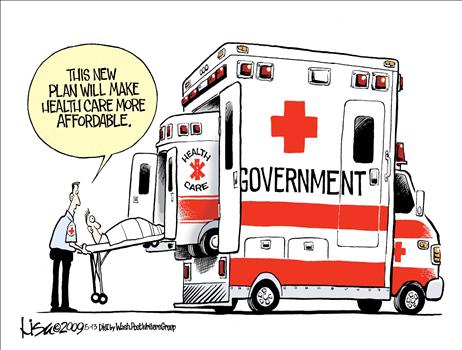
Why did all this happen? Because liberals in a hurry refuse to trust the self-interested wisdom of individual practitioners, who were already adopting EHR on their own, but gradually, organically, as the technology became ripe and the costs tolerable. Instead, Washington picked a date out of a hat and decreed: Digital by 2015.

(source: Government Is Forcing Doctors to Spend More Time on Data Entry and Less with Their Patients)

It is important to respect the organizing principle of each society within the nation, not to simply treat all questions as matters for the regime to problem-solve; when we don’t, we turn brain surgery into blunt-force trauma in a heartbeat.