Prescient, Persistent

Thomas Hibbs’ recent review of the Mad Men finale directs me to the following fascinating passage in de Tocqueville, one of those writers whose most famous quotations list has made him seem to be a token booster of American national pride.  But this could have been written in our generation, friends:

It is strange to see with what feverish ardor the Americans pursue their own welfare, and to watch the vague dread that constantly torments them lest they should not have chosen the shortest path which may lead to it.

A native of the United States clings to this world’s goods as if he were certain never to die; and he is so hasty in grasping at all within his reach that one would suppose he was constantly afraid of not living long enough to enjoy them. He clutches everything, he holds nothing fast, but soon loosens his grasp to pursue fresh gratifications.

In the United States a man builds a house in which to spend his old age, and he sells it before the roof is on; he plants a garden and lets it just as the trees are coming into bearing; he brings a field into tillage and leaves other men to gather the crops; he embraces a profession and gives it up; he settles in a place, which he soon afterwards leaves to carry his changeable longings elsewhere. If his private affairs leave him any leisure, he instantly plunges into the vortex of politics; and if at the end of a year of unremitting labor he finds he has a few days’ vacation, his eager curiosity whirls him over the vast extent of the United States, and he will travel fifteen hundred miles in a few days to shake off his happiness. Death at length overtakes him, but it is before he is weary of his bootless chase of that complete felicity which forever escapes him.

At first sight there is something surprising in this strange unrest of so many happy men, restless in the midst of abundance. The spectacle itself, however, is as old as the world; the novelty is to see a whole people furnish an exemplification of it.

(source: Tocqueville: Book II Chapter 13)

Do you doubt that this is a durable component of our national character?  Take a look at what mind-warping folly is often written on the subject of jealousy (the laudable, if tempered, desire to protect what one rightly enjoys) and envy (the mortal sin of desiring that no one else should enjoy anything unless I can enjoy it, too).

M. de Tocqueville continues: Continue reading

Notable Points of Agreement

I happened to notice this 2012 post from Greg, while clicking around the back end of the site.  With slight adjustments for windage, I think we’re heading the same direction, here:

In the lawsuits over Obamacare, the administration has asserted the theory that a profit-making business or a hospital or a school cannot be said to exist primiarly for a religious purpose or mission. If the courts endorse this claim, Christianity has been made illegal. Christianity cannot be what it is if the total primacy of God’s claim on our lives and the mission he has given us in the world is not permitted to achieve institutional expression in all areas of life, rather than simply in churches narrowly defined. This is not to say that all Christians must attend distinctively Christian schools or work in distinctively Christian businesses; far from it. However, if the formation of such institutions is illegal, Christianity is illegal.

(source: Religious Institutions and Modern Society | Hang Together)

And I’ll cheerfully sign on to this critique:

Romantic individualism has a contradiction at its core: it is not as individualistic as it thinks it is. It has always sought, and achieved, institutional embodiment – all while denying to itself that it seeks this. The two chief places it has been embodied are in the state – hence the need for a state-controlled “civil religion” in the Social Contract – and in educational institutions. The near-total triumph of Romantic individualism in these two sectors has coincided with a continual contraction of actual liberty for the individual, as both these types of institutions have become more rigid in imposing Romantic individualism as orthodoxy.

Rousseau foresaw all this and laid it out plain and simple in the Social Contract – those who do not voluntarily find their freedom in submission to the general will must be “forced to be free.” Those words are widely misunderstood and abused – Rousseau was no totalitarian – but the indifference to the individuality of the individual was very real and deliberately chosen.

(source: Religious Institutions and Modern Society | Hang Together)

I’m a tiny bit less sanguine about the potential for modern liberal democracy to survive its contradictions, but I whole-heartedly agree that if there is any hope for it, it depends on our recovering or inventing cultural institutions that offer a convincing alternative to “Romantic individualism.”

And in any case, first and foremost, if there is any hope for any of us, the Church must be the Church.

Just the Truth: No Hucksters Needed

This seems worth considering, and at first hearing rings true.  I’d love to hear more comments on this point:

A Huckabee primary loss — which will happen entirely because of his more liberal record on taxing and spending — is a sign of religious conservative strength. With every single candidate in the Republican field vowing to protect life and religious liberty, and with every single candidate highlighting the plight of the persecuted church overseas, religious conservatives aren’t reduced to voting for the “most overtly Christian” candidate to make their voices heard in the culture war. When Mike Huckabee loses the Republican primary, he’ll be defeated by another pro-life, pro–religious liberty candidate — but one who probably has a stronger conservative economic record or better national-security credentials. How is that a sign of religious-conservative weakness?

(source: Why a Huckabee Loss Would Be a Win for Religious Conservatives)

Promoting Commentary

A lot of the best stuff on this blog happens three comments deep.  Quoth Greg:

In general, only a society committed to running on moral consensus can have a revolution in the strict sense of that word (as distinct from, say, mere rioting or revolt or secession). Other societies recognize no transcendent standard separate from the social or constitutional order as such, to which revolutionaries could appeal in opposition to that order. And a society committed to running on moral consensus will soon find, if they didn’t know it from the start, that the idea suggests at least the potential for revolution, and the constructive political uses of that potential (see Locke’s comment about “the best fence against rebellion”).

(source: Concept Art | Hang Together)

I’m too much of a Burkean not to have a large caveat on any generalization about revolution (I regard the U.S. War for Independence as an outlier precisely in its having a stronger foundation in English constitutional history than the Royalist faction in Parliament of the day could possibly have had–the “revolutionary fevers” of 1848 and 1968, Bolshevism, and even to some extent the abortive “Arab Spring,” all seem far more typical of revolutionary theory and reality, to my mind).  

That to the side, it simply must be true that there can be radical improvement in a society’s power structure only when the society acknowledges some common basis for appeal beyond the regime–absolutely.  It must be possible for all to recognize the difference between just and legitimate authority, however incidentally froward or unfair, and the tyrant; and to recognize who has the authority to restore justice by deposing the tyrant; and to recognize the direction for change toward a more just and legitimate authority in the aftermath.  Fail any one of these, and the actions are unjust and the results detrimental to society, state, morality, and law.  A chief problem of most 20th-Century democratic reasoning, in fact, is that it suppresses the possibility of one or more of these things (see under “government is the one thing we all do together” for examples).

I will point out one other thing, too:  This change can only possibly be improvement when the common basis is, in fact, true–is reality itself, made intelligible and acknowledged to be so.  This cannot be done when anti-realist philosophy is treated as though it were “our last, best, hope for peace.”

Greg continues with praise for “Chesterton’s Orthodoxy, a book more praised than read.”  I agree, and by chance the Chesterton Club I attend monthly just did finish going through Orthodoxy (not for the first time for most of us, and not for the first time together for those who’ve been in the club longer than I).  I actually find that Orthodoxy, but especially Heretics, sometimes suffers from a too-great love of antithesis and a somewhat timebound pleasure in puncturing the ironies of contemporary cant–cant contemporary to an Edwardian, that is.  Our own cant sometimes has shifted enough that Chesterton’s resonant wit goes flat, like a piano with slack strings.  But at moments, Chesterton is speaking directly to our day, in words that seem more relevant now than they did when he wrote them!

(And especially in the chapter I’m about to cite, Chesterton sometimes seems as though he has imbibed more Hume than is strictly hygienic, but then so did I, so there’s that.)

I’ll just pull a passage, as an example, that touches on several Hang Together themes at once (but think of this as an invitation to read promiscuously in Chesterton’s oeuvre, not a summation): 

This elementary wonder, however, is not a mere fancy derived from the fairy tales; on the contrary, all the fire of the fairy tales is derived from this. Just as we all like love tales because there is an instinct of sex, we all like astonishing tales because they touch the nerve of the ancient instinct of astonishment. This is proved by the fact that when we are very young children we do not need fairy tales: we only need tales. Mere life is interesting enough. A child of seven is excited by being told that Tommy opened a door and saw a dragon. But a child of three is excited by being told that Tommy opened a door. Boys like romantic tales; but babies like realistic tales—because they find them romantic. In fact, a baby is about the only person, I should think, to whom a modern realistic novel could be read without boring him. This proves that even nursery tales only echo an almost pre-natal leap of interest and amazement. These tales say that apples were golden only to refresh the forgotten moment when we found that they were green. They make rivers run with wine only to make us remember, for one wild moment, that they run with water. I have said that this is wholly reasonable and even agnostic. And, indeed, on this point I am all for the higher agnosticism; its better name is Ignorance. We have all read in scientific books, and, indeed, in all romances, the story of the man who has forgotten his name. This man walks about the streets and can see and appreciate everything; only he cannot remember who he is. Well, every man is that man in the story. Every man has forgotten who he is. One may understand the cosmos, but never the ego; the self more distant than any star. Thou shalt love the Lord thy God; but thou shalt not know thyself. We are all under the same mental calamity; we have all forgotten our names. We have all forgotten what we really are. All that we call common sense and rationality and practicality and positivism only means that for certain dead levels of our life we forget that we have forgotten. All that we call spirit and art and ecstacy only means that for one awful instant we remember that we forget.

(source: Orthodoxy – Christian Classics Ethereal Library)
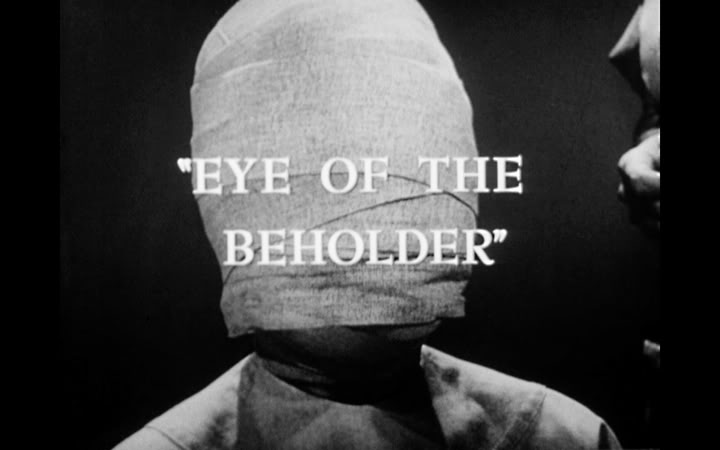
Concept Art

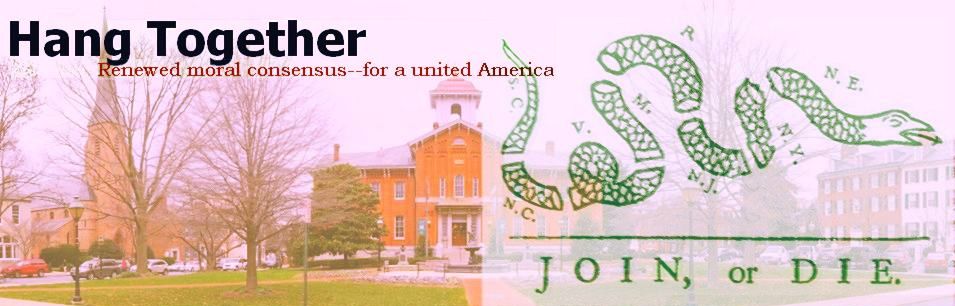
I have a confession to make.  I’ve always found it a little hard to sort out the overlay of two revolutionary images (Franklin’s “Join or Die” with the French Republic’s Tricolor) and the blog’s motto “Renewed moral consensus–for a united America.”  So I mocked up some concept art in order to kickstart a little bit of discussion of how the blog’s banner, slogan, and general rhetorical “flavor” are developing.  

My own style is more bulldog than raconteur, of course, but I hope that over time I make it evident that my hope is for a comity which results from a reality-based understanding of basic human character and relations–and which therefore reprehends willful distortions of reality, particularly when these are institutionalized by law!

Anyway, here’s some concept art:


(source: banner-small.jpg (955×306))