
Torches and pitchforks, people. Torches and pitchforks, indeed.
(Incidentally,
I cannot tolerate […] that the […] people’s authority should be menaced from any quarter: and that holds good above all for the Churches! So long as these confine their activities to religious affairs, the State will not molest them. But if they arrogate to themselves, through acts, decrees or Encyclicals, rights which are not theirs at all, we shall drive them back into their spiritual domains.
(source: New Light…)
Sounds familiar, no?
The painter Salvador Dalí had a particular attachment to Millet’s The Angelus, and he also had a premonition about it. He saw in the shape of its figures and the hue of its light a scene of mourning, not just work and prayer. This was not a widely accepted interpretation until, sure enough, the Louvre had the painting examined by x-ray, and the outline of a child’s coffin could be seen under the basket of potatoes. The steeple in the distance, too, was a late addition.
We don’t know why Millet replaced a burial with the Angelus; perhaps, simply, it would make the canvas more sellable to the pious. But Dalí’s insight, and the revelation that followed, implies a certain continuity between ordinary mortality and the prayer, which thwarts the work-day’s ruse to either mechanize or aggrandize us. It announces that the worker is still, and will insist on remaining, human.
(source: The Angelus at Work | America Magazine)
Dali’s interpretation of Millet:

(source: Archeological Reminiscence of Millet’s “Angelus”)
We must work the works of him who sent me, while it is day; night comes, when no one can work. As long as I am in the world, I am the light of the world.
(source: John 9 RSVCE)

Watch and pray that you may not enter into temptation; the spirit indeed is willing, but the flesh is weak.
(source: Mark 14 RSVCE)
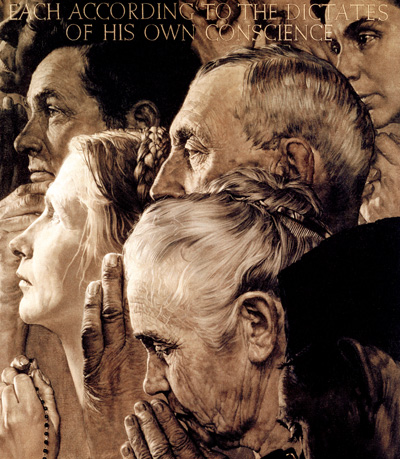
Yesterday, First Things carried an exchange between HT’s own Dan Kelly and Yale prof Andrew March on the question of whether the Windsor decision, which struck down the Defense of Marriage Act, strengthens or weakens religious pluralism. Both contributors did an outstanding job – but I’m the editor, so I’m biased, check it out for yourself! As I wrote in my comment on the exchange:
The most interesting aspect of the debate for me is the question of “dignity.” Kelly attacks the court for presuming to confer human dignity upon practitioners of same-sex marriage; the law, he argues, cannot confer dignity upon human beings—and it cannot even effectively compel people to recognize one another’s human dignity. March, for his part, accepts the possibility of “justifiable transfers from one ledger to another in the national economy of dignity,” pointing to civil rights laws. For my own part, I have never gone as far as my friend Dan in discounting the role of public law in constructing our conceptions of meaning and purpose. We are, after all, cultural creatures. But I share his view that we cannot really form a meaningful concept of dignity that would make it subject to redistribution through political action—dignity isn’t dignity unless it’s intrinsic.

Tolkien is one of those reliably wise souls. Even when we are pretty sure we know what we’re doing, we should “not be too eager” in matters of life and death.
Want a hard one? Apply this to your urge to “rally the troops” to any side of a life-and-death issue. There are always some among us who are “too eager” to find the very most radical edge: curb your urge to hurl them against the wall (or the enemy), or you may destroy them–and yourself. In the middle of all that, the loss of your cause will come to be trivial. Then you will see, too late, why you ought not to have been “too eager.”