The Metaphysics of Undergraduates

Robert Royal recently referenced a line from Burke’s Reflections on the French Revolution that delighted me, especially as I warm up for another semester teaching Rhetoric to my freshmen. Royal’s point is as follows:

The radical Enlightenment–the part that Edmund Burke discerned in the French Revolution as operating “with the metaphysics of an undergraduate and the mathematics and arithmetic of an exciseman”–is with us still and often provides the background music to our lives. We see it in public figures who seem to believe that there are known remedies for all social ills, which have been “blocked” because of the ill will of the privileged or the ignorance of the underprivileged, both of whom it’s okay to ignore and perhaps even to eliminate from the conversation.

I think Royal is not only right, but is pointing us in the right direction, when he refers to this passage from Burke. “The metaphysics of an undergraduate” is an important jibe; it signifies far beyond mere detraction. I think something very similar is at work in passages Greg has posted recently in two different articles:

Across both these broken relationships (with God and with family) the appeal of pornography is the illusion of power. It is not primarily the physical senses that pornography stimulates, but the imagination. Pornography helps the user enter and remain within an illusion of his own creation. Within that illusory world, he is all-powerful. Everything bends to his will; even the most outrageously implausible scenarios become easy.

(source: Pornography and Power | Greg Forster | First Things)
and

Few people improve their behavior much strictly on their own initiative, through self-awareness and self-discipline. Our moral development comes much more from our response to other people’s prompting, encouraging and restraining us. While the basic principle here is ancient wisdom, Haidt backs it up with an impressive collection of empirical data, and shows that to some degree this social basis of morality is hard-wired in human physiology.

(source: They Know Not What They Do | TGC | The Gospel Coalition)

Triumph of Thomas

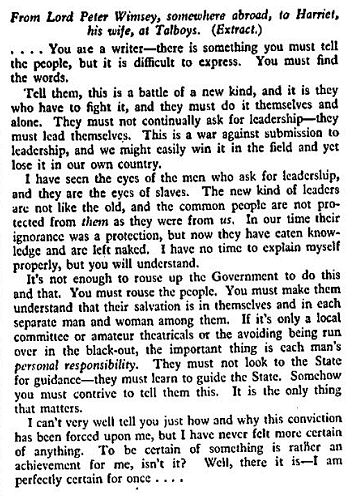
What all of these seem to be suggesting is that humans today have a reality problem. Describing that problem philosophically pretty surely won’t solve it, but it may well help us devise correctives that are more useful. To that end, I urge you to read the entire passage from Burke (below), but to note especially the argument he makes about bad metaphysics, here.   Continue reading
Speaking of Silence….

Catholic Fiction.net has just posted a review I wrote earlier, a profoundly mixed review of Shusaku Endo’s Silence. Here is the conclusion:

Given the nature of the critical literature surrounding Silence, the example of Endo’s own trajectory through Deep River, and the most obvious reading of the story itself, no one should recommend Silence as an exemplary Catholic novel without qualification.  Teachers and parents who share it should be careful to surround it with good literary instruction and sound catechesis; where this is not possible, it may be better to leave Silence for later.  For those who seek a novel indelibly marked by the baptismal faith of the author, and who are prepared to struggle and pray their way through a gripping and tragic confrontation between a faith shaped by martyrs and a world full of collaborators, Endo’s work has much to recommend it.  Artists should seek to emulate Endo’s mastery of narrative style; and anyone interested should turn from the portrayal of Garrpe’s martyrdom to the many historical accounts of the Japanese martyrs, and pray for the souls of their kinsmen.

(source: Silence)
What are your thoughts?

I beg to differ

Even Homer nods, and the excellent David Warren wrote a beautiful column over at The Catholic Thing which I think has some ill-considered observations.

Dominion jarOne thing that I did not mention in my brief comment on that site is specific to the Wallace Stevens poem he discusses, there.  He takes issue with the idea that the “jar” in question can reasonably be identified as a Dominion Glass Company canning jar (“The jar was round upon the ground / And tall and of a port in air. // It took dominion everywhere”).  Now, if he has specific historical or biographical data that demonstrate that Stevens could not have meant a Dominion jar, or must have meant something else (and my cursory research has not turned up any), Warren does not share it.  Instead, he says that this reference is “a (typically Stevensian) irony.”

Irony, however, is hardly meaningless decoration in a poem like this; and to say “irony” while refusing the most obvious literal significance (that a jar with a round bottom, taller than wide, open at the top, and suggesting “dominion” is likely a jar made by Dominion Glass Company, which was in mass production in 1918) is to render the poem more opaque to reality and less definite; it is to choose the writer’s preferred meaning over the poet’s work–which is just the sort of critical error that Warren sets out to criticize.

My comment:

I fear that the estimable and enjoyable David Warren has stumbled into the trap of doing what he criticizes, preferring an elusive and allusive irony to honest criticism.

Surely, there is plenty of bad criticism out there–and plenty of bad poetry, too. In an era when criticism is written to justify the critic’s paycheck to other critics, and poetry is written to justify the poet’s MFA student loans to other MFA program participants, we are desperately in need of good criticism to answer bad poetry–and good poetry to confound bad criticism.

Warren justly argues that realist metaphysics, and ready acceptance of the gifts God gives us, are necessary to good art of any kind. Huzzah! Let us close ranks.

It seems a bridge too far, though, to suggest–and possibly I am reading Warren harder than he wants me to, I confess–that “all true critics” are mimeticists, judging art by its conformity to [consensus view of] empirical reality. Surely great art also declares realities beyond nature, gracious realities which heal and perfect nature, and which also therefore confront the wounds of nature. Would you not agree? And surely competent criticism recognizes that “literary criticism should be completed by criticism from a definite ethical and theological standpoint,” as T.S. Eliot so memorably posits. Must you not agree?

It seems to me that supine “appreciation” simply lets bad poetry, and the bad philosophy that accompanies it, go unanswered. Warren objects to criticism because there is so much bad criticism, like those who object to philosophy because there is so much “philosophy and empty deceit” in the world.

The Catholic critic and the Catholic poet will have to be more than mere mimeticists, and more than mere “appreciators,” in order to co-operate with grace and confound bad critics and poets.

The results may be jarring.

Another Difficult Quandary

Jobless

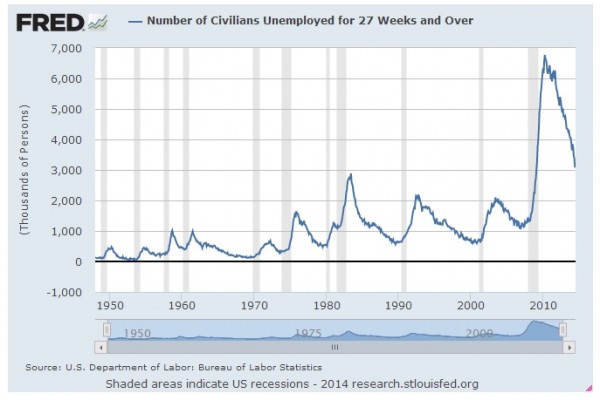
It is conventional wisdom on the right that extending the period of time people are eligible for unemployment insurance (UI) just keeps them from looking for jobs. They stay on UI as long as you let them, and once UI runs out they go look for jobs. The evidence adduced for this is that unemployment rates among UI recipients go down significantly right after the benefits are cut off – regardless of when you cut off the benefits.

So my eyebrows were raised by this post from James Pethokoukis arguing that cutting off UI does not really get people back into jobs. He looks at evidence that the UI recipients disappear from the ranks of the “unemployed” after benefits are cut off, not because they found jobs, but because they gave up looking for work. Transitions from unemployment to jobs appear to be unaffected one way or the other by UI. What is affected by UI is the transition from claiming that you are looking for work (which you must, to be eligible for UI) to admitting you’re not.

To the extent that this evidence is reliable (I’m not qualified to judge) it certainly tells against the idea that we can promote work by yanking UI benefits. On the other hand, I’m not sure this is evidence we should extend UI benefits, either. Pethokoukis seems to think so, but on his own showing, there would seem to be a substantial number of people who are only on UI to milk it as long as they can. Does it make any sense to pay people to claim they’re looking for work if they’re not?

The real takeaway, in my mind, is that the solution to joblessness has nothing to do with safety net programs one way or the other. In the short term, we need to cultivate and encourage entrepreneurs; in the long term, we need universal school choice to revolutionize the education system. Let’s set a fixed term for UI and not monkey around with it, so we can focus our attention and energy on clearing away the obstacles to work.