Frozen Fatherhood

Frozen funeral

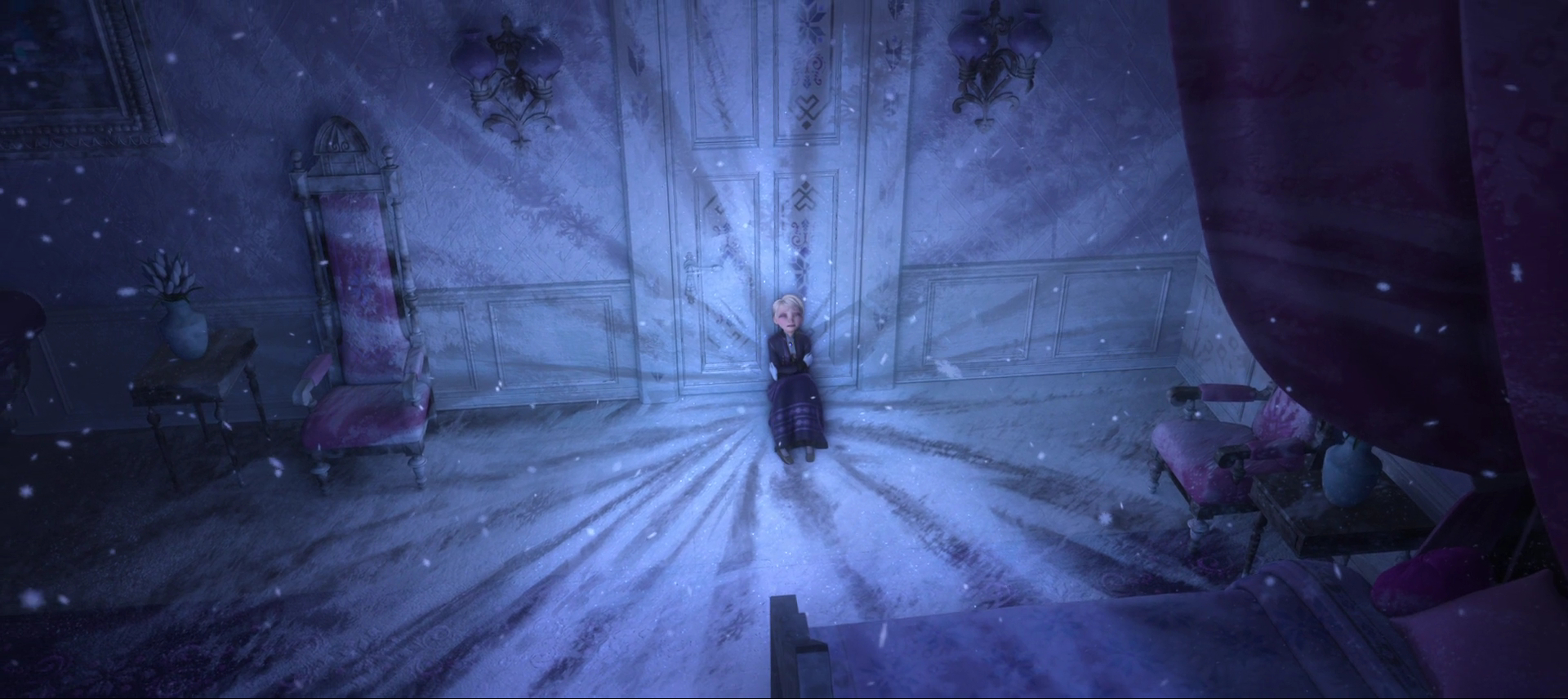
Do you see what’s wrong with the picture above? Keep reading – we’ll come back to it.

The overarching theme of Frozen, my new very favorite movie, is the struggle between love and fear. I’ve already argued that Frozen speaks from a moral worldview that challenges the deepest roots of the cult of self-expression; now I’m going to carry that a little further. I think Frozen responds in a powerful way to the breakdown of the family. (Spoilers below.)

The contrast between love and fear begins right at the start of the movie, with the ice miners:

Cut through the heart, cold and clear!
Strike for love and strike for fear!
There’s beauty and there’s danger here
Split the ice apart!
Beware the frozen heart…

In our broken world, you can’t have love without fear. To be in relationship with people is to make ourselves vulnerable to pain, loss and injustice. “There’s beauty and there’s danger here.” But if we allow our fear to drive us away from loving relationship, we end up with frozen hearts.

C.S. Lewis writes in the conclusion of his masterpiece, The Four Loves:

To love at all is to be vulnerable. Love anything and your heart will be wrung and possibly broken. If you want to make sure of keeping it intact you must give it to no one, not even an animal. Wrap it carefully round with hobbies and little luxuries; avoid all entanglements. Lock it up safe in the casket or coffin of your selfishness. But in that casket, safe, dark, motionless, airless, it will change. It will not be broken; it will become unbreakable, impenetrable, irredeemable.

This is why the family is dying – people are running away from permanent bonds. People are afraid to treat marriage as what it is – a promise of permanence – because that kind of love leaves no escape hatch. We want to be able to get away if we really have to. And thus we are producing a whole culture of frozen hearts.

The only solution to the pain and injustice love subjects us to is not to run from love, but to face our fears and conquer them with more love, with deeper love, with love that can “cut through the heart” and, as the lyric says elsewhere, “break the frozen heart.”

Do you see now what’s wrong with the picture at the top of the post? Keep looking. It took me three viewings of the movie before I saw it.

 Frozen parents 2

The troll tells the young Elsa, speaking about her powers, “There is beauty in it, but also great danger. Fear will be your enemy.”

But her father responds to this with . . . fear. He teaches Elsa: “Conceal it, don’t feel it.” That’s the fear response – people who are afraid of being hurt by love respond by trying not to feel.

He means well, but he is locking his daughter’s heart in that dark, motionless casket Lewis described. And so his fatherhood ends up looking like this:

elsa_don't touch me

“Don’t touch me!” cries little Elsa. “I don’t want to hurt you!” And he doesn’t. He doesn’t touch her.

The whole plot of the movie unfolds from that one mistake. Little girls need to be held by their dads, especially when they’re afraid. He should have said to himself, damn the danger, I’m going to hold my little girl and make sure she knows that I love her. But he didn’t.

By his example, he taught her that fear is more powerful than love.

Now do you see it? Go back up and look carefully.

Anna Swing_Painting

The entire plot of the movie is explained by this fact: Elsa and Anna were starved for love by their father. Elsa retreats in fear – “don’t let them in, don’t let them see”; “don’t let them in, don’t let them know.” Anna, by contrast, is so desperate for something to fill the void of her father’s love that she rushes into the arms of the first handsome man she (literally) stumbles across.

Elsa’s retreat from the bonds of relationship and obligation doesn’t work. Oh, sure, she has that exuberant power ballad about being alone and free. “The fears that once controlled me can’t get to me at all!” she claims.

But it’s not true. As soon as Anna shows up and tells her that Arendelle is covered in snow, we see that she never left the fear behind. After she casts Anna out of her castle, we see her pacing back and forth, clenching her fists, scrunching up her brows, chanting: “Don’t feel it, don’t feel it.” Nothing has really changed. And the horrible ice daggers begin to grow out of the walls toward her.

Oh, and she kills her sister.

Anna Frozen_Heart

As for Anna’s way of seeking a male love to replace her father’s, well . . . what needs to be said? Look around you at our culture and ask how many Annas we’ve produced, rushing headlong into “love,” doing tremendous damage to their own hearts because they can’t bear the isolation. The only difference is that they’ve been at it so long and have failed so completely to find anything to fill the holes in their hearts, they’ve now grown content to simply give the Hanses of the world what they want. They don’t think anything better is possible. And thus our men become more and more like Hans, because no higher expectations are set for them.

There’s only one person. In the funeral scene, in the picture above. Standing between the gravestones in the center, there’s only one person. There ought to be two daughters there.

Elsa didn’t go to her father’s funeral.
Elsa's_loss

Kristoff, for all his eccentricities, is a decent and prudent man because he was taken in by the trolls – the love experts. As he explains to Anna, he was on his own until they took him in and raised him. He was raised by a family – a whole family. It’s a family of weird people, which is why Kristoff is a weird man. But who would not rather be him than literally anyone else in this movie? He is, without contest, the only happy and virtuous human being in the story.

Think I’m reading something into the movie that isn’t there? Well, I suppose I wouldn’t be the first, if you look at some of the cockamamie theories that have gained circulation.

But before you dismiss me, consider the final stanza of “Fixer-Upper”:

Everyone’s a bit of a fixer upper
That’s what it’s all about!
Father! Sister! Brother!
We need each other
To raise us up and round us out!

You see what they did there? We need fathers to raise us up.

I’m telling you, these people are playing to win.

Religious Liberty Roundup

Rockwell (square)

Wow, big flurry of articles on religious liberty, tied to the Supreme Court hearing Hobby Lobby this week. Over at First Thoughts, I offer a caution about something Rick Warren says in his op-ed, and Gabriel Rossman reveals the existence of a startling ancient legal document, recording the challenge of a “Jewish superstition that worships Christus” against the ancient “Lex Obama.”

More seriously, Peter Berger offers this stimulating reflection: In practice, religious freedom draws much of its support from businesses and other interests that stand to gain materially from it. Berger points to the government of China, which has somewhat relaxed its persecution of religious movements out of transparently mercenary motives; and also the emergence of a business-led coalition against apartheid in South Africa in which some actors were moved by an exogenous moral disgust at apartheid, but some saw apartheid as a threat to the bottom line.

Berger argues we should not be overly worried about building coalitions in favor of a morally desirable outcome in which many members of the coalition have mercenary motives. I agree, but have a few reservations about aspects of his analysis:

It is one thing to say that religious freedom is often good for business – and, more broadly, a well-functioning society. It is quite another thing to argue that religious freedom is systematically good in that way. And it is still a third thing to say that it is both systematically so and that it will be relatively easy for the business leaders and other interests that stand to benefit to see this. I cannot tell which level of claim Berger is making.

Obviously this is not a new question, but what especially moves me to raise it is the recent defeat of a very mild religious freedom statute in Arizona. The opposition did not really come from concerns that the law would overreach. It came from business leaders who feared they would be publicly targeted by gay rights activists if they did not use their pull with the governor to kill the law.

All of which is simply to say that while I think it is true that religious freedom is good for business and society systematically, it is only so on the whole and in the long run. And it is very easy for businesses and other interests to lose sight of the long run if they face painful losses in the short run.

This leads me to a broader concern about Berger’s piece. He sets up a very sharp distinction between supporting a policy like religious freedom for the sake of what he calls “principle” and supporting it for the sake of what he calls “results.” On some level such a distinction makes sense; I would not be willing to curse Jesus no matter what the results would be. On the other hand, in general and on the whole we must care about results if we care about principles, and (putting the shoe on the other foot) when people care about results they do so out of some set of principles that guides them.

We need not draw too sharp a distinction between wanting business to succeed and wanting morality to triumph. If we do, we risk reinforcing the already strong tendency of the culture to assume that businesses and societal interests do not have, and need not be expected to have, moral commitments. That kind of thinking is what produces business leaders who fear gay rights activists more than they support religious freedom.

Can We Trust Each Other?

Pew-Millennial-Trust

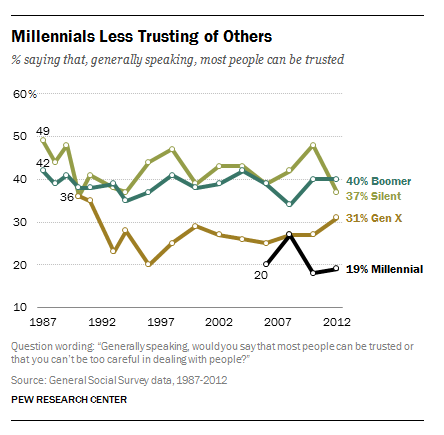
Today TGC carries my article on the latest Pew and Gallup data on Millennials. While others have focused on the decline of work, marriage and churchgoing – and written excellent stuff on it – I focus on the decline of social trust. America’s unprecedented cultural success has been based on our extraordinarily high levels of social trust, but that trust has been declining for a generation. I argue this is an even deeper cultural challenge than the (already formidable) difficulties we face in the decline of work, family and churchgoing:

Do “the mystic chords of memory” and “bonds of affection” still bind us as a people? There can be no rebuilding of the institutions of work, family, and religion—there can be no effective solution to our social disruptions—unless we firmly believe that “we are not enemies, but friends.” Lincoln could say those words in 1861, yet for some reason few seem confident saying them today.

But there is hope; there is always hope. Through the Christian virtue of φιλοξενία, we can lead our neighbors back to trust.

Ten Reasons Joy Brings Christ to Our Culture

JFTW

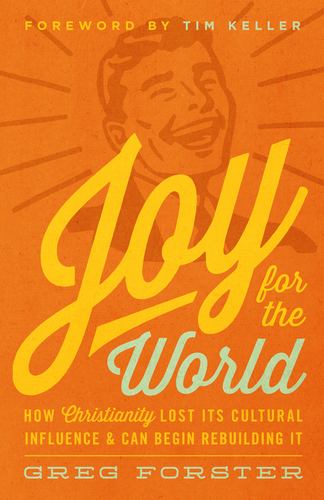
The Crossway blog recently posted my “Ten Reasons Joy Brings Christ to Our Culture,” based on my forthcoming book (which you can totally buy now, thanks for asking):

10. It gets people with their guard down. People are naturally wary of canned gospel presentations, political agendas or “Christian cultural impact” campaigns. They’re not wary of joyful people.

9. It offers an alternative to lust, sloth and gluttony. The joy of God rips people out of their selfish fantasy worlds, and gets them off the couch and doing something meaningful with their lives.

8. It offers an alternative to pride, greed and wrath. The joy of God casts out the fear and guilt that drive people to build fortresses of misery around themselves.

7. It liberates people from worldly enslavement. People who have the joy of God can’t be controlled and manipulated by systems of sex, money, and power.

6. It reveals new possibilities for our lives. The renewing of our minds by the Word and Spirit reveal how the world really works, showing us things we would never have dreamed of on our own.

5. It changes our priorities. You can’t address cultural problems like financial chaos, family breakdown and cutthroat politics unless you have people who care more about doing what’s right than about doing what’s easy or makes us feel good.

4. It makes us responsible. People with the joy of God want to be good stewards of all that comes under their care, and pass on a flourishing world to the next generation.

3. It reconciles Christian cultural influence with religious freedom. You can’t Christianize people with the power of the state ; the only way to genuinely influence culture for Christ is to get people to want what we have.

2. It’s good training for the New Jerusalem. Sharing the joy of God will be the whole basis of our cultural life.

1. It’s the miraculous work of the Holy Spirit in us. Why show our own cultural efforts to our neighbors when we can show them God’s?


Christian Humanism and Religious Liberty

Today TGC runs my review of Joe Loconte’s God, Locke and Liberty: The Struggle for Religious Freedom in the West. In that review I focused on what the popular reader will get out of the book, and that is a lot. But I want to stress that scholars of Locke, historians of early modernity and specialists in religious liberty will all find much new and interesting material in the book for them as well. Loconte has studied both the primary texts and scholarly literature on the emergence of religious freedom carefully. From the primary sources, he brings forth a good deal of material that has been mostly (but, I admit, not entirely) neglected; in reviewing the scholarly literature he uncovers patterns and makes important connections that specialists will want to think about. Check it out.