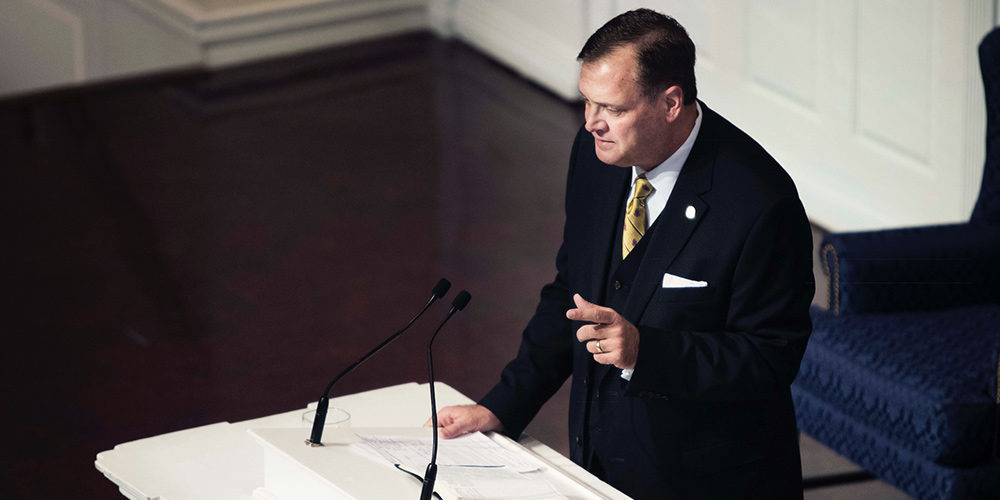
Earlier this summer, I published an essay on Al Mohler’s book The Gathering Storm. This week, Mohler published a reply, but not a response.
As a reminder, here was the thesis statement of my essay:
The inherent difficulty I see in Mohler’s attempt to position contemporary evangelical social activism as an across-the-board opposition to secularism is not in the substance of his positions on these issues. I love Western civilization, for all its warts, and I give ground to nobody in my militancy for the historic evangelical positions on all these issues. The problem I see is twofold. In the short run, evangelical social activism that defines its agenda solely in terms that serve the political Right lacks the spiritual credibility it would need to stand as a real alternative to secularization, and Gathering Storm moves it in the wrong direction on this front. In the long run, evangelicals have not seriously confronted the hard theological questions that any Reconquista from secularization would demand, and Gathering Storm helps them avoid doing so.
Mohler is not, of course, obligated to reply to me or anyone else. We are all very busy these days – seminary presidents especially, in this tumultuous moment for educational institutions. And, lest I position myself as judge of my own case, I dare not rule out the possibility that my charges against Mohler are not even worth replying to in the first place.
But if he does choose to reply, one would love to hope that Mohler would feel obligated to include in his reply a response to what is in the essay.
Mohler is free to repeat “unchecked secularism will destroy us!” until he is blue in the face – I said the same thing, as I have consistently over a twenty-year writing career – but what good is that if our current approach to fighting secularism is, as I charge, not only incapable of success but actually a major factor reinforcing secularism?
While I continue to await a response, I contemplate afresh my essay’s closing thought:
You would never guess this from his prolific political commentary, but Mohler punches his timecard every Monday morning as the president of one of America’s biggest and best seminaries. His school trains thousands of church leaders whose tireless and unglamorous work holds back the collapse of the liberal social order—not by prosecuting a culture war, but by shoring up the social conditions of individual moral virtue, institutional integrity, and community solidarity as shepherds of their congregations. That never-ending rearguard action of holding back the tides of decay needs to become a constructive mission of building a new culture of neighbor-love.
But seminaries are in big trouble these days. Even before the current public-health emergency, they have struggled to respond to huge changes in their economic landscape. Judging from results, and recognizing the imperfection of all our endeavors, it looks to me like Mohler must be doing something right at Southern Baptist Theological Seminary. I doubt it has much to do with political commentary. I’d love to know what it is.
I hope Mohler’s next book ends with an appendix on seminaries, not courts, as the vital-but-vulnerable institutions that desperately need to be saved from destruction for the sake of both the church and civilization—Western, or any other kind.
I continue to hope so.