This essay on Hayao Miyazaki’s evaluation of Japanese culture is fascinating. Fascinating, that is, provided you know Miyazaki – if not, drop what you’re doing and go find out!
It’s interesting to me seeing confirmation that Miyazaki is a believing animist. This only deepens my appreciation of the extensive continuities between Christianity and the higher paganisms. While the overlap with other “world religions” like Islam or Buddhism comes in formal thought – ethics, philosophy, even theology – the overlap with something like animism comes in the narrative. Consider Princess Mononoke: The world is under a curse; the great spirit is killed by men, yet also can’t be killed, because he is always all around us.
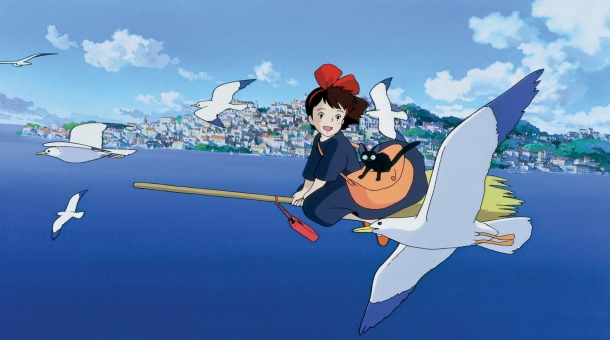
Miyazaki says his goal is to draw people’s attention away from fantasy to what is real. This is a deeply ironic statement when you think about the fantastic content of his films, yet the more I think about it, the more sense it makes. The real point of My Neighbor Totoro is not forest spirits and magic trees, but two little girls whose mother has cancer. The real point of Kiki’s Delivery Service is not the broomsticks and black cats, but a thirteen-year-old girl who needs to find her purpose in life. The real point of Princess Mononoke is not the gods and demons, but the tragic fact that human beings can neither transform nature nor refrain from transforming it without killing a part of their own humanity. It is very much the real world Miyazaki wants us to live in.
Trying to get us to see the real world is, I suspect, the goal of all religious people who are engaged with culture. The very considerable cultural edification produced by Miyazaki’s films might very well be classified in the “first they must convert to serious paganism” file. Shame on us that there’s no Christian Miyazaki.
Even more interesting, though, is his analysis of what ails Japan. He describes what he sees as a vast distortion of desire; the opportunity to use technology to shape desire has been used to alienate children from what is real:
The desires of many—if not most or even all—Japanese children, Miyazaki believes, have been hollowed, stretched, inflated for the false, and, thus, deflated for the true. The beauty of woman for man and man for woman, especially, has been supplanted by the cartoonish, pornographic, robotic, and monstrous. This is what he meant when he called animated films “the source of the downfall of a people.”
But although Miyazaki has never fully extracted himself from his Marxist past, he does not (as so many tiresome people do) equate this distortion of desire with capitalism and place his hope in central planning. Quite the contrary, his hope is exactly where it should be – in entrepreneurs who take the opportunities that only capitalism provides and use them to produce a better culture:
His animism may explain the content of his films, but not necessarily his approach to film craft. His criticisms of Japanese culture and the manga industry offer a better starting point. The largest problem facing the manga industry is that the people running it are anime fanatics, known as otaku in Japan. These “sickly otaku types,” as Miyazaki called them, were reared on manga and Japanimation, and developed an inordinate desire for them—their shape, scale, motion, symbols, and narrative tropes. Such children, “locked in [manga’s] own enclosed world,” became illustrators themselves, reinforcing the enclosure. With their arrival in the industry, characters became boxier, eyes ballooned, and, to be frank, breasts grew larger. The expressiveness of the manga industry was further attenuated, a cycle that cheapens and thins the general taste of Japanese society. These otaku, “raised amidst the clamor,” Miyazaki said, “probably can’t be the flag bearers for new images.”
To bear “new images,” to make films that liberate, the filmmaker must himself be liberated, free of the customs of the genre. That’s why Miyazaki frequently stresses that he does not “watch film at all” and describes his own career as an ongoing effort to escape the yoke of his great forebear, Osamu Tezuka, the father of manga, creator of Astro Boy, and Miyazaki’s greatest influence. That’s also why he strongly urges that, if an illustrator is to spur audiences to seek and love the world, he must himself be filled with its riches. That is, he must gain an intelligent understanding of it by cultivating “a constant interest in customs, history, architecture, and all sorts of things.” Otherwise, he “can’t direct.” And if he doesn’t have time to study, he must “look carefully at what is right in front of [him].” If he fails to do so, no matter what he makes, “it turns out to be a film we’ve seen somewhere, or something we’ve seen in manga.”
Verily, freedom and economic development create opportunities for people to distort their desire. But to contract freedom and development would only deliver us into the hands of an elite formed by that cultural decay, locking in the distortion of desire, freezing in place the present decadence. The solution instead lies with those who not only make responsible use of their opportunities, but inspire others to follow them in doing so (“to spur audiences to seek and love the world”).