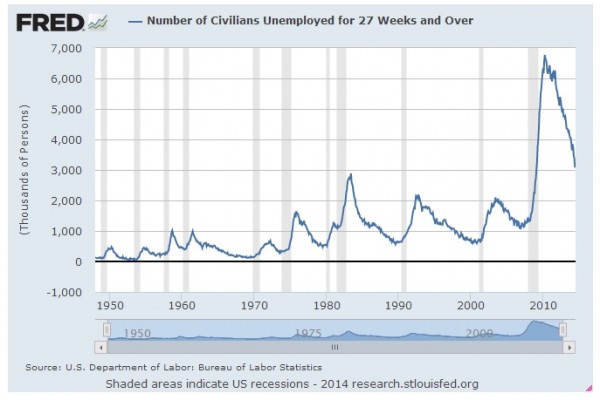
It is conventional wisdom on the right that extending the period of time people are eligible for unemployment insurance (UI) just keeps them from looking for jobs. They stay on UI as long as you let them, and once UI runs out they go look for jobs. The evidence adduced for this is that unemployment rates among UI recipients go down significantly right after the benefits are cut off – regardless of when you cut off the benefits.
So my eyebrows were raised by this post from James Pethokoukis arguing that cutting off UI does not really get people back into jobs. He looks at evidence that the UI recipients disappear from the ranks of the “unemployed” after benefits are cut off, not because they found jobs, but because they gave up looking for work. Transitions from unemployment to jobs appear to be unaffected one way or the other by UI. What is affected by UI is the transition from claiming that you are looking for work (which you must, to be eligible for UI) to admitting you’re not.
To the extent that this evidence is reliable (I’m not qualified to judge) it certainly tells against the idea that we can promote work by yanking UI benefits. On the other hand, I’m not sure this is evidence we should extend UI benefits, either. Pethokoukis seems to think so, but on his own showing, there would seem to be a substantial number of people who are only on UI to milk it as long as they can. Does it make any sense to pay people to claim they’re looking for work if they’re not?
The real takeaway, in my mind, is that the solution to joblessness has nothing to do with safety net programs one way or the other. In the short term, we need to cultivate and encourage entrepreneurs; in the long term, we need universal school choice to revolutionize the education system. Let’s set a fixed term for UI and not monkey around with it, so we can focus our attention and energy on clearing away the obstacles to work.
Don’t miss this insightful conversation about why many militant secularists seem to be unable even to understand what the fuss is all about when they demand that businesses, schools, etc. operate on purely secular terms. Among much else, Jonathan Haidt’s social psychology of morality is invoked – correctly, I think – to explain how secularists lack the necessary mental apparatus to make sense of our claims to religious liberty because the ideas are simply absent from their social context.
Also important is the point that the institutional environment that forms these militant secularists doesn’t fully practice what the secularists preach. Often they welcome open discussion of ideas. And I would add that the higher up you go on the ladder of prestige and social importance, the more this is the case. This is relevant because, however many horror stories we may hear about totalitarianism at third-rate colleges, the people who actually run the institutions at the top of American civilization are not formed in such places. At Yale I never encountered any attempt to prevent me from fully speaking my mind on account of my belief in God and my insistence that he was relevant to political science, and I can only remember one occasion on which there was such an attempt to silence me because I was conservative. That’s actually a pretty good track record of openness and real pluralism!
This point is important, I think, for reasons we canvassed early in the history of Hang Together, in the form of a spirited debate between Dan and myself. (See here for my view; I let Dan have the last word – for the time being – here.) The question at hand boiled down to, are they always malevolent, or could they sometimes be ignorant?
I think Haidt’s work on the social psychology of morality, and other factors, would lead me now to say that this dichotomy is too simple. There are large spaces in between the merely ignorant and the purely malevolent. And the militant secularists are probably mostly living in those spaces.
I just watched a special online “backers screening” of Wish I Was Here, the new Zack Braff movie that I dropped $40 on through Kickstarter. Wow, I can’t tell you how glad I am that I helped make this movie happen without any interference from the morons who run Hollywood. Admittedly, it’s a little rough around the edges in places. But I’m actually glad it is. Part of the point of the movie is that we have to learn to love people who are more than a little rough around the edges.
This is not just another movie about death, love and responsibility. Religion looms large in this movie, in a way that the morons who run Hollywood never would have permitted. Technically the religion is Judaism, but what they’re dealing with in WIWH isn’t really Judaism in any important sense, either as a specific religion or as a specific cultural phenomenon. With one exception, which I’ll get to later, Judaism is only on the screen to represent religion in general.
This is a movie about people asking big questions. Why do people matter? Why does it matter what we do? Religion is one of the things at the center of the movie because religion claims to have answers. In the long run it’s the only thing that can plausibly claim to have answers. People like Zack Braff – excuse me, “Aidan Bloom” – have reached the point, in a way far too few of their parents’ generation have, where they see that if they seriously ask these questions, they’re going to have to confront religion.
What I love so much about this movie is that it’s brutally honest. Let’s face it, people can really be awful to each other. Sometimes it’s the people closest to us who are the worst. And it’s not giant, horrifying betrayals. It’s the little cuts, the little pinpricks in our skin, day after day, year after year, never relenting.
You know what this movie made me think of? Just two days ago I re-read an old passage from C.S. Lewis where he’s talking about the challenges of defending the gospel in the modern world. One of the points he makes is that the original preachers of the gospel could take it for granted in all their audiences, whether Jews, “God-fearers” (Judaizing Gentiles) or Pagans, a sense of sin and personal unworthiness. Modern man, Lewis comments – especially the “proletariat” – has been so thoroughly petted and flattered and catered to that he is more self-satisfied than perhaps any class of people in history. They are sure, Lewis writes, that whatever is wrong with the universe it cannot be themselves.
Then he makes a striking statement: “I have sometimes thought that it might be necessary to re-convert men to serious Paganism before it will be possible to convert them to Christianity.” Of course he doesn’t mean this literally, but there is a depth to this statement that sticks with you.
That’s what this movie made me think of. Not that “convert to serious Paganism” is the lesson of the movie. There is, in fact, no lesson to the movie as such. It’s not the kind of movie for lessons. It’s a brutally honest story about people who are suffering and choose to do the hard thing and love an unlovable man, and that’s it.
But there’s a lesson in that, too. It’s not a formally religious lesson, and yet the movie does, in a sense, take its shoes off on the holy ground.
And that one exception I mentioned earlier? Alone among all the generations of her family, the preteen daughter really believes. She chants a prayer before doing something scary, tells her bewildered and uncomprehending mother that “I think God is testing my faith.” She, like everyone else on the screen, has growing up she needs to do. But she becomes more, not less, religious as she does so.
Her name is Grace. But I’m sure there’s nothing to that.
Two generations ago, it would have been the grandfather who had real faith. One generation ago, no one on the screen would have had real faith. Today it’s the daughter. Who will it be a generation from now? Don’t think they’re going to stop asking why people and what they do matter. The questions get bigger, not smaller. That’s another lesson of this movie.
Which opens in the big cities this Friday, then expands. Go see it if it’s playing where you are. It’s a beautiful movie, in more ways than one; worth seeing on a big screen.