Ten Reasons Joy Brings Christ to Our Culture

JFTW

The Crossway blog recently posted my “Ten Reasons Joy Brings Christ to Our Culture,” based on my forthcoming book (which you can totally buy now, thanks for asking):

10. It gets people with their guard down. People are naturally wary of canned gospel presentations, political agendas or “Christian cultural impact” campaigns. They’re not wary of joyful people.

9. It offers an alternative to lust, sloth and gluttony. The joy of God rips people out of their selfish fantasy worlds, and gets them off the couch and doing something meaningful with their lives.

8. It offers an alternative to pride, greed and wrath. The joy of God casts out the fear and guilt that drive people to build fortresses of misery around themselves.

7. It liberates people from worldly enslavement. People who have the joy of God can’t be controlled and manipulated by systems of sex, money, and power.

6. It reveals new possibilities for our lives. The renewing of our minds by the Word and Spirit reveal how the world really works, showing us things we would never have dreamed of on our own.

5. It changes our priorities. You can’t address cultural problems like financial chaos, family breakdown and cutthroat politics unless you have people who care more about doing what’s right than about doing what’s easy or makes us feel good.

4. It makes us responsible. People with the joy of God want to be good stewards of all that comes under their care, and pass on a flourishing world to the next generation.

3. It reconciles Christian cultural influence with religious freedom. You can’t Christianize people with the power of the state ; the only way to genuinely influence culture for Christ is to get people to want what we have.

2. It’s good training for the New Jerusalem. Sharing the joy of God will be the whole basis of our cultural life.

1. It’s the miraculous work of the Holy Spirit in us. Why show our own cultural efforts to our neighbors when we can show them God’s?


Christian Humanism and Religious Liberty

Today TGC runs my review of Joe Loconte’s God, Locke and Liberty: The Struggle for Religious Freedom in the West. In that review I focused on what the popular reader will get out of the book, and that is a lot. But I want to stress that scholars of Locke, historians of early modernity and specialists in religious liberty will all find much new and interesting material in the book for them as well. Loconte has studied both the primary texts and scholarly literature on the emergence of religious freedom carefully. From the primary sources, he brings forth a good deal of material that has been mostly (but, I admit, not entirely) neglected; in reviewing the scholarly literature he uncovers patterns and makes important connections that specialists will want to think about. Check it out.

Religious Liberty . . . Is It Compossible?

Realm of the Compossible

Bryan McGraw has a good post at The Federalist on the future of religious liberty. He’s more pessimistic than I am about some aspects of the situation, but he points us back to an important philosophical question that precedes how we think about religious liberty issues. Are our rights “compossible”?

Implicit in many of the strong denunciations of the Arizona bill (and other similarly structured efforts) is the belief in compossibility: if you think that it is morally impermissible for people to discriminate on the basis of sexual orientation, it won’t really matter that laws that follow this sort of moral claim will tread on religious liberty rights.  Our rights here are of a piece and if we think we perceive a conflict among them, we are in fact mistaken and should adjust our perceptions forthwith.

It does no good, then, for those looking to protect the consciences of religious believers in these sorts of cases to simply advert to claims for “religious liberty” and expect the argument will carry through.  Religious rights, like any other right, are not absolute—as Bill Galston has been wont to say, there’s no religious liberty for (human sacrificing) Aztecs—and for those who are looking to shift our society’s conceptions here, they will merely cry “discrimination” and let loose the lawsuits.  The fact that such a move might have pernicious effects on other liberties they value won’t occur to them until long after this fight is done…

Things in this regard do and should look bleak for religious conservatives, but only so long as we are playing on the field of compossibility, so to speak.  Fortunately, compossibility is not actually true—our rights do not all fit together in one neat package and claims in favor of one person or group sometimes means a loss for others.

I would add that it is not only opponents of laws like the one that was vetoed in Arizona who presuppose the “compossibility” of rights. Most advocates also presuppose this.

Indeed, they presuppose it more strongly than their opponents, because the compossibility of rights is the whole reason they view things like the wedding-cake case or the HHS contraception mandate as ominous portents. I have seen many people ask: How could you possibly think that your religious liberty is at risk because a tiny group of people (religiously scrupulous business owners) are encountering this challenge? No one is contemplating barging into your office and ripping the crucifix off your cubicle wall. Didn’t the business owners put themselves in a position to encounter this sort of difficulty when they decided to operate a “public accommodation” in a pluralistic society? So aren’t they the only ones at risk? If rights are not compossible, this line of reasoning might make some sense. But if rights are compossible, the right to order businesses to do these things implies a huge contraction of religious liberty rights that has much larger implications.

So if McGraw is correct that rights are not compossible, we have less to worry about than we might think we do. But is he correct?

I think there are two different senses in which we might ask the question “are rights compossible?” If we ask the question philosophically, we are really asking “are rights in principle compossible, such that any time two people make rights claims that imply conflicting accounts of rights, we know that at least one of them must be wrong?” In this sense I think rights are compossible.

What is a right, in principle? You may take Thomas Hobbes’ view and say that a “right” is nothing more than an assertion of privilege with no basis other than your own self-interest. In that case, rights are clearly not compossible. But if you take the view that has predominated from the high Middle Ages onward in both Christian and non-Christian philosophy, a “right” is a claim that it would be morally wrong for someone to do something to you. You rights are correlative to other people’s duties, and their rights to your duties. If we take this view, when we ask if rights are compossible we are really asking if all human moral obligations are compossible. Could the same thing both be required and forbidden in an ultimate moral sense – by God, or the natural law, or the categorical imperative, etc.? I say no, and I don’t see how you do any sound moral reasoning without that presupposition.

But we might ask “are rights compossible?” in a functional sense. In this case, we are really asking “are rights as we are able to recognize them in practice by law and policy compossible, such that if any two people make rights claims that imply conflicting accounts of rights, we know that law and policy cannot accommodate both?” In this sense I see no reason why rights need to be compossible. As I have argued:

All the arguments that compromise is impossible seem to rest on the presumption that America will inevitably be forced to adopt a neat and tidy marriage policy that is logically consistent, morally justifiable and produces no absurd and contradictory outcomes. I would love to live in such a world, but as a practical matter I see no grounds for the presumption that we actually do live in such a world. “But when such-and-such happens, government will be forced to choose where it stands on such-and-such.” No, it won’t. Politicians and lawyers (including judges) are actually pretty good at having their cake and eating it too. The end result of the conflict over marriage may not be a tidy, coherent policy that makes sense and is morally justifiable. In fact, I’d place a long bet that it won’t be.

I’m not sure which sense McGraw has in mind when he says rights are not compossible. However, most of his analysis is centered on what we can expect to happen in the near future rather than on what the ideal religious liberty policy would look like, so in terms of his larger point – don’t panic, the world is messy and the rejection of this law doesn’t imply that these rights won’t be protected going forward – I agree.

The “Let It Go” Problem

Elsa in the light of day
Like millions of little girls across the country right now, my daughter loves to sing “Let It Go,” the big power ballad at the center of my new favorite movie. A lot of people who love Frozen are very anxious about the cultural influence of this song, which has become a huge kids’ smash; some people who agree with me that Frozen the movie is a positive influence are actually saying that the overall impact of Frozen the media property will be negative, because the damage done by “Let It Go” will outweigh the good done by the movie from which it comes.

The problem in a nutshell is that “Let It Go” embodies the cult of self-expression that the movie is subverting, and when the song is removed from the context of the movie and sung without irony, it can actually encourage the cult of self-expression. “No right, no wrong, no rules for me!” sings Queen Elsa. In the context of the movie, when Elsa sings this, it is the first step toward the death of her sister. But now we have millions of little girls running around singing “no right, no wrong, no rules for me!” and it’s not at all clear how many of them have internalized the message of the movie. And if you read what people are writing on the web, while I think there’s a strong case to be made that the overall impact of Frozen on the culture has been very positive, there’s no question that some people are adopting “Let It Go” as an anthem of self-expression without appreciating how the story of Frozen as a whole undermines Elsa’s point of view.

First let’s step back from “Let It Go” and say something about the general problem of which this is a specific case. The general problem is that cultural artifacts do not interpret themselves; they require a culture within which they are interpreted. As a result, each individual cultural artifact can only do as much positive (or negative) work as the culture within which it is situated allows it to do.

Here is an extreme example that illustrates the point with shocking clarity. When the movie Schindler’s List was in theaters, the Washington Post carried a story about a high school teacher who took his class to see it, hoping they would learn some powerful lessons about evil. But several of the boys in his class took nihilistic delight in watching the Nazis slaughter Jews – when the camp commandant started shooting prisoners at random from his window, they shouted things like, “Pow! He got him! That’s so cold!” Etc. They reacted this way not because they were fascists or anti-Semites, but simply because they had been conditioned to experience movies about people murdering each other as an opportunity for recreational enjoyment.

“Let It Go” is not at that extreme, but I can see why people are concerned about it. Still, I think the comparison puts things in perspective. In a culture that is in so much trouble that even Schindler’s List can be an occasion of evil for some audiences, it is simply too much to expect that any positive cultural artifact will not affect some people negatively. Indeed, the more trouble the culture is in, the more we should expect this. Thus, as the need for good cultural products rises, so does the extent to which we should expect to see them abused.

The appropriate conclusion, I think, is that we should not be too troubled by the abuse of “Let It Go.” This is the price you pay for releasing a cultural product of any kind into a chaotic culture.

In the particular case of “Let It Go,” there is something that makes the real value of the artifact even greater, while increasing the likelihood of its abuse. This is the ambiguous nature of the song itself. Objectively, this is a strength, not a weakness. As I’ve written before, what makes Frozen so powerful is that it acknowledges the individual’s legitimate claims to dignity, justice and freedom. Because Queen Elsa is fleeing from real injustices, we are right to feel good that she is finally free – even as the deadly seed of willfulness is mixed into her celebration.

This is what makes the movie’s confrontation with the cult of self-expression real and costly. Frozen is not subverting a cardboard caricature of the cult of self-expression, but the real deal. It shows us that cult at its most appealing, not at its least appealing, before taking it on. And this is why Frozen is such a triumph.

A fact worth knowing: from all the interviews and information available on the web, it’s pretty clear that the makers of this movie made major changes to the story after the songwriters turned in “Let It Go” and everyone in the room realized they had something really unique on their hands. The details of the accounts vary, but it appears that Elsa became a more three-dimensional character, and much more sympathetic, after “Let It Go” was written. That makes sense – if you only look at the lyrics and don’t hear the music, you might think “Let It Go” was sung by a two-dimensional villain. Maybe that’s what Elsa was when they handed the songwriters this assignment, and the songwriters did too good a job letting her have a real human voice.

Because that, in the end, is what makes “Let It Go” so powerful, and the power of “Let It Go” is what makes Frozen’s subversion of what “Let It Go” stands for so powerful. People in real life are not movie villains, who have all the wealth and privilege in the world, but won’t be satisfied with anything less than global domination. They suffer, and often they suffer unfairly and unjustly. They turn to evil not out of megalomania but simply because they want dignity, justice and freedom, and see no other way to get it. As the song “Fixer-Upper” tells us, Elsa’s choices are not extraordinary but very ordinary. This is what human nature does when natural love relationships (especially in the family) are obstructed.

And what about my daughter? I sat her down and talked it over with her. I explained that Elsa says and does some good things during the song (“like making Olaf!” she exclaimed) but she also says and does some bad things. After we talked and I reminded her of where “Let It Go” leads in the story of the movie, she understands. So now she sings “Let It Go” and I don’t worry, because she knows that “no right, no wrong, no rules for me!” was a bad thing for Elsa to say.

The deepest failure of the culture is not that there’s a lot of bad stuff out there. That’s a symptom. The real failure is that parents don’t know what they believe and why they believe it, watch what their kids watch, and talk to them about it. If we did that, the bad stuff wouldn’t matter as much, and in a generation it would fade away because our kids would grow up into people who don’t buy the bad stuff.

But, for the moment, we don’t do that. All the more reason we need Frozen, “Let It Go” and all, to help us remember to be that kind of people.
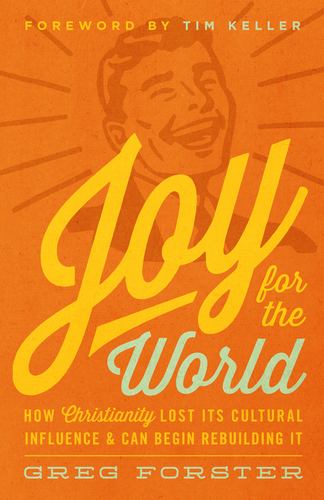
JFTW at TGC

JFTW

Today, TGC carries an interview with me on my new book, Joy for the World, which releases in about a week. Here’s a taste:

You need organizational Christianity—most fundamentally the local church, but also all the other kinds of institutions committed, as institutions, to advancing Christ. These are the only places where the special work of the Spirit in the hearts of believers can fully reach expression in shared life—where we can have koinonia that permeates the rhythms of the organizational culture and shapes our rules and policies. We need these places to ground us and to equip us, and also to carry out certain special functions the mission of Christ requires.

But that’s not where people live most of life. Most of life takes place in a culture we share with unbelievers, and if we’re not building people up to practice discipleship and spread the joy of God in those places, we’re mostly wasting our time. By definition, organizational Christianity can’t carry the joy of God into those structures of culture outside the church; we need a mode of Christian cooperation that’s more organic, something that subsists in our relationships and personal interactions rather than formal institutions.