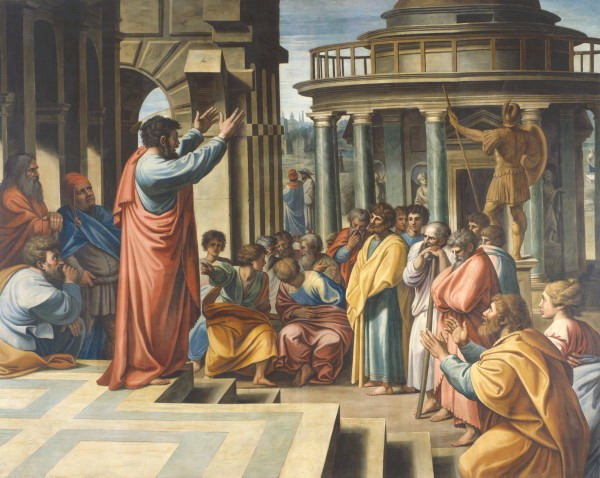
A Case of Just Prerogative

virtue of Prudence


Prudence depicted as a martial virtue (HT)

When I wrote last week about how the president’s monarchical attempts to “fix” his health care law raise the question of just prerogative, I knew that to illustrate my point fully I really ought to provide an example of the just use of prerogative, preferably from the same president’s administration. But I was writing in a hurry and couldn’t think of one off the top of my head. I have just found the perfect example in this article on the topic of the president’s contempt for the law, by the always-interesting Kevin Williamson.

In a similar vein, President Obama refused to cut off foreign-aid funds to the Egyptian government, though he is required by law to do so in the event of a coup d’état, which is precisely what happened in July in Egypt. It might be embarrassing for the president to punish the Egyptian military and the grand mufti of al-Azhar for their overthrow of the unpopular Mohamed Morsi, but the law does not make exceptions for presidential embarrassment.

Three points:

1) Williamson seems to suggest that the president was wrong to continue aid to Egypt after the coup, even though the new regime is actually preferable to us compared with the Muslim Brotherhood, solely for the sake of adhering to the law. This strikes me as precisely the sort of case where just exercise of prerogative is warranted. The law that we must cut off aid after a coup is a good and useful law as applied to most circumstances, because we want to reward just and legitimate governments while distancing ourselves from tyrants. However, in this case the coup was actually overthrowing a tyrant; applying the law here would undermine its very purpose.

2) If the decision to keep aid flowing to Egypt had been announced transparently as an exercise of prerogative, rather than by engaging in some legerdemain over the definition of what counts as a coup, we would all have been better off. The legislature would have had to take that as a clear occasion to either back the president (if only implicitly by doing nothing) or pass a law to overrule him. Either way, the exercise of prerogative would have been more clearly reconciled with the rule of law, because the legislature would have been put in the position of making the final decision. And the public would have gotten an education in the just power and limits of prerogative, which might have come in handy right about now.

3) Most importantly, Williamson’s article demonstrates Locke’s point that the consistent abuse of executive authority delegitimizes the prerogative power even when rightly used. Williamson chronicles a long list of monarchical power grabs by the executive branch under this administration. It is no wonder he is not inclined to trust the administration to exercise its judgment about when to apply the law and when not to. Executives need that trust; bad executives forfeit it, to everyone’s detriment.

What Is Just Prerogative?

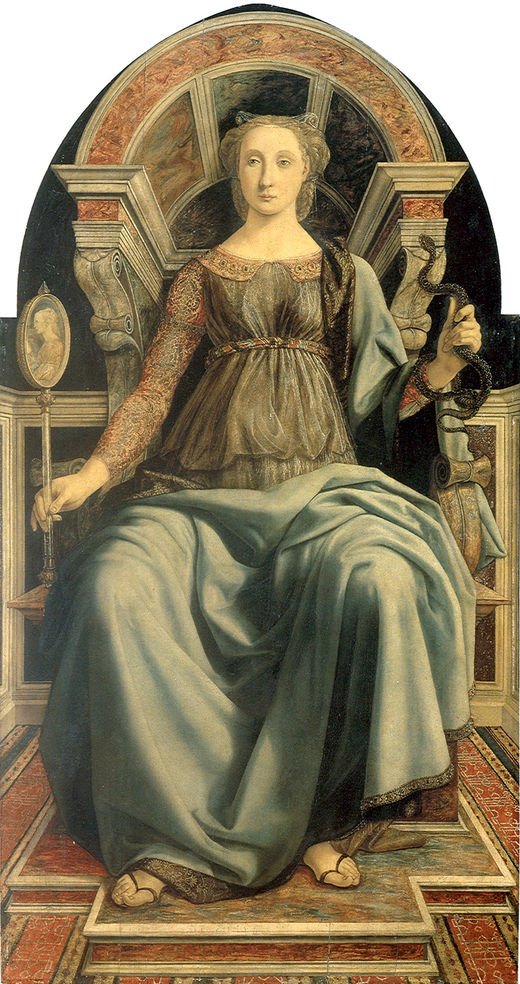
Prudence by Piero del Pollaiuolo

Prudence, by Piero del Pollaiuolo (HT)

Lots of digital ink being spilled over Obama once again “fixing” (i.e. altering) the law simply by decreeing that it shall be so. He does this a lot, and his critics are right that this is an essentially monarchical exercise of power. As Montesquieu argued, the essence of monarchical and aristocratic government is the discretion of the rulers to act differently in different cases, both because they are trusted to do so (that is the presupposition of this type of government, after all) and because they are restrained by a predominant “spirit of honor” in the culture, which limits the socially acceptable exercise of their discretionary powers. By contrast, the essence of democratic and republican government is precisely the expectation that officials will not have a broad latitude to judge what justice requires in each case; to preserve the nature of this type of government they must make decisions in accordance with fixed, stable and transparent rules. This is made possible because a “spirit of virtue” in the culture restrains public behavior sufficiently that officials need not exercise moral formation over the public quite so proactively. In the one case officials are moral tutors to the public; in the latter case the public is the moral tutor of the officials.

But it does not therefore follow that all such acts are wrong case by case, even in our republican government. In fact, government officials informally rewrite the law every day through the way they interpret and apply the law; in a surprising number of these cases they actually avoid doing what the law plainly requires, simply because doing what the law requires in that particular case would be dumb. And far from being challenged, when the result of these decisions is that dumb applications of the law are avoided, people praise the officials for their “common sense.”

John Locke – who was nobody’s squish when it comes to watching like a hawk against abuses of executive authority – makes a powerful case for this discretion, which he calls “prerogative power.” In fact, the written law cannot anticipate every exigency. Rigid enforcement of the law without prerogative tends to create dysfunctional systems of behavior that grow over time, ultimately overwhelming the original law itself. (Locke points to the problem of “rotten boroughs” as an example; interestingly, the authors of the Federalist cite the same example.) And while Locke was a constitutional monarchist, I think this case establishes the necessity of prerogative power for republican and democratic government as well. As all the great constitutionalists have observed since Aristotle, a well designed government cannot be purely of one form, but must mix institutions of both democratic and aristocratic tendencies to succeed.

Ah, but for anyone who wanted to rely on this to justify the president, there’s a catch. Locke argued that prerogative could only be legitimate where it is “manifestly for the good of the people.” That is, it must be clear to the public that you are deviating from the letter of the law for the public’s own good. Locke seems to think that the public will not have difficulty discerning when the executive is acting for the public good (and thus using his just prerogative) and when the executive is substituting his own will for the law, putting himself at war with his people.

In this way, prerogative is much like civil disobedience. You are sticking your neck out by defying the law and claiming that it is legitimate to do so. The only way to do this and maintain the rule of law is if you agree to abide by the consequences. For the civilly disobedient, this means submitting to punishment. For the executive using prerogative, it means abiding the judgment of the community. If your defiance of the law is not clearly for the public good, the community has every right to take corrective action.

One of the most important barometers of sincerity is whether the executive is willing to work with the legislature to craft a remedy in the law, so that prerogative power will no longer need to be exercised. The president’s unilateral rewriting of the heath care law looks particularly bad in this regard, because even as he is purporting to “fix” the law by fiat, he is openly opposing all efforts in the legislature to actually fix the law.

Thankfully, the American founders have bequeathed us a constitutional republic in which we have many options for reining in a willful executive without resorting to the armed rebellion that was, too often, the only practical recourse against kings. I predict we will be needing these options more and more in the coming generation.

No Seastead Is an Island

seastead

In a fascinating article about the perennial attraction of some people to the idea that the U.S. Constitution “has failed” or “is obsolete” and needs to be rewritten, Kevin Williamson mentions that Peter Thiel “is involved in sea-steading, a plan to create autonomous free-trade cities in international waters. Google’s Larry Page pines for ‘safe places’ to experiment free of government interference.”

I must confess that the idea has always held a certain fascination for me as well. It need not involve a radical, total separation from existing society; in fact it probably would not. Right now, the costs of medical care have been so outrageously inflated by bad laws and regulations (all of which, ironically, are intended to expand access to care) that for a while now some companies have actually been paying employees to travel to places like India to receive major surgeries. How hard would it be to buy a surplus aircraft carrier and hang out a shingle twelve miles from Los Angeles? Everybody wins. Okay, okay, maybe they don’t sell aircraft carriers on the secondary market – although they should. But you get the point.

The serious seasteaders, though, don’t strike me as the modest type. They’re rationalistic techno-futurists. So it’s worth noting serious limitations on the possibility of creating your own utopia in international waters.

If anything is clear in the history of political philosophy, it is that civil communities that take up only a small geographic area cannot accommodate a wide latitude for diverse moral viewpoints and practices. People confined to a small space come into conflict with one another more frequently, and the consequences of conflict are higher because getting out of each other’s way is harder. It is simply in the nature of things that small communities must share a much higher degree of moral agreement about what is good, right and fair in human life. Larger communities can accommodate more diversity simply because it is easier to get out of one another’s way on a day-to-day basis; the level of conflict is low enough that it is easier to create political, legal and economic systems where less is taken for granted about how much we agree.

This, in case you have forgotten, is the whole point of Federalist 9-10. It is also the whole point of The Merchant of Venice; in spite of Venice’s proud boast that its laws treat all people equally, the law must actually be animated by a particular moral view, so enforcement of the law necessarily excludes other moral views. And in a city as small as Venice, a Shylock cannot simply be dismissed by the court; his continuing presence in the community is an ongoing threat to public order. He must be crushed – left with no alternatives but to submit to the dominant worldview or flee.

All this becomes much clearer when you think about the practical challenges involved in a seastead. How will conflicts be resolved? What’s the political system? With so few people in such a small space, I can see only two real practical alternatives. The optimistic scenario is that the seastead is created by a community that had a strong shared value system before they embarked for international waters; in this case, the specific process for resolving conflicts is less important because in practice conflicts will always be resolved according to that shared value system, whatever the process. Social legitimization would demand it. The less optimistic scenario, which unfortunately is the one more likely to occur in real life, is that the seasteaders – influenced by the rationalism of techno-futurist ideologies – believe they can write a set of clear, rational rules that will make the correct resolution of conflicts plain. All they need then is a relatively simple quasi-court system to enforce the rules. In real life, such a system will lead to major conflicts relatively quickly, because it is not in the nature of justice to be reduced to a set of clear, rational rules that can be written down. The conflicts will be absolutized because each side of the conflict, influenced by techno-futurist rationalism, will believe that the other side is irrational and illegitimate. The likely outcome would be, in effect, the dictatorship of a charismatic leader.

In short, seasteads can’t be independent of real, morally “thick” communities. They could work if they brought their community with them from the shore, to provide shared meanings for the moral terms that their rules must enforce. If they are set up as a flight from community, they will have what political philosophers have always recognized is the only form of government possible without community: tyranny.

Conversion Illustrated

A succinct synopsis

“A succinct synopsis”

Check out this amazing story-in-pictures over on TGC. An Emmy-winning illustrator shares her journey from “angry atheism” to Christianity – and shares the drawings she made of God before, during, and after her conversion. This line knocked me right down:

Gradually, cloud-god’s fierce brow started to soften. And then he became empathetic. He delighted in me. He grieved with me. And I guess it was not really cloud-god that was softening.

Don’t miss it.

Joe Carter and Kermit Gosnell

areopagus

I really appreciate this candid post from Joe Carter on the conundrums of the public intellectual – or, to use his terms, the “influence-seeker.” A lot of what he’s saying resonates with my own experience. And he raises the deeper problem of what counts as influence:

I’ve said and written things that have been seen and heard by millions of people…Yet if I assessed the level of influence I gained from appearing on those venues I would rank it from negligible to non-existent. When readers and listeners folded the newspaper, closed the magazine, and turned off the radio they completely forgot about my message.

Joe points instead to “regularity and rapport” as “the two keys to influencing hearts and minds.” That’s something you can achieve only with a much smaller audience – more on the level of 150 people than millions, he suggests.

There’s something to that. Yet there are other forms of influence that don’t rely on regularity and rapport. In the Kermit Gosnell case, a relatively small set of people forced several major national media outlets to begin covering the trial. Given the way it happened, it seems likely to me that this episode will have at least some lasting impact on the way the media covers that type of trial; once you’ve been shamed into doing something, and even into admitting that you’re being shamed into doing it, you’re not going to want to be put in that position again. Now, this handful of bloggers, tweeters and columnists – all of them obscure names outside their own religious and political circles – did not have to establish regularity or rapport with the editorial team of the Washington Post in order to move them. Nor did they reach millions of people and start a grassroots rebellion. What they had to do was say the right thing in the right way at the right time, and do so with just enough publicity in the right places that they couldn’t quite be ignored.

Think about it this way: Whose disapproval did these reporters and editors fear?

  • Not their personal acquaintances. Each of them no doubt has a circle of something like 150 people with whom they have real personal relationships, but virtually nobody in those circles would have objected to their failure to cover Gosnell. Quite the contrary, they were much more likely to be made intensely uncomfortable or even positively offended by the decision to cover.
  • Not their reading or viewing audiences. This is the “millions of people” Joe talks about. The previous generation of Christians and conservatives (two different groups but with much overlap and many parallel concerns about the direction of the culture) would have placed a great deal of stock in the virtue of the masses. The way to move an institution like the Washington Post was to appeal to the readers. Today we know better. I think it’s very unlikely that more than a handful of the readers/viewers were objecting to the failure to cover the trial, or would have objected even if they had continued not to cover it.
  • But there’s a third group: their profession. Reaching out beyond the 150 people they personally know but long before they get to the millions of people they write and speak for, there is a group – probably in the thousands – of people who have invested their sense of identity and motivation for work in the idea that they are “truth tellers.” Here is the lever that moved them. Yes, most journalists are not personally inclined to prefer coverage of the Gosnell trial; that’s why there was no coverage as the trial began. But these same journalists have invested in an identity, and they will apparently act to protect that investment, even against their own more immediate preferences.

And professions are not the only intermediate locus of influence between the personal circle (which is small but over time can be moved with great force) and the teeming millions (which is large but normally can’t be moved much at all). Thinking in terms of these intermediate loci is central to the new conversation about culture change that’s going on simultaneously in both evangelical and conservative circles.