As I write this, I am sitting in the waiting room as my daughter has major surgery. She is, of course, in the Lord’s hands, and it is at times like this I am most grateful for the joy of Calvinism. But the Lord uses means to accomplish his ends, so I have much more to be grateful for – and much more tangibly – than just his immediate, unknowable work in my heart or his equally unknowable superintendent providence of all events.
Many of his means for accomplishing his ends, probably most of them, involve the mediation of human culture. Two of these means are particularly standing out to me with new clarity as I sit here awaiting news that will be life-changing, either for better or worse.
The waiting room is teaching me that the reserves of American character are surprisingly deep. I am sitting in a crowded room full of people who all have every reason in the world, right now, to think of no one but themselves. (The woman next to me just heard that her daughter’s heart is stopped.) Moreover, in this place the selection biases of race, class, political party, etc. are mostly removed; if anything, the neighbors with whom I am now confined in close quarters, all of us waiting together for our life-changing news, are disproportionately different from myself and from one another. And I am really surprised – perhaps it doesn’t speak well of me – that everyone here is so manifestly good. It is not simply that people who don’t even know each other and are not superficially like one another and have problems of their own to think about are looking out for one another, it is that they do so with such casual frankness and unselfconsciousness. To be good to one another seems to be the most natural thing in the world. Just now someone sitting across from me said to someone else, “thank you for helping, I couldn’t do this without you.”
That does not happen by accident; it is not the natural state of humanity. To train people to be (humanly speaking) good requires a certain kind of culture, one that is difficult to build and just as difficult to maintain. And it is well known among us professional character-mongers that America’s sources of character are declining. More than most people in this line of work, I have assimilated all the worst diagnoses from the most pessimistic sources. There is no argument for despair that I have not heard – indeed, examined at some length.
But you know what? American culture has a way of defying pessimistic expectations. We social scientists can never quite stop selecting on the dependent variable – we look for signs of hope or decline in the places where signs of decline are more visible than signs of hope. We expect the sources of tomorrow’s strength to be the same as yesterday’s sources. But yesterday’s sources are always in decline – that’s just how it is in the fallen world. Meanwhile, in the places where we’re not looking, entrepreneurs are inventing new sources of cultural strength and vitality. The signs of decline are always right where you expect to find them; the signs of hope spring up in the last places you expect.
The subject of entrepreneurship brings me to the other cultural means of God’s providence that I’m grateful for. Before we sent our daughter into surgery, I signed a piece of paper that effectively gives the doctors permission to do whatever they want to her. Yes, there are laws about malpractice, but if you know anything about hospitals you know that they know how to protect themselves from liability. Sure, there are plenty of big jackpot malpractice verdicts, but how much are the malpractice verdicts really related to the merits of the cases? As important as civil justice is – and you will not find any more ardent advocates of it than myself – only a fool would trust his daughter’s life to it.
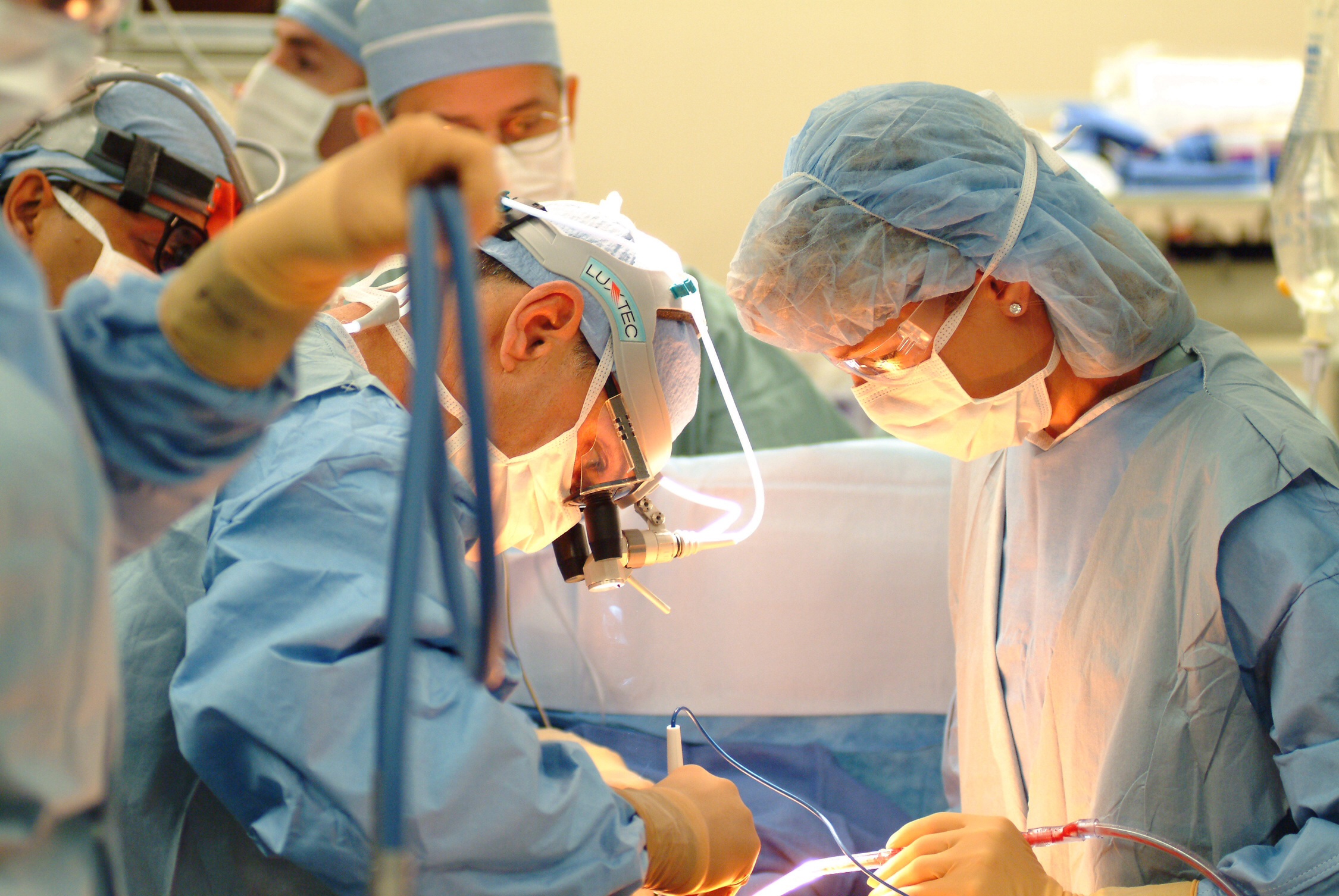
What I’m trusting my daughter’s life to is the professional ethic of the medical staff. This morning, in a short space of time, I met pretty much everyone who’s going to be working on my daughter today. I was really amazed – again, it may not speak well of me – at how obviously these people care about getting everything exactly right and taking the best possible care of my daughter. I feel not the slightest doubt in trusting my daughter’s life to these people.
But my daughter’s life is not just in the hands of the American work ethic as she goes into surgery. As we drove here this morning, her life was in the hands of the work ethic of assembly line workers in car factories – not just the people who made our car but the people who made every car on the road. When we slept in the hotel last night, her life was in the hands of the work ethic of the housekeeping staff, whose diligent labor alone stands between us and whatever germs were brought into that room by all its previous occupants. My daughter’s life is in the hands of the American work ethic every day, and so is mine and so is yours.
Once again, this is not the normal, natural state of humanity. It is difficult to build and sustain a culture in which people feel a sense of moral responsibility when they put bolts into car parts or change bedsheets. It requires an institutional environment in which people are allowed to be stewards of their own lives, so that they are able to understand themselves as responsible moral agents; more fundamentally, it requires an entire cultural environment that makes the concept of stewardship and its responsibilities plausible. Without all this, you can’t build civilization above subsistence level – which is why scraping by at subsistence level is the normal, natural state of civilization.
And once again, all the obvious signs – the signs we social scientists are likely to read – are of a decline in the work ethic, yet sources of hope are springing up all around us in places we don’t know to look.
Charles Murray ended his recent book with four reasons to expect the American experiment in responsible freedom to end in the coming generation, and four reasons to think it might not. One of his reasons for hope was simply that time and again in its history, America has inexplicably bounced back from existential catastrophe. “Inexplicably,” that is, to social science. To those who understand the entrepreneurial spirit, America’s persistent refusal to accept our invitations for it to expire is less inexplicable.
It is even less inexplicable for those who understand the work of the Holy Spirit, who has been the deepest source of the culture of responsible stewardship and entrepreneurial creativity.
The Lord does not owe us success, and perhaps what I’m seeing in the waiting room today is the last delicate fruit of a tree whose roots have already died. But “hope does not put us to shame,” and hope is not just for the eschaton. Hope means God is at work now, today, and thus we can be (rationally, realistically) hopeful about our temporal fortunes. Despair is a sin – it denies that God is in control. And as Scott McCloud once said, if there’s a 99% chance of total disaster the only rational response is to focus all our attention on the remaining 1%.
Update: She’s out of surgery and everything went perfectly. Praise God!