
How the World Challenges the Church for Cultural Leadership

job

Last week I used Job as an example of how the church challenges the world for cultural leadership. Job describes how he was a cultural leader before he was stricken by the adversary’s plagues. He says that people looked to him as a source of wisdom (i.e. as a cultural leader) because he served the needs of those around him – especially the poor and the marginalized.

But the question might be asked: why then is he no longer a cultural leader after he’s stricken? In fact, as soon as he comes under attack the whole culture turns against him. In last week’s post I was looking at chapter 29; most of chapter 30 is about how Job is now laughed at and despised. Here’s a small sample: “And now I have become their song; I am a byword to them. They abhor me; they keep aloof from me; they do not hesitate to spit at the sight of me.” (v. 9-10)

The answer, of course, is that human culture in a fallen world is always hypocritical to some extent. Every culture affirms moral norms of behavior that it wants people to follow; because of God’s common grace, those norms mostly align with God’s natural revelation of moral goodness to humanity. They never align completely with God, and in some cases they go far astray; the alignment that Paul famously observes in Romans 2 is only a general pattern. And (as Paul goes on to observe) every culture fails to actually uphold even the imperfect standard it sets for itself. In a fallen world there is never a “Christian culture” in the sense of a culture that can be simply identified with Christianity. There are cultures that are highly influenced by Christianity, and cultures that explicitly profess allegiance to Christianity. (They are not always the same cultures!) But no culture is simply the same thing as Christianity.

In Job’s case, the culture appears to have had a Pharisaical approach to the relationship between virtue and prosperity. It is one of the broad, overarching themes of scripture (especially in the wisdom literature) that in general and on the whole, virtue leads to prosperity. Affirming this pattern as a general truth is usually necessary to preserve our doctrines of creation and providence; without it we tend to lapse into a Gnostic dualism that views the material world as evil. However, some cultures Pharisaically raise this general correlation between virtue and prosperity into an absolute law; those who are not prosperous must be unvirtuous.

There is, alas, no cure for this condition until Christ returns. A Christian life must necessarily bring us into conflict with human culture in some respects, and there will always be people ready to pounce on any opportunity to stigmatize and marginalize the church. Part of the struggle for cultural leadership is accepting this and lamenting it without resenting it.
How the Church Challenges the World for Cultural Leadership

JFTW

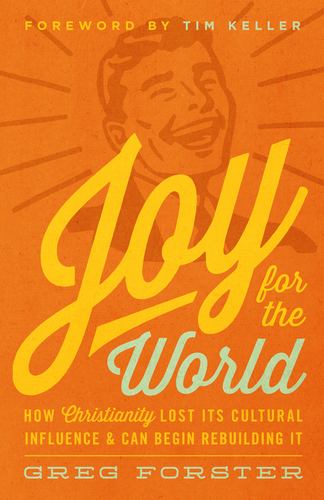
In my forthcoming book I argue that Christianity can and should be a leading influence in human culture. We do this not by seizing control of the institutions of culture and imposing Christianity on people by force, but by acting as cultural entrepreneurs.

A good example of what I mean can be found in Job 29. This passage follows the famous passage on wisdom in chapter 28, which is one of my favorites in all scripture. I had never paid close attention to chapter 29, though, until the other day when I realized what was going on in that chapter. The ESV editors label the passage beginning with chapter 29 and running through the rest of Job’s discourse as “Job’s Summary Defense.”

Job begins the passage by lamenting for the social position he held before his downfall:

“Oh, that I were as in the months of old,
as in the days when God watched over me,
when his lamp shone upon my head,
and by his light I walked through darkness,
as I was in my prime,
when the friendship of God was upon my tent,
when the Almighty was yet with me,
when my children were all around me,
when my steps were washed with butter,
and the rock poured out for me streams of oil!
When I went out to the gate of the city,
when I prepared my seat in the square,
the young men saw me and withdrew,
and the aged rose and stood;
the princes refrained from talking
and laid their hand on their mouth;
10 the voice of the nobles was hushed,
and their tongue stuck to the roof of their mouth.
11 When the ear heard, it called me blessed,
and when the eye saw, it approved,
12 because…

Let’s stop there for a moment. Before he was stricken, Job was a cultural leader. People looked to him for wisdom. And the word “because” in verse 12 indicates that he’s about to tell us why people looked to him for wisdom. Was it because he was smarter? Was it because he was wealthy and successful? No doubt those factors were important, but Job does not identify them as the main source of his cultural leadership. Instead, he points to something else:

12 because I delivered the poor who cried for help,
and the fatherless who had none to help him.
13 The blessing of him who was about to perish came upon me,
and I caused the widow’s heart to sing for joy.
14 I put on righteousness, and it clothed me;
my justice was like a robe and a turban.
15 I was eyes to the blind
and feet to the lame.
16 I was a father to the needy,
and I searched out the cause of him whom I did not know.
17 I broke the fangs of the unrighteous
and made him drop his prey from his teeth.

Job was a cultural leader because he served human needs. The connection is reinforced in the following verses, where Job seamlessly transitions back from his deeds of service to his position of cultural leadership. “Men listened to me and waited and kept silence for my counsel…” etc.

We become cultural leaders not by seizing control of institutions but by inventing new ways of serving human needs and proving that they work better than the anti-Christian alternatives. We are able to invent new ways of serving human needs because the Spirit has empowered and equipped us in unique ways – through the revelation of the Bible that gives us “inside information” about how the world works, and through the transformation of our hearts and lives. When Christians and Christian institutions serve human needs better than secularists and anti-Christian institutions do, people stop looking to them for leadership and start looking to us.

The Nation-State Or . . .

west_europe_13th_century

While I pick my teeth out of the carpet from Bat-Dan’s vicious counterpunch (Zapp!! Bamm!!! Sockk!!!!) do yourself a favor and read Bret Stephens’ absolutely brilliant column for this week:

Rather than waste time and money on a fruitless diplomatic brawl, Prime Minister David Cameron should say he’s prepared to relinquish Gibraltar to Spain—on just one condition. That would be a declaration by the Spanish government that it will renounce its own claims to the cities of Ceuta and Melilla, which lie opposite Gibraltar on the northern coast of Africa…

Of course, Madrid couldn’t just turn over Ceuta and Melilla without asking Morocco to readjust its own territorial claims…

Stephens traces a bewildering array of territorial disputes sweeping all the way down from Britain to central Africa and back up through central Europe and over to Greenland and beyond. Once you start to unravel the nation-state, where do you stop?

The Riddler and the Samaritan

Riddler_(Batman_1966_TV_Series)_005Good Samaritan

AEI just released a health-care proposal that reminds me of my great Riddler debate with Bat-Dan over the legitimacy of transfer programs. The plan would (my summary):

  1. Abolish barriers to direct, multi-year contracts between insurers and individuals so that every individual can buy an insurance policy that a) reflects that person’s needs and b) is priced to that person’s real risk. In my own, non-expert opinion, I think you would get almost all of this accomplished simply by abolishing barriers to interstate commerce in health insurance. Congress is clearly authorized by the Constitution to pass a law allowing people to buy their insurance from a company in any state, and once you have that you just need one state to adopt this sensible policy of allowing people to buy the insurance they want – which quite a few states would want to do in order to attract the business. I’m really amazed no major politician has had the wit to make that the centerpiece of health care reform.
  2. Eliminate the arbitrary and deeply wicked IRS practice of exempting employer health policies from taxation, but not individual policies. My understanding is that U.S. law does not require this distinction, but the IRS adopted the practice in the 1940s and has never reconsidered it because it serves powerful interests. This practice effectively treats people as slaves of their employers by implicitly institutionalizing employer ownership of employees’ bodies. It must stop.
  3. Use the revenue from taxing all income equally (instead of arbitrarily exempting employer health policies) to subsidize poor households to buy health insurance in the market created in step 1, above.

Henry Olsen and Brad Wassink outline the program on NRO today, correctly defending the presence of some subsidies for the poor in terms of “the dignity of the individual.” (They call the belief in the dignity of the individual “conservative,” which is problematic, but that’s another topic.) The proposal itself explains why the dignity of the individual justifies some subsidies, describing what they call The Samaritan’s Dilemma: our most basic human and social values compel us to rescue those in imminent danger, yet the knowledge that we will step in to rescue leads the more marginally functional people to tempt fate. They become poor stewards of themselves, counting on the rescue party they know is always waiting in the wings.

A moderate safety net program is better for everyone than having people constantly showing up in the ER demanding rescue. As I said to Bat-Dan: “While we might envision a system where we wait for people to be on the brink of death before government helps them, it’s in everyone’s interest to introduce rules and regularity (a rescue-on-demand system would be subject to all kinds of arbitrary abuse).”

Your Words Are Written

jobLeaf by Niggle

Here’s a follow-up on Job and work. Last time I compared Salieri (drawing on an illustration from Tim Keller’s book on work) to Job. I made the point that God uses our toil and frustration for his own purposes, even though we can’t always see how. Job’s suffering had an important purpose – to vindicate the goodness of God before all cosmic witnesses – but he was never permitted to know that purpose. I would add that while Job was probably not a real person, it’s difficult to avoid feeling that the inclusion of this story in scripture becomes, somehow, an extension of that purpose. The very line between fiction and nonfiction is blurred, and the sufferings of a fictional person gain meaning beyond anything he could have imagined, for they reach into the real world and establish a witness for God in time-space history.

This morning I stumbled across this passage in Job 19 (verses 23-27):

Oh that my words were written!

Oh that they were inscribed in a book!

Oh that with an iron pen and lead

they were engraved in the rock forever!

For I know that my redeemer lives,

and at the last he will stand upon the earth.

And after my skin has been thus destroyed,

yet in my flesh I shall see God,

whom I shall see for myself,

and my eyes shall behold, and not another.

My heart faints within me!

For centuries, Christians have marveled at this ancient proclamation of the gospel – not only the redeemer-mediator, but a redeemer-mediator who is both human and transhuman (he is transhuman because he “lives” even though he is not in the flesh, yet he is human because in his time he will come in the flesh) and a personal, bodily resurrection and restoration to face-to-face fellowship with God.

But what caught my attention today is the first part of the passage:

Oh that my words were written!

Oh that they were inscribed in a book!

Oh that with an iron pen and lead

they were engraved in the rock forever!

The editors of my Reformation Study Bible comment: “Job has an important message that he wants permanently inscribed for posterity. Through the inspiration of the Spirit his words are preserved for all time in the Bible (c.f. Mark 14:9).”

Think of that! Job, in crisis and perishing, cries out for the opportunity to write down the gospel somewhere where it can’t be erased. He survives his ordeal, lives the rest of his life and dies without knowing why God inflicted such sufferings on him. Though he is restored to health and wealth, and (more importantly) repents of his doubts about God’s faithfulness, he never learns the true purpose of his suffering: Through the very torture of his flesh and spirit, he was at that very moment engraving the gospel into a rock that can never wear away.

In his book, Keller draws on J.R.R. Tolkein’s story “Leaf by Niggle,” where an artist is frustrated in his desire to bring his artistic vision to fruition. When he reaches heaven, he finds that the tree he had been trying to paint is there. Keller tells us that through the toil and frustration of our work, we should remember: “There is a tree.” I’m leading a book group at my church through Keller’s book, and that statement has resonated with some of the people in our group more than anything else. We keep coming back to it – “there is a tree.”

There’s a tree for Job, too, and for us.

Tree image by Alan Lee