Christianity, “Conservatism” and “Capitalism” (Again)

economicvaluessurvey

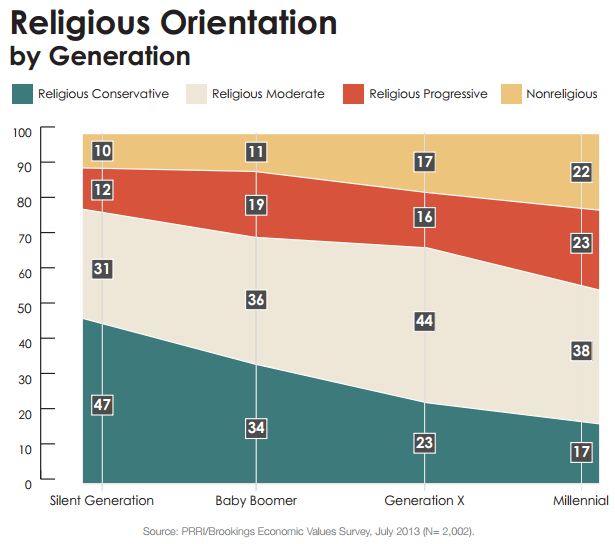
Lots of attention for Brookings’ Economic Values Survey. Left-leaning media outlets are crowing about the declining numbers of people who self-identify as religious conservatives, particularly among young people. As the above chart shows, the decline is driven not primarily by a leftward shift in American religion but by the exodus of young people from self-identified “religious conservative” populations into a “non-religious” identity. This is once again the rise of the Nones, a topic we’ve discussed before here on HT.

Which is not to say there’s been no leftward shift at all. George Weigel points out that evangelical institutions of higher learning are starting to follow both the secular and the Roman academy on their “trail of tears” toward “a sojourn into a new wilderness” of socialistic claptrap, trading their entrepreneurial birthright for a mess of redistributionist pottage.

In an excellent post, Josh Good makes the case for long-term optimism, partly because the teachings of Christianity really do align with the entrepreneurial mindset and the spirit of enterprise, rather than with the endless growth of the nanny state. I agree. Good also appeals to the greater cultural integrity of conservative denominations as against progressive ones; that’s true as far as it goes, but the question is whether those conservative denominations are going to remain “conservative.”

One strategic problem we’re going to have to wrestle with is the very language and concepts of “conservatism” and “capitalism.” The economy built on enterprise, entrepreneurship and opportunity cannot survive if it is something supported only by one side of the political spectrum. (In saying so, I’m only following the lead laid down by Charles Murray and others.) So the identification of that economics with “conservatism” is strategically problematic. Intellectually problematic, too, because the entrepreneurial economy is as much about progress (the advance of human flourishing) as it is about conservation. Hence the increasing number of self-identified “progressive” intellectuals and celebrities who embrace free enterprise, at least in principle, as the best way to accomplish their goals.

Also problematic is the word “capitalism.” Thanks to a century of woolly thinking kicked off by Max Weber’s execrable book, large numbers of people insist that the word “capitalism” simply means an economy that runs on greed. I have heard them say so myself, numerous times. And most of the time they are not open to hearing alternative perspectives; if you challenge the notion that capitalism is a system that runs on greed, you are only a huckster for the system that runs on greed (or a dupe of its hucksters). “Free markets” and “free enterprise” have the same problem, though less severely. “Freedom” still resonates to some extent, particularly with evangelicals if you can show the links between religious freedom and economic freedom – but it also raises suspicions that need to be allayed. “Entrepreneurial economy,” “spirit of enterprise” and “opportunity” seem to open doors, and I expect we’ll be using more of that language in the years ahead.


Hope for Marriage at TGC

Marriage

Today TGC carries my latest article on marriage. I argue that the recent Supreme Court decision did not change the cultural situation, but did display it with new clarity:

As the court’s decision shows, the movement for same-sex marriage is seamlessly integrated with a cultural narrative that labels the gospel as evil. If that narrative becomes institutionalized, doors and hearts will close against the gospel across America. The Lord will build his church, of course, but part of how he builds his church is through our cultural engagement. In fact, the way we participate in these kinds of debates can itself be a magnificent witness for the gospel. Let’s not lose that opportunity.

In addition to advice about changing our strategy, which you may recall from previous articles, I add a point about treating all disordered desires the same:

We should reorient our thinking to treat all disordered sexuality on the same terms. In the area of sexuality, people with homosexual desires have the same basic problem as everyone else. All of us have disordered sexual desires. Some men desire other men; some men desire women whose bodies have been grotesquely mutilated by plastic surgery. I see no reason to think the former sin is more evil than the latter sin, and I see much reason to think the latter is much more widespread than the former.

Meanwhile, lower courts are already jumping on the opening the Supremes have given them. A federal district court in Ohio says the state is required to recognize same-sex couples as married even though Ohio law says otherwise. The Supreme Court did not require this conclusion, but it laid down a very clear path that lower courts could follow to reach it. They are now doing so.

Fox News v. Reza Aslan – Whoever Wins, We Lose

Lauren-Green-TML

For crying out loud! I was working on what would be the best way to communicate the absurdity of both sides in the Fox News/Reza Aslan dustup, and Timothy Michael Law goes and beats me to the punch. First read this, then this, then add derisive laughter and/or wails of despair (to taste).

Backfill, as far as I can make it out:

  • Aslan wrote a dumb book about Christianity. (Now there’s a sentence you never thought you’d read!)
  • Fox News attacked him, not because the book is dumb, but because Muslims aren’t supposed to write books about Christianity.
  • Aslan defends himself by waving around his Ph.D. and bragging that he is a credentialed expert who has studied everything.

It’s like Aliens versus Predator – “whoever wins, we lose.”

HT Collin Garbarino

Job, Salieri and the Meaningfulness of Work

jobsalieri

The social scientist in me is delighted that Justin Taylor has posted a statistical analysis of “What Is the Longest Book in the Bible?” I have to disagree with his findings, however.

The longest book of the Bible is Job. Anyone who says otherwise hasn’t really read it.

Job is actually my favorite book of the Bible. I don’t often have a strong subjective sense of God’s presence, but I usually do when I read Job. It is as though God said: “You want to talk? Okay. Let’s really talk.”

I thought of Job again today as I was re-reading Tim Keller’s new book on faith and work. In chapters 5-6, Keller points to the figure of Salieri in the famous book and movie Amadeus to illustrate several points about how the fall has affected our work. Salieri is gifted with a desperate thirst to make great music, and has not been gifted with the ability to do so. Instead, God gives this ability to the immature Mozart, who doesn’t have to work for his gifts and doesn’t even seem to appreciate the greatness of what he’s doing. After a lifetime of trying to bargain with God for the talent he feels he deserves, Salieri curses God for what seems like his capricious, even imbecilic distribution of talents. Keller uses Salieri to point to the fact that our work is meant to be fruitful (i.e. Salieri is right to want to make great art) but if we don’t do it in service to God it becomes pointless (both because the tide of history will ultimately wash it away, and because we will be frustrated with it ourselves even within our own lifetimes).

Here’s what made me think of Job. When I first began to wrestle with Job, I asked myself: Why did Job have to suffer? The first answer I came up with was: So we could hear this story and witness the goodness of God clearly vindicated against Satan’s accusations. At that time, being young in the faith and having been led in a somewhat fundamentalist direction in my assumptions, I took it for granted that Job must have been a historical figure. I know better now, but that first answer still seems right to me. I see it implied, at least, in the opening dialogue – not only implied in the content of the dialogue, but implied by the very inclusion of the dialogue in the story. Job was almost certainly not a historical figure, but the question “Why did Job have to suffer?” is still meaningful; it means “If this story were true (i.e. within the world of this story), why did Job have to suffer?” The answer is to vindicate God against Satan before all witnesses.

But Job himself is unaware of this. Job does not know why he has to suffer. He is called upon to trust God that his suffering is meaningful. So are we all, when we suffer, or when we see evil or the appearance of chaos in the world. A former pastor of mine once illustrated this with the statement: “I once saw a group of masked men strap someone to a table, knock him unconscious, cut him open and cut out his heart.” That is, he witnessed a heart transplant operation. But if you didn’t know what a heart transplant operation was or what good it accomplished, the partial description of it seems horrible.

Even when he confronts Job, even when he restores Job, God makes a point of not telling Job the reason for his suffering. That’s important – Job must repent without knowing why he suffered, and for that act to be meaningful, Job must still not know even after he repents. For a long time it felt to me like the ending to the story was just a little too pat, a little to deus ex machina (if you’ll forgive the expression). I see now that it isn’t. Yes, after he repents Job gets his wealth back and has lots of new children, but he never finds out why he suffered. Things are not really back to the way they were before the calamity hit him; they never will be, because he never finds out.

The difference between Job and Salieri, of course, is that Salieri curses God and Job does not. It is not often remembered that Job does not curse God. We focus on Job’s desire to bring a complaint against God; the Hebrew scholars say the text points to a legal complaint, i.e. Job wants to file a grievance against God if only he can find a court with jurisdiction to take the case. But if your neighbor’s tree falls and damages your house and he refuses to pay, you can file a grievance against him without cursing him. Part of the point of Job is that he does not curse God even though he believes he has a grievance. Job is rebuked by God for believing he had a grievance, but he is not condemned in the same way his false friends are – God even orders the false friends to let Job act as their mediator and make sacrifices on their behalf to restore them before God, indicating Job is accepted for a priestly role in which the friends have been rejected. It appears from the text that the story takes place during an era when God was accepting sacrifices from heads of faithful households; the false friends have apparently been deemed unworthy to sacrifice until Job’s mediation restores them.

This may seem trite to say, but the reason Salieri curses God when Job did not is that Salieri never really served God in the first place. He told himself he was serving God, he gave up all kinds of opportunities (for pleasure, for money) because he told himself he was serving God, but he was never really serving God. The first and most fundamental command of God’s law is “love me and trust me.” If you don’t obey that, you haven’t obeyed any of the other laws, either. Calvin pointed to this as the basis of all Protestant theology: You can’t get holy and then be declared just, as Rome holds, because until you’re declared just you remain alienated from God, and you can’t get holy if you’re alienated from God because the first and most fundamental law of holiness is “love me and trust me.” How can we love God – really love God, love him for who he is, love him disinterestedly – until we know he has taken us back?

In our daily work, we suffer and toil routinely. Keller’s book emphasizes that honest work is always meaningful in spite of our suffering and frustration. I would add that even the suffering and frustration itself has a purpose, even if we don’t know what it is. That’s one of the many lessons of Job.

Renewal of Hope on This Year’s Fourth

kaye-america-the-beautiful-660-80

Those of you who were present at the conception will remember my inaugural post on HT, which was about my experience watching Independence Day fireworks on Labor Day. I found much to be troubled about, but also good reason for hope:

Things didn’t start out too well, though, because when the fireworks began, our hotel began blasting “Born in the U.S.A.” …

So I’m sitting there, and while my six-year-old is dazzled by the fireworks, I’m starting to get really worried about whether there’s still an America worth saving for her. Sure, I can tell her what the fireworks are really about, but if she only hears it from me, it’s not a real national identity. If the hotel doesn’t play it, it’s not a culture…

The national anthem was played, but in instrumental only – no scanning of difficult 19th century poetry for us! Worse, they didn’t even play the whole frikkin’ song. They started it halfway through…

But about halfway through this, there was one song that, by itself, gave me all the confidence I needed and more. It was a song that convinced me America has as good a shot at sustaining its culture in the coming century as any country on the planet.

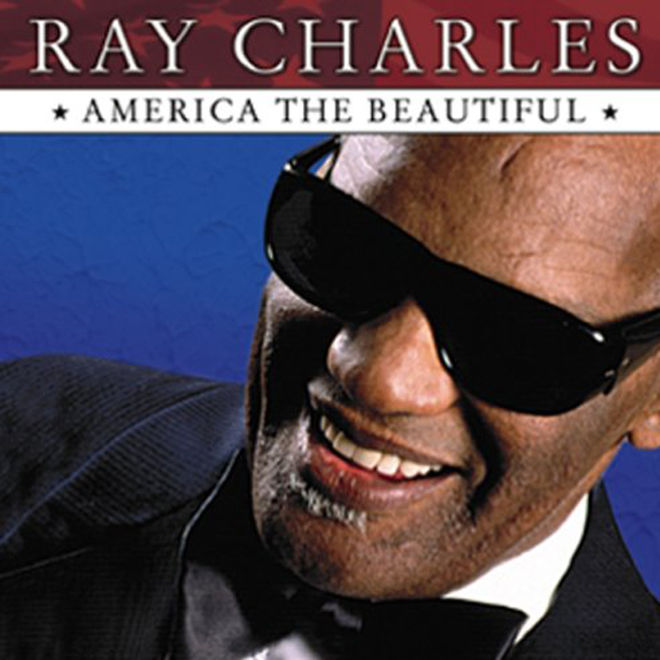
That was Ray Charles covering “America the Beautiful.”…Ladies and gentlemen of the jury, I defy you to show me any nation in the whole history of this world where that blind, black son of sharecroppers grows up to be Ray Charles….If it’s the good, true and beautiful you’re looking for, a country in which Ray Charles can grow up to be Ray Charles has a lot to offer.

Well, we were staying at the same hotel this year, and just to mix things up they held Independence Day on July 4. And it was a much more hopeful experience for the future of American culture.

Once again they started off on an unencouraging note – this year the fireworks opened to the tune of “Firework,” a catchy pop song that wallows in the worst excesses of expressive Romanticism. Its original performer, Katy Perry, is essentially in the business of marketing pornography to teenage girls. But after that, they pretty much switched gears.

What we got this year was a reasonably balanced mix of traditional Independence Day songs and more recent songs. They not only played the entire national anthem, they even played – get this! – Stars and Stripes Forever! The whole thing!

Another thing that gave me almost as much hope for our cultural integrity was the total absence of right-wing culture war songs. Last year’s “Red, White and Blue,” “American Soldier,” etc. just about screamed WE’RE LOSING OUR CULTURE! WE’RE LOSING OUR CULTURE! Strong cultures don’t play songs in which fidelity to the nation is presented as a contested cause to be championed. Strong cultures play songs so outdated and corny that you learned parody versions of them as a child. (“Be kind to your webbed-footed friends/’Cause a duck may be somebody’s moooooooother…”) If last year’s ceremonies were 90% weak culture and 10% strong enough culture to give me all the hope I needed, this year’s were more like 50/50.

And yes, once again Ray Charles slammed “America the Beautiful” out of the park.

As I said last year:

The old songs – even the national anthem – may well be past saving as central cultural products. But we can always make new cultural products. And we clearly have deep resources upon which to draw.

Turns out not even the old cultural products were quite as dead as I’d feared. God bless this beautiful country.