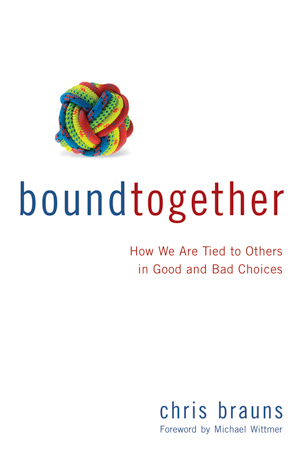
Read Chris Brauns’ Bound Together

boundtogethercover1

This morning, TGC runs my review of the new book Bound Together by Chris Brauns. I think readers of HT will find the book highly valuable on wrestling with the issues of national and political identity theologically:

One of the strengths of Bound Together is the way it draws together scriptural passages, wisdom from great Christian thinkers, and the latest scholarly analyses of the issues. Brauns reads much like C. S. Lewis in that he’s widely versed in all these sources and modest enough not to have much desire to be original. He masterfully pulls together the right quotes and passages in just the right way to help others come into a knowledge of these issues…

Beginners will find this an invaluable introduction, and those who have already studied this topic will surely discover new insight.

The chapter on political and civic problems stemming from our failure to understand the human person as a social creature is quite good. It’s aimed at a lay audience, but even an old hand like myself found it beneficial.

Part 2 of the New Fight for Marriage at TGC

20130313-082045.jpg

Part 2 of my article on a new fight for marriage is up at TGC this morning:

We need to stop imagining real marriage is like the Apple of 2013—assuming we are the dominant entity and our opponents are upstarts trying to displace us from our position at the top. We need to realize that today, real marriage is the Apple of 1984—we’re trying to break into a market completely dominated by our rivals and offer a radically different kind of product…

We know the truth about sexuality and can therefore describe it accurately. We can tell stories that make people say, “Yes, that’s the truth about life.” We cannot deliver the short-term comfort and pleasure they provide, but we can deliver the deep satisfaction and functional life that they cannot.

We must speak the truth about sexuality and romance in the language of sexuality and romance. This can’t be a special, private sexual language for Christians that others will need to learn. It must be a language that speaks to people in terms of their everyday experiences and doesn’t presuppose that you need to be Christian before you can have a humane understanding of sexuality.

There are so many more questions I didn’t have space to get to – like, “how do we actually make this transition?” – that I hope to return to the subject soon. Commentary, questions and challenges are very welcome as prods to better thinking, so open fire!

A New Fight for Marriage at TGC

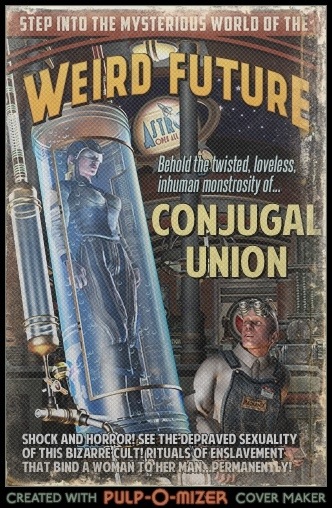
Conjugal union

Today, TGC runs part 1 of my two-part article on A New Fight for Marriage. Part 1 lays out the reasons I think the fight for marriage is currently on a losing track:

As Koppelman explains, all of Gergis’s talk about “conjugal union,” “coitus,” “reproduction,” and “the common good” comes across as obscure, irrelevant, and alienating. Koppelman shrewdly devotes chunks of his time to reading passages from Gergis’s book; he knows its descriptions of sexuality and marriage come across to the audience as bizarre. Even though the arguments are true—indeed, they are ironclad and unanswerable to anyone who accepts their initial premise—they are nonetheless driving people away from Gergis’s position rather than towards it.

To me, “conjugal union” sounds like some kind of cosmic phenomenon from Star Trek: “When the positronic wave signatures of the isotropic energy fields are aligned, they achieve a state of conjugal union.” “Spock, I’m a doctor, not a particle physicist!” Every time the leading advocates of marriage use this alien terminology, another young American goes over to the other side.

In part 2 I’ll lay out the first steps to what I think would be a winning strategy.

The HHS Mandate Is Like a Treasure, Hidden in an Obamacare Field…

Matt13_44

Joe Knippenberg finds a particularly valuable treasure hidden in an otherwise very unpromising field:

I’m reading NFIB v. Sebelius (the Obamacare decision) in preparation for teaching the case to my constitutional law students and came across the following most interesting passage in in Justice Ginsburg’s opinion: “A mandate to purchase a particular product would be unconstitutional if, for example, the edict impermissibly abridged the freedom of speech, interfered with the free exercise of religion, or infringed on a liberty interest protected by the Due Process Clause.”

Has anyone cited this passage in briefs challenging the contraceptive/abortifacient mandate?

FTW!

Riddle Me This, Bat-Dan!

Riddler_(Batman_1966_TV_Series)_005

Ladies and gentlemen, your regularly scheduled Hang Together blog post is being interrupted to bring you the following important message.

Na-na-na-na na-na-na-na,

na-na-na-na na-na-na

Na-na-na-na na-na-na-na,

na-na-na-na na-na-na

BAT-DAN!

We now return to your regularly scheduled Hang Together blog post. We apologize for the interruption.

Dan, I agree that things like this can be called “involuntary servitude.” And if this kind of blatantly unjust exploitation – the strong taking money from the weak and giving it to their friends simply because they can – were the primary activity of the federal government, I think we’d have no choice but to say that the state had crossed the line that divides a legitimate government from a criminal enterprise that masqureades as a government. (“With all that that implies,” as the guy from The Iron Giant would say.)

Kent Mansley

However, I’m not ready to go with you and say that 2/3 of the federal budget consists of involuntary servitude (“with all that that implies”).

1) Your comments on why people continue to support these programs if they’re involuntary servitude basically boil down to “they don’t understand what’s going on.” Well, I’m glad to see you’ve dropped your opposition to my earlier argument that elections are very imperfect as indicators of the public’s policy preferences. In fact, you’re now going much farther than I did! Doesn’t your position here imply that people aren’t responsible for their own voting?

I think people are more than well aware that entitlement programs are funded by taxes. If you want to take the position you do, you’re going to have to wrestle with the fact that almost no Americans are libertarians.

Ultimately, obedience to what we know to be right trumps popular consent. However, the presence or absence of popular consent is one of the critical components we need to factor in when judging what is right. Before we label the entire modern state a system of slavery, let’s notice that it arose and it continues to exist because it is what people want. That does not by itself justify the system, but it makes it much harder to call it a system of slavery.

I’m not saying there aren’t problems here, I’m just asking you not to paint with so broad a brush.

2) Your thought experiment on “making the programs voluntary” shows the weak point of your argument, I think. Is it your position that if a government collects taxes coercively, that government does not exist by consent? You see the problem. If you answer yes, you’ve eliminated the possibility of legitimate government. If you answer no, my response is “then why do you describe the modern state as involuntary?”

3) I disagree with your view that moral consensus only relates to prudential questions rather than the question of what government has the authority to do. This goes to the heart of government by consent of the governed. Where does legitimate authority to govern come from if not from the consent of the people (within the bounds of moral law)?