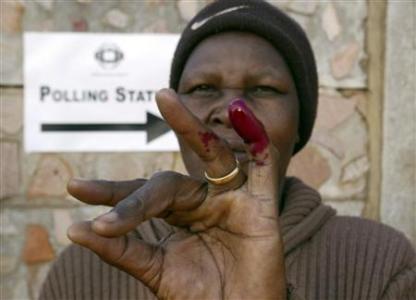
A voter in Zimbabwe’s rigged elections, 2008 (Reuters)
Jay Nordlinger, in a post entitled “We the People” (including quotation marks), argues that this election is finally placing a clear choice before the American people:
For some Republicans, it is never the people’s fault. I’ll tell you what I mean: If the Republican nominee loses, it’s always because he ran a lousy campaign. Couldn’t communicate. Made tactical blunders. Etc. I say, the electorate always has a clear enough choice. Sufficient information. . . . This year, the electorate has a very clear choice, not least when it comes to economics. . . . You can’t force people to save themselves, or their country. If they don’t want to — they don’t want to. In a democracy, people get what they deserve (or at least a majority does). Republicans often say, “The Left controls education from kindergarten to grad school. They dominate the movie industry. The news media. Entertainment television. Popular music. Everything except talk radio!” Okay — and if you think that, do you have any right to be surprised when the people vote Democrat? The 2012 election, I think, is not so much a test of Obama or Romney as a test of the people. There is a clear choice, with two very different candidates, each an excellent exponent of his view. Whatever the outcome of the election, the people will be responsible for that outcome.
I affirm Nordlinger’s urgent desire to remind us that voters have real agency. There is a disturbing trend among some social scientists to dismiss elections as mere legitimizing rituals that have very little impact on the behavior of the state. That theory doesn’t survive an encounter with the facts. Just to take the single clearest example, the elections of Margaret Thatcher and Ronald Reagan were indispensable to western victory in the Cold War.
Yet Nordlinger’s understanding of what elections are and how they work is inadequate. This, too, would not survive an encounter with the facts. Indeed, I think it is precisely in reaction against this sort of oversimplication that some social scientists overreact into the opposite oversimplification.
If I recall from my grad school days correctly, research finds that over 80% of voters (something in the lower 40s for each party) form a party preference early in life and vote for that party with few changes throughout life. You can explain that in terms of good behavior – people figure out early what their basic values, principles and aspirations are, and identify with the party that represents those; or you can explain it in terms of bad behavior – voters form party allegiances for essentially non-rational reasons and then rationalize their votes based on whatever arguments their parties supply. What I think you cannot do is attribute all agency and therefore all responsibility to the voters. Regardless of how much you see the stability of party preference as the result of good or bad behavior, their partisan consistency reflects the reality that what choices the electorate is presented with when it goes to vote is largely determined by forces outside the electorate’s control. For example, the electorate did not vote to change the economic direction of the country in 2008 partly because that option was not on the ballot.
The other forces constraining the electorate’s responsibility fall into roughly two big classifications, both of which are dismissed by Nordlinger. One is the choices of the parties and campaigns themselves. The other is the ability of non-electoral cultural institutions (“education from kindergarten to grad school . . . the movie industry. The news media. Entertainment television. Popular music.”) to control how we describe our reality and thus to control what options are within the bounds of socially defined legitimacy.
But setting aside the claim that the electorate is always responsible, periodically we get elections, like Thatcher and Reagan, where the electorate is really in the driver’s seat. When it comes to 2012 I think Nordlinger’s point is well taken. Here we really do have “a clear choice, with two very different candidates, each an excellent exponent of his view.”
Take a look at that woman voting in a sham election in Zimbabwe and be thankful we really do have the right to choose our rulers.