Why can’t we all just get along? Oh wait.


red blue

On a recent flight, I listened to a very outdated podcast of This American Life, one that detailed relationships that were broken by, wait for it, political affiliation. Ruined friendships, family members who won’t speak to each other, colleagues alienated in the workplace, even – my favorite – a woman denied entrance into a hiking club, all by political differences. The stories were exaggerated forms of experiences we probably all find familiar – being told that we “just don’t understand” the other side’s position on X, or having the conviction in a conversation that your interlocutor must seriously be missing a frontal lobe to believe some of the cant they’re spouting. (I mean, let’s be honest. It’s not just the other side.)

Fine, it’s normal. But the radio program was, I think rightly, lamenting the fact that disagreements over policy could wreak serious havoc on real, committed relationships, with the implicit question of “why? Why should this matter so much?” Why, indeed? Why should politics – the ideology or actions of a distant politician, usually within the Beltway, doing their thing – get in the way of my 15-year-long friendship, or cause such tension with my sister-in-law?

I think that asking that question actually betrays a certain statist—fine, one might say “liberal”—bias. Why, you ask, have we become so deeply entrenched in our red or blue commitments? Why are our differences, once a hallmark of the American spirit, now so insurmountable? Well, duh, if you put the state into every aspect of life, your colleague’s political opinion – and vote – does represent a threat to your own way of life. If the state is going to have its hand not just in roads and defense but in vaccines and phone records and kindergarten curriculum, the stakes of any political disagreement – especially with those you consider allies – are extraordinarily high.

So, dear NPR, if you want to bewailour intractable political fighting, perhaps you’d better reconsider running to Washington every time something needs change. Maybe, in order to have the freedom to disagree, we’re going to need a little bit of freedom to do things on our own.

Military Benefits

In the middle of the moral consensus discussion between a Homosexual, an Amish man, and a Presbyterian Pastor, the Department of Defense issued guidance granting benefits to those in the military in homosexual marriages. This creates the perfect segue into an important discussion on consensus as it relates to civil moral liberty.

On the surface, the decision by the DofD seems like one made out of respect to equality and liberty, both of which are protected by the constitution and other similar civil rights documents. However, in the arena of moral consensus, one must be careful to distinguish between liberty and advocacy. The DoD actually gave rights and benefits to homosexual marriages that the heterosexual marriages do not have, such as a 10 day ‘honeymoon’ break to get married. In its actions, the DoD also granted rights to homosexual marriages, marriages which are still illegal in 37 states. In other words, the DoD gave legal rights and financial reward to those who break the law of their state. The DoD is not simply protecting liberty and equality, they are advocating for homosexual marriage.

The problem with Legal Advocacy of one person’s rights is that in the arena of moral consensus, this advocacy impedes on the rights of another group. For instance, if the government states that a person may not speak against homosexuality because doing so would violate the rights of the homosexual, the government is thereby restricting the free speech rights of the other person. It is an issue of liberty to state that people may be homosexual. After all, the US government is not a sexual police force. On the other hand, decisions which seek to promote or advocate for homosexuality often impinge upon the freely held opinions of those believe homosexuality to be immoral. One would be shocked if the US government began advocating for abortions instead of simply allowing them, but the larger culture seems to be okay with the US government being pro-gay, forgetting that justice is supposed to blind and impartial. In many ways, the US government is not content to simply protect the liberties of homosexuals but feels it must actually advocate for them. When a child in a public school is told they cannot speak against homosexuality but may speak against Christianity, that is advocacy which violates another’s liberty.

So how should the DoD address homosexual marriages which do exist in the military? There is actually a fairly simple solution. Military (and other legal) benefits should be available for financial dependents. Marriage has become synonymous in the US tax code (and military benefits proceedings) with “financial dependent.” So why not make this explicit? Eliminate marriage as the deciding factor and instead allow benefits for financial dependents. This would include cohabiting couples, dependent siblings parents or grandparents, and even marriages. This would return military benefits and the tax code to their original purpose of supporting financial dependents instead of weapons of advocacy for moral positions. No one should have a real objection to simply supporting legally claimed financial dependents, but they should object to the US government advocating moral positions that are not based upon consensus.

The Nation-State Or . . .

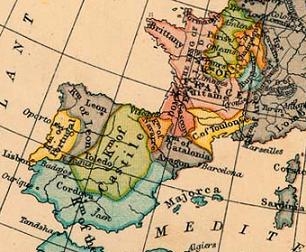
west_europe_13th_century

While I pick my teeth out of the carpet from Bat-Dan’s vicious counterpunch (Zapp!! Bamm!!! Sockk!!!!) do yourself a favor and read Bret Stephens’ absolutely brilliant column for this week:

Rather than waste time and money on a fruitless diplomatic brawl, Prime Minister David Cameron should say he’s prepared to relinquish Gibraltar to Spain—on just one condition. That would be a declaration by the Spanish government that it will renounce its own claims to the cities of Ceuta and Melilla, which lie opposite Gibraltar on the northern coast of Africa…

Of course, Madrid couldn’t just turn over Ceuta and Melilla without asking Morocco to readjust its own territorial claims…

Stephens traces a bewildering array of territorial disputes sweeping all the way down from Britain to central Africa and back up through central Europe and over to Greenland and beyond. Once you start to unravel the nation-state, where do you stop?

A starting point?

So what happens when a Homosexual man, an Amish man, and a Presbyterian Pastor all show up at the same gas station in rural Virginia and begin working towards moral consensus? First they have to find a starting point, a foundation, a point on which they all agree in order to begin working towards consensus.

For the Amish and Presbyterians, all morality is based upon the Bible, a Bible which the Homosexual and larger society may completely reject as manmade. Even in cases in which Homosexuals claim to follow the Bible, there is a lack of consensus on how the Bible should be handled in relationship to culture. Evangelicals may view the Bible’s prohibition against homosexuality as an open and shut case, but the growing prevalence of homosexual Christians shows that this is not always the case. While Christians are right to appeal to the Bible, this will prove unfruitful in building consensus within this country.

Natural Law is also often sought as a foundation for consensus, but this too has its weaknesses as natural law is subject to human reason, and humans are lacking in reason. In addition, homosexuality itself is viewed by many as a rejecting of nature, while those in the lifestyle view sexuality as being beyond law. Americans cannot even come to consensus on what is ‘natural’ let alone what is moral, so this too will provide a poor basis.

So what can be the foundation for consensus, that go-to place that serves as the basis of consensus and sets the parameters for the discussion? I would suggest a simple phrase from the US constitution: “life, liberty, and the pursuit of happiness.” Versions of this same idea can be found in the Declaration of Human and Civic Rights from the French Revolution. I would even go so far as to say that for the sake of consensus one might even use the Declaration of the Rights of Man and of Citizen of 1793, also from the same time period in France, this second French document having “equality before the Law” as its distinctive. This is not that novel of a suggestion, given that the constitution was based upon moral consensus at its inception. Upon examination, it would appear that these statements might provide an agreed upon basis, not simply for basic human rights, but also for morality.

The issue in revolution-era France and in American culture today is not so much the idea of liberty or freedom but how far that liberty and freedom go. Remember again that the three men in the gas station all chose different paths for their lives but all felt compelled to pay for their purchases. Liberty, according to the DHCR document ends as soon as it infringes upon another’s. In other words, my freedom to swing my fist ends where the other person’s face starts. Thus, my freedom to exercise my personal morality ends when it begins to infringe upon another’s. I can choose to be homosexual or non-homosexual until I infringe upon the opposite view. A person’s homosexuality should be limited by others ‘anti-homosexuality’ and vice versa for the sake of consensus.

So what would this look like? In the case of homosexuality, it would look like people being given the freedom to voice their opinions, but none of those opinions being seen as trumping another. The issue in America right now is that culture has slowly shifted to the position that tolerance means promotion. In order to tolerate homosexuality I must now promote the behavior and to do otherwise is hate speech. However, this is in violation of liberty found in the US constitution and the freedom of speech the DHCR and the idea of equality before the law found in the DRMC 1793. The rights of those disagreeing with homosexuality are being infringed upon by such actions.

On the flip side, if this indeed was the conclusion of the consensus, it would be wrong for Amish and Presbyterians to expect the Law to prohibit homosexuality. It would also be against consensus to give tax credits and discounts to heterosexual couples but not homosexual ones, an idea that many on this very blog have pointed out is outdated. Equality before the law means equality before the law, removing preferential treatment for one’s freely expressed views. The United States government should not be a sex police. Instead, they should be preserving people’s rights. Lady Justice is blind, as well she should be. There is equality, an equality that was lost on one side of the coin over the last decades, and the other side of the coin which is being subjugated now.

The real issue is not that the foundation of moral consensus has been eroded as the Bible was never the foundation of moral consensus in the US anyway. What has actually happened is that this country has strayed from its foundation upon the constitution, to the point now that the liberties of one group are subjected to support another’s. This is not allowed by the constitution as its very goal and purpose was to create consensus. In order for the Amish man, the Homosexual, and the Presbyterian Pastor to build moral consensus, they really have to go no farther than the words of their own constitution. The issue is not that they have no foundation consensus, the issue most of the time is that they don’t want to give anything up in order to build consensus.



Finding Consensus for Moral Consensus

Our proverbial automobile has returned to the gas station once again as the Homosexual Man, the Amish man, and the Presbyterian Pastor prepare to pay for their convenience store items. Can the three find moral consensus? Will the cashier also find consensus? Will the men’s families in their cars wonder why they are taking so long inside? Stay tuned to find out…

The caricatures of these three men are rather unhelpful in the real world. The Amish are often seen as unyielding to any culture influence or change, Presbyterians just want to talk about head in the clouds theology and gospel transformation, and Homosexuals have no basis of morality but desire. All three of these pictures are quite off the mark, but the use of stereotypes makes humans more comfortable with division and provides excuses for not working towards consensus. The reality of the situation, if one were to take the time to actually engage each of these three men, is quite the opposite.

Most Presbyterians, for all of their talk about theology, do not want to create a Theonomic state with the Bible as the foundation in a Christian version of Sharia Law. The truth is that the Presbyterian Pastor is well aware of the fact that the morals of moral consensus will be looser than his own personal morals and while he hopes the Gospel does indeed transform society’s morals, he understands that there will always be a difference between church and culture. Likewise, Homosexuals do not want a society where morality is simply based on what feels good. While they may argue for personal freedom of sexual orientation, Homosexuals still grow morally outraged over injustice, sexual abuse of children and animals, and anarchy. Both the Presbyterian and the Homosexual would agree that moral consensus is necessary for society to function. The Amish man is not as removed from society as one would think. Many of the social security laws in the US were created after the Amish sued the IRS. Does that sound like the actions of a completely removed and disengaged people group? I think not. The Amish have as much of a vested interest in the moral consensus of this nation as any other people because they benefit from the freedoms and protections of the Law as well. All three in the gas stations, four if you include the cashier who is glad their is consensus on paying for store items, would all agree as a consensus that moral consensus is necessary.

Not to overstate the obvious, but the Homosexual, the Amish man, and the Presbyterian Pastor (and the cashier) all care about America. The Amish man, while having German or Swiss roots wants what is best for America. The Homosexual as well wants the good of the country, and while the Presbyterian prays the country is transformed, he too wants national good. In order to consensus to be created, the three men involved must agree that moral consensus is good for the fabric of this country. The Founding Fathers understood the value of freedom, but also the value of consensus, a liberating but also restraining force upon the inhabitants of this land. For the good of the many, for the good of the United States, moral consensus is necessary and required.

Not only that, everyone involved would agree that moral consensus means each person will have to give up some of their personal beliefs for the sake of consensus. Moral consensus cannot be reached without such consensus. For instance, the Presbyterian Pastor may not agree that Homosexuals should receive all of the rights and benefits of heterosexual couples, but he would agree that murdering Homosexuals because of their orientation is wrong. The Homosexual disagrees with the narrow view of the Presbyterian on sexuality, but also recognizes the Presbyterian and Amish right to freely speak their views. In light of recent Supreme Court decisions, many may think that Homosexuals would disagree with the last portion of that sentence, but most Homosexuals are smart enough to realize that there can be no consensus with discussion of differing views and the Homosexual in this gas station is very smart. The Amish man, while desiring freedom to practice his beliefs, also understands that all the “English” are not suddenly going to become Amish. For the sake of moral consensus, some behavior which is verboten within the Amish community must be allowed for greater US population. Thus, in order for true moral consensus to exist, there must be consensus that such consensus will require give and take on the part of each involved.

Thus, as the wives in the cars begin honking the horn for their husbands to come out of the gas station, the Homosexual Man, the Amish Man, and The Presbyterian Pastor are prepared to begin creating Moral Consensus, agreeing that give and take will be necessary, but the end result of moral consensus will be good for each and good for the United States as a whole. Agreeing to meet again, each heads back to his own life, realizing that maybe each of these three is not that different after all.