The Riddler and the Samaritan

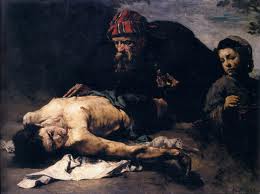
Riddler_(Batman_1966_TV_Series)_005Good Samaritan

AEI just released a health-care proposal that reminds me of my great Riddler debate with Bat-Dan over the legitimacy of transfer programs. The plan would (my summary):

  1. Abolish barriers to direct, multi-year contracts between insurers and individuals so that every individual can buy an insurance policy that a) reflects that person’s needs and b) is priced to that person’s real risk. In my own, non-expert opinion, I think you would get almost all of this accomplished simply by abolishing barriers to interstate commerce in health insurance. Congress is clearly authorized by the Constitution to pass a law allowing people to buy their insurance from a company in any state, and once you have that you just need one state to adopt this sensible policy of allowing people to buy the insurance they want – which quite a few states would want to do in order to attract the business. I’m really amazed no major politician has had the wit to make that the centerpiece of health care reform.
  2. Eliminate the arbitrary and deeply wicked IRS practice of exempting employer health policies from taxation, but not individual policies. My understanding is that U.S. law does not require this distinction, but the IRS adopted the practice in the 1940s and has never reconsidered it because it serves powerful interests. This practice effectively treats people as slaves of their employers by implicitly institutionalizing employer ownership of employees’ bodies. It must stop.
  3. Use the revenue from taxing all income equally (instead of arbitrarily exempting employer health policies) to subsidize poor households to buy health insurance in the market created in step 1, above.

Henry Olsen and Brad Wassink outline the program on NRO today, correctly defending the presence of some subsidies for the poor in terms of “the dignity of the individual.” (They call the belief in the dignity of the individual “conservative,” which is problematic, but that’s another topic.) The proposal itself explains why the dignity of the individual justifies some subsidies, describing what they call The Samaritan’s Dilemma: our most basic human and social values compel us to rescue those in imminent danger, yet the knowledge that we will step in to rescue leads the more marginally functional people to tempt fate. They become poor stewards of themselves, counting on the rescue party they know is always waiting in the wings.

A moderate safety net program is better for everyone than having people constantly showing up in the ER demanding rescue. As I said to Bat-Dan: “While we might envision a system where we wait for people to be on the brink of death before government helps them, it’s in everyone’s interest to introduce rules and regularity (a rescue-on-demand system would be subject to all kinds of arbitrary abuse).”
Your Words Are Written

jobLeaf by Niggle

Here’s a follow-up on Job and work. Last time I compared Salieri (drawing on an illustration from Tim Keller’s book on work) to Job. I made the point that God uses our toil and frustration for his own purposes, even though we can’t always see how. Job’s suffering had an important purpose – to vindicate the goodness of God before all cosmic witnesses – but he was never permitted to know that purpose. I would add that while Job was probably not a real person, it’s difficult to avoid feeling that the inclusion of this story in scripture becomes, somehow, an extension of that purpose. The very line between fiction and nonfiction is blurred, and the sufferings of a fictional person gain meaning beyond anything he could have imagined, for they reach into the real world and establish a witness for God in time-space history.

This morning I stumbled across this passage in Job 19 (verses 23-27):

Oh that my words were written!

Oh that they were inscribed in a book!

Oh that with an iron pen and lead

they were engraved in the rock forever!

For I know that my redeemer lives,

and at the last he will stand upon the earth.

And after my skin has been thus destroyed,

yet in my flesh I shall see God,

whom I shall see for myself,

and my eyes shall behold, and not another.

My heart faints within me!

For centuries, Christians have marveled at this ancient proclamation of the gospel – not only the redeemer-mediator, but a redeemer-mediator who is both human and transhuman (he is transhuman because he “lives” even though he is not in the flesh, yet he is human because in his time he will come in the flesh) and a personal, bodily resurrection and restoration to face-to-face fellowship with God.

But what caught my attention today is the first part of the passage:

Oh that my words were written!

Oh that they were inscribed in a book!

Oh that with an iron pen and lead

they were engraved in the rock forever!

The editors of my Reformation Study Bible comment: “Job has an important message that he wants permanently inscribed for posterity. Through the inspiration of the Spirit his words are preserved for all time in the Bible (c.f. Mark 14:9).”

Think of that! Job, in crisis and perishing, cries out for the opportunity to write down the gospel somewhere where it can’t be erased. He survives his ordeal, lives the rest of his life and dies without knowing why God inflicted such sufferings on him. Though he is restored to health and wealth, and (more importantly) repents of his doubts about God’s faithfulness, he never learns the true purpose of his suffering: Through the very torture of his flesh and spirit, he was at that very moment engraving the gospel into a rock that can never wear away.

In his book, Keller draws on J.R.R. Tolkein’s story “Leaf by Niggle,” where an artist is frustrated in his desire to bring his artistic vision to fruition. When he reaches heaven, he finds that the tree he had been trying to paint is there. Keller tells us that through the toil and frustration of our work, we should remember: “There is a tree.” I’m leading a book group at my church through Keller’s book, and that statement has resonated with some of the people in our group more than anything else. We keep coming back to it – “there is a tree.”

There’s a tree for Job, too, and for us.

Tree image by Alan Lee

Pro-life, or maybe vegan.

This New York Times article from yesterday details a wing of the pro-life movement that is focusing on the ability of the baby to feel pain as a means of reducing the number of abortions. The idea is that, according to some research, a baby is able to feel pain after 20 weeks and therefore any abortions that remain legal should be conducted before that point.

What was particularly interesting, though, were these two comments that followed the article. They appear in the order in which they were printed, sans any redaction on my part:

Roger StensonBradenton FL
After 20 weeks gestation the unborn child has all the prerequisite anatomy, physiology, hormones, neurotransmitters, and electrical current to connect the loop and create the conditions need to perceive pain.
Aug. 2, 2013 at 11:08 p.m.

Joseph Bianco St. Louis
Animals feel pain but that doesn’t mean we can’t kill them for our convenience.

I mean, um, exactly. I’m not sure if Joseph is trying to make an indirect pro-life point, an animals-are-people vegan point, or simply a very brutal pro-abortion point, but he sure makes the first one very well. Last I checked, we aspired to treat human beings better than animals.

Towards Consensus

So a Homosexual Man, an Amish man, and a Presbyterian Pastor walk into a gas station…  No, this is not a joke, although it certainly sounds like the start of one! This past Tuesday night I (the Presbyterian Pastor) walked into a gas station in rural Virginia to find what appeared to be an Amish man and a Homosexual man shopping for snacks for the car and paying for their gas. Of course, the fact that one man was driving a car means he was certainly not Amish, and my assumptions of the other man’s orientation were based purely upon his appearance and mannerisms. I am fully aware of the danger of stereotypes, but as I made my way to the facilities, I thought “What if they were an Amish and a Homosexual?” What if they were a separatist and a non-conformist? There are certainly wide ranging differences in our understanding of morality, as would be exemplified by the three of us in a gas station, but also great similarities and possibilities for consensus.

The three of us in my imagined story in the gas station would not be more different. The Amish are an Anabaptist group descending from the 16th century, a group my theological ancestors persecuted, often to the point of death. Praise God we have stopped attempts at consensus through bloodshed! The Amish are best known for their manner of dress, rejection of modernity, conservative morality, and extreme separatism. Conversely, Presbyterians are focused, not on separating from culture but on transforming in through the power of the Gospel. The Homosexual man bases his view of morality upon personal liberty and desires, allowing behavior in opposition to both the Amish view of morality and my own. His view of culture is that we should be free to do what we want. How does one work towards moral consensus in all of that?

Let’s assume for just a moment, ignoring the fact that he was driving a car, that the first man was indeed Amish. And, putting aside stereotypes, the second man was indeed a Homosexual. All three of us paid for our snacks. The Homosexual did not argue with the cashier that he should be allowed to take his snacks without paying because he did not feel like paying for them. The Amish man did not argue that it is wrong for the government to tax his purchases and then use those fees on non-Biblical judicial practices. And I did not argue with the cashier that he should understand the gospel of Jesus Christ and how my paying for my sales tax and my purchases was validating the cashier’s place in our society and creation as a worker. Instead, we all simply paid. We all shared consensus that we were morally obligated to pay for our purchases. We all got in our respective vehicles and drove down the road on the right side of the median. Again, consensus. How did this happen and why does it not happen on larger issues?

It would seem that the problem lies in our recognition of differences. I said three men, all Virginians, all driving in automobiles, all stopped at the same gas station in rural Virginia, all purchasing gas and snacks for the road. We were all American, and I would add, all roughly the same age. And yet, the fact that I noticed first was that one appeared to be German Anabaptist and the other a Homosexual. We as humans are naturally drawn to differences rather than similarities. And yet, when our forefathers created our constitution, they did not focus as much on differences as on similarities, on consensus. Consensus is not always found by debating our differences until we come to a solution but often in finding where we already agree and then using those agreements to discuss the differences. There is a point at which the Amish, the Homosexual, and I all agreed in that gas station: there are limits on personal freedom. We all sacrificed liberty to pay the cashier and protect his liberty as a store owner. When we focus on differences, we are focusing on division. When we focus on already shared consensus, we begin from a position of unity. There is already much consensus to build upon that would be helpful in the debates currently swirling around Washington, consensus very similar to our acts in that gas station, and a point which I will attempt to prove in the second half of this thought in my next post.


Christianity, “Conservatism” and “Capitalism” (Again)

economicvaluessurvey

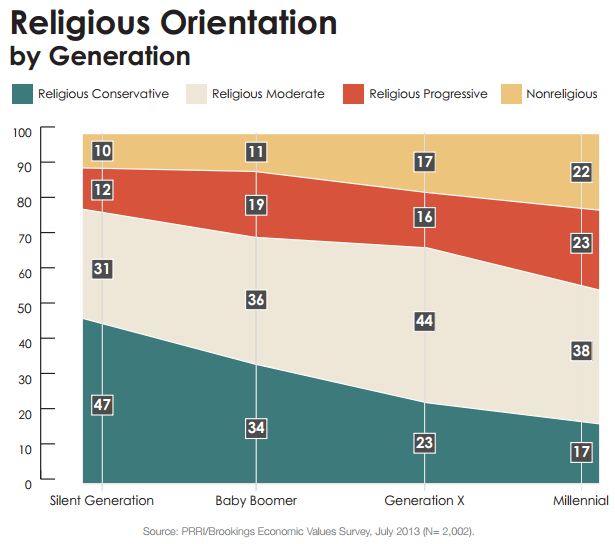
Lots of attention for Brookings’ Economic Values Survey. Left-leaning media outlets are crowing about the declining numbers of people who self-identify as religious conservatives, particularly among young people. As the above chart shows, the decline is driven not primarily by a leftward shift in American religion but by the exodus of young people from self-identified “religious conservative” populations into a “non-religious” identity. This is once again the rise of the Nones, a topic we’ve discussed before here on HT.

Which is not to say there’s been no leftward shift at all. George Weigel points out that evangelical institutions of higher learning are starting to follow both the secular and the Roman academy on their “trail of tears” toward “a sojourn into a new wilderness” of socialistic claptrap, trading their entrepreneurial birthright for a mess of redistributionist pottage.

In an excellent post, Josh Good makes the case for long-term optimism, partly because the teachings of Christianity really do align with the entrepreneurial mindset and the spirit of enterprise, rather than with the endless growth of the nanny state. I agree. Good also appeals to the greater cultural integrity of conservative denominations as against progressive ones; that’s true as far as it goes, but the question is whether those conservative denominations are going to remain “conservative.”

One strategic problem we’re going to have to wrestle with is the very language and concepts of “conservatism” and “capitalism.” The economy built on enterprise, entrepreneurship and opportunity cannot survive if it is something supported only by one side of the political spectrum. (In saying so, I’m only following the lead laid down by Charles Murray and others.) So the identification of that economics with “conservatism” is strategically problematic. Intellectually problematic, too, because the entrepreneurial economy is as much about progress (the advance of human flourishing) as it is about conservation. Hence the increasing number of self-identified “progressive” intellectuals and celebrities who embrace free enterprise, at least in principle, as the best way to accomplish their goals.

Also problematic is the word “capitalism.” Thanks to a century of woolly thinking kicked off by Max Weber’s execrable book, large numbers of people insist that the word “capitalism” simply means an economy that runs on greed. I have heard them say so myself, numerous times. And most of the time they are not open to hearing alternative perspectives; if you challenge the notion that capitalism is a system that runs on greed, you are only a huckster for the system that runs on greed (or a dupe of its hucksters). “Free markets” and “free enterprise” have the same problem, though less severely. “Freedom” still resonates to some extent, particularly with evangelicals if you can show the links between religious freedom and economic freedom – but it also raises suspicions that need to be allayed. “Entrepreneurial economy,” “spirit of enterprise” and “opportunity” seem to open doors, and I expect we’ll be using more of that language in the years ahead.