Over the weekend, TGC put up a pocast in which I discuss with Collin Hansen and Mark Mellinger what it would look like to wage a narrative fight for marriage, and how we can fight for marriage and religious liberty at the same time. The more we prove to our neighbors who identify themselves as gay that we want to find a social order that affirms their human dignity and equal membership in the civil community, the less need people will feel to institutionalize gay marriage, and the sooner we can subvert the “victimhood competition” in which the group that has been victimized the most always wins.
Category Archives: Uncategorized
Nominate a Villain for “The Higgy”
Last fall I introduced HT to The Al Copeland Humanitarian of the Year Award, given out by Jay Greene at his blog (where I co-contribute). The Al is in its fifth year of honoring heroes who contribute to the good of humanity. This year I’m tickled pink to bring you a brand new award from the same source, The William Higinbotham Inhumanitarian of the Year Award. “The Higgy” will honor (in a manner of speaking) those who distinguish themselves by subtracting from the good of humanity.
I first singled out Higinbotham for (dis)honor a while back, to explain why he would never deserve the Al Copeland award in spite of his having invented the video game. This week, I nominated David Sarnoff for The Higgy, for his outstanding contribution to crushing innovation and ruining the lives of inventors who seek to serve mankind.
Head over to JPGB and nominate your favorite scoundrels!
My Leaven Anxiety
In his fabulous post below on the culture and gospel debate, Greg suggests that I have an anxiety that the Gospel will remain too much as the Pearl of Great Price and not enough as the Leaven of Culture. In response, I would say “Yes, I do.” Yet, my anxiety comes from the very issue that Greg is addressing–a lack of balance. As Greg argues,
The artificial separation of the cultural mandate from the great commission, erected out of fear that the gospel will not be allowed to be leaven, makes it difficult for the gospel to be a pearl of great price.
I couldn’t agree more. There CANNOT be a separation between the Cultural Mandate and the Great Commission. The thought behind my initial post was that our attempts at fulfilling the Cultural Mandate are not being balanced by the Great Commission but superseded by it. To use Greg’s words (from Ballor from Bavinck), our allowing the Gospel to be leaven is not being balanced with allowing it to be the pearl of great price. It appears that the assumption of many is that we cannot fulfill the Cultural Mandate until culture is converted, meaning that I must fulfill the Great Commission first and make disciples of people before I can work to fulfill the Cultural Mandate and transform culture. Or, the assumption is that the Great Commission is more valuable than the Cultural Mandate [being a missionary is more valuable than championing good highways]. These are both false dichotomies. I am called to fulfill both the Mandate and the Commission simultaneously, not one first and then the other.
Greg states of my post:
However, I think he errs when he separates the cultural mandate from the great commission as though they were not connected.
I understand how my earlier post may have given that impression, but that was not my intention. I do not want to separate the two. I agree with Greg that someone who is being made a disciple of Jesus Christ will be more culturally transformed, so that our task of the Cultural Mandate is certainly more accomplished when that particular part of cultural is also discipled through the Great Commission. Perhaps saying that a musician would not play “better” was not the best word choice. My point was simply that becoming a Christian does not suddenly make a baseball player have a higher batting average or run faster, but they will be “better” in terms of their glorifying God and understanding their calling as an athlete. This being “better” may make them more of a team player, affecting the team more even if they as an individual cannot suddenly run a 4 second 40 meter sprint. And yet, at the same time my engagement with transforming culture does not require that they are discipled but that I am a disciple. Certainly my hope and prayer is their conversion, certainly they will be “better” at culture if they are disciples of Jesus Christ, but I am called to fulfill the Cultural Mandate to the Glory of God while I fulfill the Great Commission to the Glory of God, not before or after.
Again, these thoughts all came about while considering the issue of homosexuality. As theological arguments have recently fallen flat in a secular culture that does not believe in a Theos, many have argued that we must work to convert homosexuals to Christ first before we can talk about the cultural issue of sex. An extreme segment has suggested that since we cannot convert homosexuals to Christ first we should give up and never talk to them about cultural issues of sex. My goal in posting Culturally Common Grace was to argue that I can and should be engaging the marriage debate from a Cultural Mandate perspective AND a Great Commission perspective, because as I argued, both flow together from the Gospel.
Don’t Worry, Make Culture
Jesus warned us about the evil of anxiety. I think one of the most important things we need to do when it comes to Christians acting within the culture is get over our fears – two of them, to be specific. A couple of blog posts published on the same day earlier this week demonstrate this need.
As Jordan Ballor has pointed out, the gospel is supposed to be both a leaven that leavens all of life and the pearl of great price. If it is a leaven that leavens all of life, we must live it out as the undergirding taken for granted in all our cultural activities. But if it is the pearl of great price, then it must be held at some distance from all cultural activities. Jesus says it must be both; therefore it can be and will be both.
The main difficulty we seem to have in discussing Christian cultural activity is the strain between two anxieties. These anxieties create unnecessary divisions between brothers, because those who are more worried about making sure the gospel is leaven view those who are more worried about making sure the gospel is pearl as people who are leading the church astray, and vice versa. We treat people as opponents when we could be treating them as allies, if we could just get over our fears.
On the one side is the fear that the gospel will not be pearl – the church will sell out, that the mission of the church will be reduced to simply serving the “common good.” Christian culture makers had better be constantly straining to stand out and make their cultural products visibly, dramatically different from those of their unbelieving neighbors. Otherwise they’re cowards and traitors to the gospel.
Jeff Haanen’s post at TGC on Monday manifests this tendency. He accuses Gabe Lyons and Andy Crouch of abandoning “what makes Christians unique” in their efforts to serve the common good. He condemns Lyons’ and Crouch’s work on these grounds.
Running throughout the post is an underlying assumption – never stated and therefore never examined – that Christian cultural activity betrays the gospel unless it stands out dramatically as something “unique” when compared to the cultural activity of others. “Serving the common good isn’t enough,” he keeps insisting.
Haanen is right that the gospel must be the pearl of great price; we should be Spirit-transformed people, and the church would be selling out if it ever really did think that serving the common good was “enough.” But neither Lyons nor Crouch says any such thing. Quite the contrary! If you bother to read what they write, it’s clear that neither of them simply identifies the gospel with cultural activity.
So why is Haanen so quick to take on this unjustified accusatory tone with his brothers? Because the cultural products and activities that Lyons and Crouch are producing don’t stand out as different – or at least, don’t stand out dramatically enough to reassure Haanen that the gospel isn’t being sold out.
But the burden of proof is not on Lyons and Crouch to prove that they’re not selling out, simply because they engage in cultural activity. Kyle’s post this Monday here on HT explains why: the institutions of human culture (family, government, business, etc.) are God-ordained. Cultural activity within them is therefore God-honoring and God-glorifying, except in cases when it involves active participation in sin. If I’m engaged in cultural activity within the institutions and purposes God ordained, the burden of proof is on you to show that what I’m doing is sinful; otherwise it’s presumptively good.
The reason Haanen illegitimately reverses the burden of proof is clear from what he writes. He’s scared that the gospel won’t be the pearl of great price. He demands to be shown some tangible evidence that Christian cultural activity stands out because, to him, if it doesn’t stand out it’s presumptively denying the gospel.
This fearful attitude (let’s call it the Haanen Test – “show me how your work stands out as dramatically different or I will condemn it!”) makes it extremely difficult for the gospel to be the leaven that leavens all of life. All of human life, everything we do without exception, is a cultural activity in some respect – even if only because our thoughts are shaped by language and images, which are cultural products. It’s unreasonable to demand that all – or even most! – of the activities we engage in every day will be visibly, dramatically different from those of unbelievers.
Let’s consider the case of a line worker. (Too much of this “culture” conversation is aimed at the kind of comfortable white-collar people who read blogs.) I’m a gospel-driven, Spirit-transformed Christian, and my job is to spend the whole day moving back and forth between two machines. I take a manufactured good that’s being constructed – a fuel injector, say – off of one machine and put it onto the other. Back and forth, all day, picking up a part and putting it down. This is not something I made up; it’s an actual job that many people do.
That person’s cultural activity in his daily work is never going to satisfy the Haanen Test. But does his job glorify God? Absolutely! It’s a beautiful thing that he does for God and his neighbor. And if we say otherwise, we’re not only in rebellion against the clear teaching of the Bible, we’re also condemning that Christian to live in a meaningless universe where what he does all day has nothing to do with God. (Not to mention the fact that we’re creating poverty and undermining our community, and also destroying religious freedom.)
However, I have to say that I think Kyle’s post falls into the opposite anxiety – a fear that the gospel won’t be the leaven that leavens all of life. Kyle does a wonderful job of magnifying the theme of the cultural mandate throughout scripture and showing that, as he puts it, the cultural mandate is about the gospel just as much as the great commission. However, I think he errs when he separates the cultural mandate from the great commission as though they were not connected.
Kyle writes that if my neighbor across the street is being attacked, I call the police becasue of the cultural mandate (“the calling upon my life to order culture to the glory of God and the working of the Gospel in my own life”) not the great commission. I agree that calling the police is obeying the cultural mandate, but I disagree that it isn’t about the great commission. And I think this matters a lot.
It’s true, as Kyle says, that I don’t call the police in order to convert my neighbor. But the great commission does not command us to make “converts.” It commands us to make “disciples.” And what is the difference between a superficial convert and a gospel-changed disciple? The transformation of everyday life by the Spirit. And “everyday life” means cultural activity, such as calling the police. Learning how to carry out the cultural mandate rightly, and helping other Christians to do so, is part of how I carry out the great commission to “make disciples.”
Why does this matter? The importance comes through when Kyle writes:
This is not to say that an artist or musician would paint better or sing better if she were a Christian, but she would have a deeper understanding and grasp of her high calling from God and a proper thinking and perspective about her place in creation and the value of what she is doing for culture.
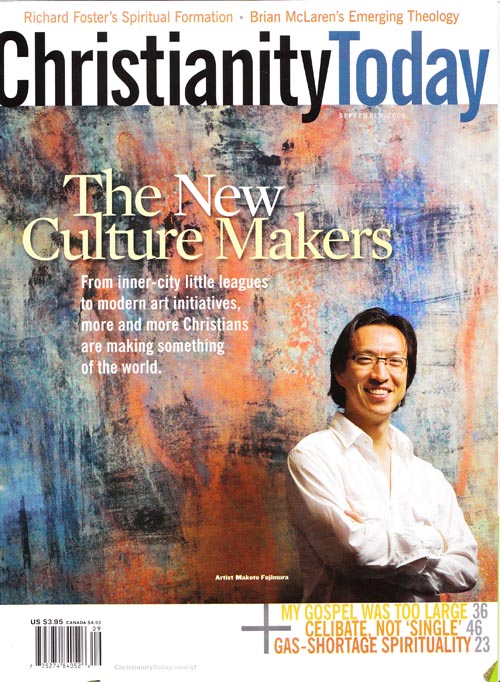
But an artist who had a deeper understanding of her calling and its place in creation would become a better artist! Or at least she should become a better artist. She had better, if she’s going to be a doer of the word and not a hearer only. Ask Christian artists who are thinking about this (like Mako Fujimura, pictured above) and they’ll tell you a Christian perspective on the vocation of art is transformative for the content and performance of art.
The artificial separation of the cultural mandate from the great commission, erected out of fear that the gospel will not be allowed to be leaven, makes it difficult for the gospel to be a pearl of great price. It becomes an excuse for going with the flow, being a hearer but not a doer, failing to pursue spiritual transformation in all of life. “As long as I’m doing the job that’s assigned to me, I’m carrying out my calling.” No, not necessarily. Your calling is to glorify God, and that involves more than taking marching orders from those who assign you cultural tasks.
Let’s come back to the line worker. I insisted above that the line worker is never going to stand out in a way that satisfies the Haanen Test. But does that mean the line worker would never stand out at all? God forbid! He should radiate the gospel in both objective and subjective ways. Objectively, he should not only be a highly virtuous worker, he should go above and beyond the predominant ethical expectations that prevail on his factory floor. Perhaps he will take on more tasks or be a peacemaker when coworkers are in conflict. He may need to constructively challenge unethical practices. Subjectively, his bearing, spirit and demenaor should radiate the gospel. His company should taste different to those around him.
I don’t want to create an artificial equivalence between Kyle and Haanen, because Haanen is unjustly condemning the good works of his brothers and Kyle isn’t. On the other hand, I have heard other people, leaning in Kyle’s direction, condemn their brothers in a way that’s closely parallel to what Haanen is doing. I think the key is to draw people back from both fears rather than try to figure out which side is more likely to misbehave.
If we all got over our fears and trusted that the Holy Spirit is working in the church, we could integrate these imperatives and focus on helping make the gospel both leaven and pearl, rather than setting up those imperatives in opposition. And I trust that the Spirit will move us to do so! I pray he will do so quickly, because the longer we wait the more time we waste, while our culture is dying.

Culturally Common Grace
Over the last several hundred years, Christians have begun to take the Great Commission quite seriously as the church’s high calling from God. Through the movement of modern missions and the emphasis on personal evangelism, the church has risen to the challenge to see the Gospel of Jesus Christ carried to all peoples. And yet, the Great Commission is not the only calling that God has placed upon Christians; we must not forget the Cultural Mandate.
In Genesis 1:28, having created mankind in His image, male and female, God gives this new couple their calling as human beings. “Be fruitful and increase in number; fill the earth and subdue it. Rule over the fish in the sea and the birds in the sky and over every living creature that moves on the ground.” Because of the subsequent fall of mankind in Genesis 3, this task became much more difficult, but even after the fall Adam and Eve still have the same calling to be fruitful and multiply and to rule over creation. God repeats this calling again to Noah in Genesis 9 after the flood, and while the dread of humans would fall upon all animals, mankind was still to be God’s vice-regent on earth, filling it and subduing it.
The subtle message of the Gospel weaves its way through Cultural Mandate in the early chapters of Genesis and beyond. Mankind fails as God’s vice-regent in the garden, God in His judgment punishes but in His grace also allows the calling of the Cultural Mandate to remain upon the now imperfect human race. Years later, God sends His Son, the true King, the second Adam, to represent this fallen race on the cross and to rise again with all rule and authority over creation until He has subjected all things to God the Father. While all humans beings are still under the calling of the Cultural Mandate given at creation, in order for fallen mankind to most completely fulfill the Cultural Mandate of Genesis 1 and ruling in God’s name, they must be redeemed by the blood of Christ and forgiven of their imperfection and empowered and enabled by the Holy Spirit to be agents of the Kingdom of Light to advance the cause of Jesus Christ in this world. Thus we can accurately say that everything in creation is at its very base related to the Gospel because we will not completely fulfill our Genesis 1 calling without the work of the Gospel in our lives. We will not be the parents, workers, or caretakers of creation that we are supposed to be without the inner of the Gospel of Jesus Christ. This is not to say that an artist or musician would paint better or sing better if she were a Christian, but she would have a deeper understanding and grasp of her high calling from God and a proper thinking and perspective about her place in creation and the value of what she is doing for culture.
However, that does not mean that everything is a Great Commission issue because it is a Gospel issue. While the Great Commission is about the Gospel, so too is the Cultural Mandate. In other words, the end goal of all things is not always evangelism! Imagine for just a moment that I see my neighbor across the street being attacked by a wild band of thugs. It is not the Great Commission or evangelism that causes me to call the police. Yet it is the Cultural Mandate, the calling upon my life to order culture to the glory of God and the working of the Gospel in my own life that causes me to cal the police. My neighbor does indeed benefit from the work of the Gospel in my life and my understanding of the Cultural Mandate, but I will probably not tell him that since I called the police he owes it to me to become converted. My performing as a professional athlete or businessman is not just so I can share the gospel with teammates and coworkers. I do not plant a nice garden and pick up trash in the woods just so I can share the gospel. While it would be great if I do get to share the gospel, I do those things because it is part of my role in culture and creation under the Cultural Mandate of subduing the earth and bringing it in line with the glory of God. The end result is that all of creation benefits, even if people in the end are not converted.
This is often referred to as God’s Common Grace. God’s special grace flows out through Jesus Christ to all who believe in Him, saving them, forgiving them, adopting them, transforming them, and one day, perfecting them. But God’s common grace also flows out to the non-believer, as ‘He makes it to rain on the righteous and the unrighteous.’ God’s common grace is closely linked with the Cultural Mandate from Genesis 1 and 9 because all of creation benefits as humans take their calling from God seriously. As I am transformed by the Gospel, I act out my salvation culturally and creationally in the world around me. I stand and say “this is not right, it must change,” or I praise the lovely and beautiful as evidence of God’s common grace in culture.
Which brings us then to issue concerning Civil Law. Is the Civil Law for a believer in Jesus Christ a Gospel issue? Absolutely! Through the Gospel I understand true justice, as well as concepts of mercy, grace, and redemption. I grasp the value of every human being and strive to ensure that the Law does not promote a justice that devalues humanity. The list goes on and on. With a redeemed mind and the knowledge of God’s natural Law and revealed moral Law, believers are better able to govern civilly in ways that are in keeping with the Kingdom of God. But just because we can relate the Gospel of Jesus Christ to the the civil Law does not make it a tool to accomplish the Great Commission! Sure, the Law points to Christ, but we should not encourage Christians to become civil magistrates just so that they can witness! We should encourage our Christian lawmakers to make a Civil Law that upholds the Cultural Mandate to bring God’s common grace upon all peoples. You can’t go around killing people and whether you are or are not a Christian does not affect that fact!
And so, as I conclude, I come to the real issue that I began this article to address. Do our efforts to speak against homosexuality stem from our goal to fulfill the Great Commission or the Cultural Mandate? I would argue that one of the main reasons that we are losing our fight against the rising tide of homosexuality in this nation is that we are convinced we have to convert everyone first in order to have real conversations with them about sex. The truth, though, is that my neighbor does not have to be a Christian for me to call the police when thugs invade his home, and neither do I have I have to convert him before I can talk about sex. I can talk to my unconverted homosexual friends about the cultural issue of sex, which is a gospel issue no doubt, because I am not just under the Great Commission but I am agent of common grace under the Cultural Mandate. Do I hope they come to the Gospel and God’s special grace? Absolutely! But I can engage my unconverted cultural even now!


