
Evangelical Awe at TGC

awe_child

Over on TGC this morning, I respond to Rod Dreher’s claim that evangelicals are less hospitable than Roman Catholics or Eastern Orthodox to awe and wonder at God. Dreher bases his article on what he feels are unfounded accusations of New Age heresy aimed at an evangelical author – accusations that he found on the web, more or less randomly, by googling.

News Flash: Harsh Criticism Found on Internet!

As I wrote at TGC:

Is this the yardstick by which Dreher would evaluate our faith tradition? Does he think that I cannot appeal to my father Google, and he will at once send me more than 12 legions of links to websites where “articulate and educated” people in his tradition also say crazy things?

I argue that evangelicals are rather a little too much given to the pastoral/devotional side of piety, and could use a little more doctrinal clarity:

If evangelical authors who focus on doctrine are anxious about the urgency of correcting theological errors in devotional writers, it’s mostly because they speak from a position of weakness, whereas the devotional writers are in a position of strength.

Check it out.

Latin Phrases Redux

moreconfrontswolsey


A while back, I posted about the difference between freedom of conscience and freedom of religion suggesting that the old Augustinian idea of “capax dei,” or the capacity (sometimes interpreted to mean desire) for God, could help us answer those who would rather do away with freedom of religion and stick to freedom of conscience.

Greg responded with the below comment, which I’d now like to answer. (This is what you get when you sign up to blog with Greg. He responds in 30 seconds, you stop and think about it for 2 weeks. Sigh.)

Obviously I agree that we must not only follow our “consciences” simply as such, but God himself. But I’m not sure your argument here answers the other side’s case, and it may actually reinforce their position. You argue that human beings must follow not only their “consciences” simply as such, but God. Yet you accept Thomas’s locating of the desire for God in the intellect. Doesn’t that reduce the capax dei to merely the conscience? The intellect is irreducibly individual and subjective; there can be no such thing as a social or objective intellect. I would say the key reason we need freedom of religion and not just freedom of conscience is precisely because we desire God, and find him, not only in the intellect but in action – not only in contemplation but in life as we actually live it – and that means we must find him socially and objectively, in institutions (as well as elsewhere). If I’m right, the Thomistic location of the capax dei in the intellect is part of the problem rather than part of the solution. Thoughts?

So, Greg would like to know if I’m really just circling back to defending conscience, not religion. I’ve written about this before, but there I argued that freedom of religion had to be preserved over and above freedom of conscience because religious institutions themselves both are a part of religion and have formative influences on the conscience:

“I think we are starting to see that religion has perhaps always been more than a matter of just what one person believes; he or she is always standing on the shoulders of giants who have, very often, worked as members of a body (ecclesia). With or without formal members of the clergy, churches and other religious institutions have established some sorts of structures and corporate identities that bear on but are not synonymous with the religious identities of their members. And I think it is important that we grant religious institutions the freedom – the libertas ecclesiae – to continue to do so.”

But I don’t think that the addition of the capax dei is either redundant with conscience, as Greg suggests, or trivial, as one might be inclined to think from the fact that, as Latin and authentic and thereby a candidate for hipster theology, “you probably haven’t heard of it.”

The capax dei resides, yes, in the individual’s mind, at least to the extent that we can say that any desire is in the mind. So it is individual in that sense. But we aren’t talking about something that exists only in the individual’s mind, since this is a capacity for God, capital G. Something that exists objectively, for which we as individuals have a capacity. True, with fallen human minds and desires, we don’t all either really seek Him or know Him. But it is an individual’s capacity for universal objective thing, not for goodness or justice or beauty.  As such, I think that this aspect of human beings points us to the role for religion, for religions mediate the individual and God, one way or another.

(Disclaimer: that last sentence needs a lot more space than I have here.)

St. Thomas More’s life – and death – gets at the distinction pretty well. Here was the king’s Lord Chancellor who was put to death rather than support the king’s self-appointment as the King of England, which ran contrary to his Catholic faith. It is absolutely the case that his objection resided in his conscience. But of course, his conscience also reminded him that he was “the king’s servant.” So there was another influence that was not purely individual in nature, an influence that convinced him that he was “God’s [servant] first.”

My original argument for religion over conscience, quoted above, reminds us that the conscience relies, in part, and both knowingly and not, on institutions for its formation – as we see with More. To deny religion its role would be grossly unfair, favoring secular institutions’ influence in forming the conscience. But the added point about the capax dei means that that thing that More died for, that final-instance conscience arbiter, is something in all of us. And if that’s something in all of us, then all of us are meant to be God’s – not an isolated conscience’s – servant first.


Jonathan Rauch’s (Mostly) Failed Agenda for Hurting Workers – and What Would Work

College of the Ozarks’ “Hard Work U” Program

I see lots of attention being paid to this article by Jonathan Rauch on the economic crisis of America’s working class. He’s looking at the right problem, but he’s looking at it all wrong. As a result, he misunderstands both the cause and the needed remedy.

Rauch is right that the bottom half of workers have a long-term problem: the economy still produces lots of wealth for the top half, but not so much for the bottom. Unfortunately, Rauch mostly thinks of this in terms of moving wealth from the top half to the bottom – not, to be sure, through government transfer programs, but through wages. Unfortunately for Rauch, transferring wealth from one social class to another is not the purpose of wages. The purpose of wages is to compensate workers for their work. The value of wages therefore reflects the value of their work (except where cheating, cronyism or other ethical failures intervene). The real problem is that the bottom half are not increasing their production of wealth. Rauch’s failure to think in these terms sends his whole analysis off track.

Helping the bottom half of American workers become more productive should be an urgent concern. And I don’t mean we should just stand back and scold them until they’re more productive. There is much we can do to help them recover their productivity growth! Unfortunately, we’re not going to do any of the things we need to do as long as we think about the problem in terms of transferring wealth rather than increasing productivity. Rauch’s article shows this; most (though not all) of his poilcy proposals represent a laundry list of failed nostrums. Below, I’ll propose a counter-list that I think will find significant bipartisan support and will actually be effective in helping the bottom half get back in the wealth creation game.

Rauch is only the latest person to reproduce these two graphs, brought to you by the hard-left Economic Policy Institute:
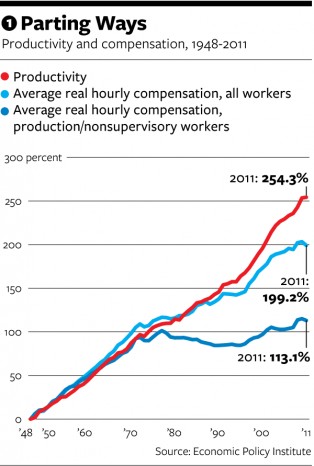
Boy, sure looks like the working man is getting the shaft from the bigshots, eh?
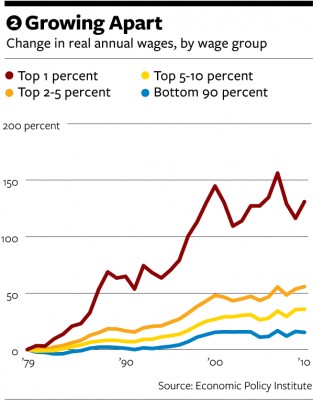
There’s lots of productivity in the economy, but those greedy one-percenters at the top are hogging it all!

Now, what’s missing from these graphs? Anyone? Anyone? Bueller?

Yes, you there in the back – Dan Kelly!

“Wages are shown separately by social class, but productivity isn’t. Moreover, even the wage line for all workers is an average, whereas the productivity line for all workers is a total figure rather than an average. This allows the graphs to mask what’s almost certainly really happening: wages are still tracking productivity just fine; the gap in wages across social classes is caused by a gap in productivity.”

Go to the top of the class, Dan! (Disclaimer: Not actually a quote from Dan Kelly.)

From start to finish, Rauch’s article frames the whole issue in the wrong terms. Productivity is something that’s just out there in the ether, like sunlight. Wages are supposed to transmit it to workers.

Buried deep in the article, Rauch briefly gestures toward what’s really happening:

A smaller share of the value that companies produce today comes from the physical goods made by people like factory workers, and a larger share comes from ideas and intangible innovations that people like software designers and marketers develop. Between the early 1980s and the mid-2000s, Shapiro says, the share of a big business’s book value accounted for by its physical assets fell by half, from 75 percent to only 36 percent.

“So the basis for value shifts,” Shapiro explains. “This is the full flowering of the idea-based economy.” Which is great if you are a brain worker or an investor; otherwise, not so much.

See Charles Murray’s new book for much, much, much more evidence of this.

So, what does Rauch want to do? Here’s his list of proposals:

• Get more people, especially men, through high school and college. (See p. 16.)The agenda includes an increase in financial aid and loans, a push for states to require that students stay in high school (as Obama has proposed), and encouragement of online learning.

The problem with financial aid is that it doesn’t help, it just drives tuition up. Virtually everyone who graduates high school with the academic qualifications to attend college actually attends college. You can’t get more kids into college without fixing K-12 schools. Requiring students to stay in high school is a non-starter; even if state legislatures passed it, which they won’t, it would just force high schools to dumb down their academic standards to keep the would-be dropouts from flunking out.

By contrast, online learning does have huge potential and we should be encouraging it. The problem here is that there’s not much we can productively do besides get out of the way. Recent efforts to use policy to promote online learning have basically amounted to attempts to create a government-protected online learning cartel – and we all know how well that works out. That said, there are some innovative proposals for how we can more effectively get out of the way.

• Expand federal support for job training and consolidate the tangle of programs. Obama wants to do this, too, as do many politicians in both parties—which doesn’t make it a bad idea.

Government job training programs are a long-proven loser. What we need to do is fix K-12 schools. School choice has improved public schools every time it’s been tried. Universal school choice would drive a radical K-12 revolution.

• Expand and improve vocational education for those not suited to college. (See p. 12.) Apprenticeship, in particular, can help prepare young men for the kinds of jobs that the economy increasingly creates. The United States does far less of this than, say, Germany does.

The insuperable obstacle to voc-ed in the existing school system is its long-term history of racism. In the 20th century, voc-ed was a code word for warehousing black students. Given the state of the schools, it’s hard to resist the conclusion that voc-ed would go down exactly the same path if we brought it back today. That’s why, every time a voc-ed proposal starts to gain momentum, it’s immediately killed by a coalition of progressive racial/ethnic activists and conservatives who view voc-ed as “the soft bigotry of low expectations” and a step away from traditional liberal arts education.

There is a way to solve this problem, though: school choice. If “the man” isn’t imposing it, it’s not racism. And if it were accountable to parents instead of to a faceless union-run bureaucracy, it would work. School choice would open the path to alternative education.

• Change Social Security disability benefits so that the program helps people keep working (and helps employers accommodate disabilities) instead of encouraging them to leave the workforce, as it does now. An analogous overhaul of welfare in the 1990s was a notable success.

Too right! Nothing but net for Rauch here.

• Liberals talk about increasing wage subsidies for low-skill jobs, raising the minimum wage, or both. Although such measures can be expensive, they may be worth it if they keep men working.

But work loses all its value if it’s not productive. Rauch’s argument here is that men need to be in jobs in order to be civilized (he especially looks at the breakdown of marriage). However, work only has this civilizing effect because it orients us toward the good of our neighbor, establishes that we are contributing to the common good, and holds us within social structures where we have to behave ourselves.Subsidized jobs won’t provide any of those benefits, because they’re not productive.

In fact, this direction would only worsen the problem Rauch is looking at. It would be (yet another) step toward severing the connection between work and productivity among the working class.

[Update: Can’t believe I forgot to mention: the minimum wage destroys jobs. Rauch wants to lift wages to lure men into work, but the minimum wage will make work harder to find. What the minimum wage does is lift wages for the most economically productive among the workers on the bottom rung, while destroying jobs for the least economically productive. So it tends to benefit those who need it less at the expense of those who need it more – particularly, those who are most likely to be already marginally attached to work. Great thinking!]

A better path was laid out earlier this year in a New York Times article co-written by economists at the conservative AEI and progressive CEPR: Reform U.S. labor law to allow companies more flexibility to respond to economic challenges in ways that radically reduce job loss.

• Conservatives talk about nudging the culture back toward stigmatizing nonwork among men. “Don’t prettify the way you talk about it,” said AEI’s Murray. “It is never rational not to take a job.” Liberals may be squeamish about stigmatizing nonwork, but some men may need tough love.

Yes, this is needed. However, it will be important that it comes from institutions with the moral and cultural credibility to deliver the message. No disrespect, but the working class wouldn’t listen to Murray – or to Rauch, or to me.

Churches are obviously going to be central here. They have the moral standing, they’re in the neighborhoods.

And most of all, they have the theological resources to do this with the right approach – with hope, not Phariseeism. No cultural message works for long if it’s negative. What’s needed is a recovery not simply of the stigma of nonwork but a lively and holistic sense that work is good – that it’s meaningful, that it provides dignity and hope. Today, sociologists mostly talk about Max Weber’s thesis that the Reformation paved the way for capitalism in terms of Protestantism restraining disorderly desires and cleaning up people’s behavior. It did do that, but more importnatly, it challenged the late-medieval ethical dualism that looked down its nose at economic work. After the Reformation, economic work was central to serving God and making the world a better place for your neighbors.

Such an approach would get to the heart of the issue: productivity. The gospel message for economic work is that human beings were made to do work that is fruitful – in other words, productive. The biblical narrative begins with a garden and ends with a city; humanity’s job, in God’s original plan, was to get the world from one state to the other through diligent, productive work. That dignity and freedom are still available to us now.

My friends in seminaries are always talking about starting a new Reformation. Well, reconnecting the gospel to the economy is the way that’s going to happen, if it happens. It worked for Luther and Calvin, and it can work again.

[Update: Profuse apologies for having misspelled Rauch’s name when this was first posted!]

Presence Part 2

It is somewhat ironic that Dan Kelly challenged me to come up with more specifics in dealing with the poor than just idealogical foundations as that was the direction I intended to head in this post anyway! I fully agree with Dan that church leaders should play a key role in leading the push to care for the poor. However, I personally believe that it is actually best if church leaders are the cheerleaders for helping the poor rather than those doing the footwork. The reason for this has to do with presence and available resources.

Some seem to believe that all the poor lack is education or encouragement. If the poor are taught about work and economics or we come alongside them and encourage them, the poor will have the necessary means to pull themselves out of their poverty. The church comes alongside to provide a few meals, a few tidbits of advice, a little education, but often little more. Is this really helping? I would suggest it does not.

What is often lacking with the poor is resources. Yes, food and education are resources, but I mean true economic resources. Any poor person can go to their local McDonalds and get a job. Why don’t they? Some say it is because they are lazy, others because they are not educated in the need to get a job. An alternative explanation is that a minimum wage job only wastes their time because it does not pay enough to solve their issue of poverty. What they need is a higher paying job, a job that is typically not in the area they live.

The resources they lack are possibly transportation to a higher paying job, knowledge of where those higher paying jobs are located, the ability to relocate to where those higher paying jobs are or having higher paying jobs come to them, or the necessary training to fill those higher paying jobs (yes, sometimes it is a lack of education). Where does the church enter into this problem of resources: Presence.

Rather than the churches planning soup kitchens and so on (which are great, don’t get me wrong), what if a church encouraged its members to take businesses into poorer areas, or provide personalized micro loans to those who want to start their own businesses, or starting car pooling for those who could fill a job in the suburbs, or encouraging businesses to offer on the job training rather than only hiring trained people. What if the church sought to be a presence in poorer communities, not just through mercy ministry, but through economic activity?

This is why I suggest that pastors should be cheerleaders but not doing the footwork. Let the entrepreneur in the pew be encouraged by the pulpit to start a business in an area where the workers could use the work rather than where the owner of the business gets the best tax rate. Let the person in the pew be encouraged to support businesses in the poorer areas of the town rather than in the suburbs. The church supports these initiatives when we buy coffee from poor Colombian farmers, sells baskets made by poor African women, and so on. Why not do the same for the poor in our own areas? The Church should not simply be a personal presence in the community but an economic presence (or paying presence to keep the p’s). Pray, personalize, partner, but also proprietorship. Could economic involvement help deal with poverty?

Of Paintings and Plato and Fr. Schall’s Idea of Learning

Should send our students to visit art museums as part of their education? Jay Greene and Greg both think that we should, and I do, too. But Jay and Greg disagree on whether we should be able to simply justify such liberal learning as art and algebra on the grounds that “they help us understand ourselves, our cultural heritage, and the world we live in” (Jay), or because they BOTH do all of those things but also have cash value (Greg).

As a teaching assistant for students who(se parents or banks) pay upwards of $40,000 per year to attend college, I would hope that students do care – as Greg insists they always will – about the likely returns, in cash value, of their education. But really, if their education is working, they will.

Why? Because an education ought to a) never destroy one’s common sense, and b) assist students’ moral formation. Both are involved in financial stewardship; even if a student(‘s parents) has so much money sitting around that they don’t notice $220,000 (four years of tuition + room and board) fall out of their pockets, that’s enough money to probably feed a good portion of Bangladesh for a month. Which isn’t to say that that’s what one should do with one’s own money at the expense of paying a child’s tuition, but just that it’s worth taking into account what the moral facets of stewardship are.

So, the abstract moral and concrete mundane features of learning absolutely must be intertwined. But what does this looklike in practice? More paintings and Plato -but talking about how those paintings and Plato can, cringe, be “applied” to “real life”?

I suggest that this kind of learning is best, er, learned by example. Father James Schall of Georgetown’s Government department is retiring today after 35 years of some of the finest teaching the world has seen since Socrates. No I will not retract that. I simply can’t do justice to his legacy – his dedication to his students’ learning, to the formation of their souls, to Christian truths or to the traditions that have given rise to Western civilization – so I will leave that task to the many others who have only begun their tributes:

Cindy Searcy (Georgetown 2004 alumna) captures well Fr. Schall’s commitment to the harmony of the abstract philosophical valueof education with its importance to our mundane existence (a mundane existence which, we can safely add, includes economic concerns). She writes:

As everyone who has taken a class with Fr. Schall knows…it is normal for him to pause in the midst of a profound discourse on Cicero’s On Old Age, or Yves Simon’s A General Theory of Authority, or any other great text of the Western tradition he teaches, and ask, “Miss Smith, how’s your mother in Long Island?” Or to quiz Mr. Jones on the last Notre Dame football game.

This seamless weaving of timeless ideas with very concrete discussions of small things in the here and now subtly underscores one of the truths that Fr. Schall endeavors to teach. Namely, that our daily lives are not separate from the things contained in Plato, Aristotle, Augustine, Aquinas, etc. This is perhaps the greatest lesson I learned in my young adult life, and I learned it from Fr. Schall.

Nick Timamos (2006 alumnus) recounts Fr. Schall’s words to him during his closing days at Georgetown:“Soon, your education will end,” Fr. Schall said, “and it would be time to do something else in order to put that education to use as best as possible.”

This is, of course, common sense. And Fr. Schall’s sort of learning does what so few academics – and so few in the field of education more broadly – seem to do, which is to preserve and foster common sense in a student. But so much more than that, he tirelessly insists that students use that common sense to understand a world that is steeped in wonder, and truth, beauty and goodness in the fullest sense.

Professor Joshua Mitchell provides the closing words for a reflection on what real learning should look like:

Look to Fr. James Schall, S.J., a great admirer of Plato, for guidance. Consider his classroom. It is a place of face-to-face conversation, guided by a master, intended first to patiently turn his students towards the authors he has them read. I dare say, however, that that is only the preparatory work, akin to figuring out what sort of supplies you must bring if you are to embark on a great hunt. The hunt itself is undertaken through the conversation that occurs in the classroom. Fr. Schall asks his students about this or that argument, this or that author, this or that point of comparison. He does this with patience; he does this with cheer — as the philosopher must. And at the end of the hour, his students walk out knowing that something has happened to them, even if they cannot quite say what it was.

Should we always conceive of education in terms of its economic value? Probably yes, because everything in the world has some kind of economic value and our dollars should be invested wisely. Any student of Fr. Schall can probably tell you some way in which his education under this philosopher’s watchful eye benefitted his career. But we must, in my opinion, insist that education never be reduced to economic terms, for the student of any great teacher will know, indeed, that something has happened to them, but what that is – or what its true value is – we usually cannot say.