Moral Judgment and the Underlying Science

Patrick J. Michaels has some good suggestions for the agenda of the new conference on the environment called for by Pope Francis.  There is, indeed, always a serious risk of being misled when applying stable principles of moral judgment to transient situations.  It is important to be cautious, and to ask all the questions:

The conference has a moral duty to seek and follow the truth, wherever it may lead, even through the thorniest of dilemmas. If crop-based biofuels reduce carbon-dioxide emissions, is it moral for the United States — the world’s largest producer — to burn up half of its corn crop every year? If these fuels indeed result in more carbon dioxide emissions than simply powering automobiles with gasoline would, is it moral to put thousands and thousands of people out of work — and gravely harm the state of Iowa — by shutting down the massive infrastructure that now serves the corn-ethanol industry?

(source: If the Pope Wants to Have a Truly Moral Climate-Change Debate, Here Are a Few Ideas | National Review Online)

I think that the Holy Father may be hoping to bring a popular scientific conception of “ecology” to bear on the real natural conditions in which humanity can flourish–he speaks of “human ecology” more often than of this or that bit of current consensus among some scientists in certain fields.  I have some reservations about the approach, but I hope that an open, careful, slow conversation will emerge.

French Evolution

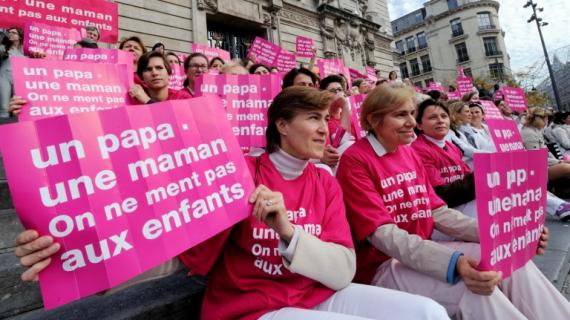
(OK, we’re not actually talking about advocates for actual marriage from France, though maybe we should be!)

Evangelical writer David French has this to say about the relationship between the violence the torch-and-pitchfork crowds do to others (and to the very possibility of just laws) and willful destruction of vital cultural institutions:

It’s important to understand that this wave of coercive intolerance is not mere aberrational excess but the natural and inevitable byproduct of grafting same-sex relationships into an institution that is a key building-block to civilization itself. Even in the face of strong sexual-revolution headwinds, our law and culture continue to not only protect marriage and incentivize marriage, it is still seen by hundreds of millions of Americans as the ideal family relationship. In other words, by grafting same-sex relationships into marriage, activists want their relationships to enjoy all the legal and cultural protections marriage has built up through millennia of human experience. To oppose “marriage” is to oppose civilization.

But marriage did not become an “ideal” or civilizational building-block by simply being the most intense and committed form of adult relationship. In fact, at its core, marriage is not about adults — or adult happiness — at all. It has been at the heart of every enduring world culture not because these cultures share the same faith, or share the same ideals about romantic love and adult happiness, but because life has long taught us cultures thrive when children are raised in stable, two-parent, mother-father homes. Indeed, spouses from many cultures would laugh at the notion that “happiness” or “romance” has anything to do with the nature and familial bond of their marriage.

(source: Like the President and Hillary, My Views on Marriage Have Evolved | National Review Online)

There’s even more to it than that, but still that’s pretty much right.

Sometimes Onion Peals Ring Bells

Trescott University president Kevin Abrams confirmed Monday that the school encourages a lively exchange of one idea. “As an institution of higher learning, we recognize that it’s inevitable that certain contentious topics will come up from time to time, and when they do, we want to create an atmosphere where both students and faculty feel comfortable voicing a single homogeneous opinion,” said Abrams, adding that no matter the subject, anyone on campus is always welcome to add their support to the accepted consensus.

(source:  College Encourages Lively Exchange Of Idea | The Onion – America’s Finest News Source.)

I’m happy to say this is not what my experience at OSU is generally like, but anyone in academia today will tell you that there’s more than a little worry about the “squeeze” from multiple directions.  On the one hand, the torch-and-pitchfork bigots who denounce anyone that doesn’t support their efforts to mandate legal recognition of a lie about marriage; on the other hand, folks who want us to reduce education to cash value and put labels on it.

(Of course, nobody will even consider draining the swamp of Title IV funding to let education be a worthwhile aim among others rather than a political mandate!)

A Comedy of Errors About Teaching Shakespeare

I like to think I’m a pretty fair Bardolater, as these things go, but Ryan Cole has seriously overshot, here:

A new study by the American Council of Trustees and Alumni (ACTA) reveals, depressingly, that only four of the nation’s top colleges and universities require a Shakespeare course, even for English majors. ACTA, a non-profit based in Washington, D.C., that encourages college trustees to act on behalf of academic freedom and excellence, surveyed U.S. News and World Report’s top 25 national universities and top 25 liberal-arts colleges. Of the former, only Harvard (the lone Ivy League institution to make the cut) and the University of California–Los Angeles require English majors to study Shakespeare. Of the latter, only Wellesley College and the United States Naval Academy do.

(source: English Majors sans Shakespeare | National Review Online)

Now, if this showed that students were making it all the way through K-12 and a 4-year college degree without ever reading Shakespeare, I’d be pretty concerned–like I am seriously upset that my students enter my college lit courses unfamiliar with even the names, dates, and most major works of writers like Donne, Milton, or Wordsworth.  It’s hard to enforce on their understanding how important Charlotte Smith is when they don’t even know how big the influence of Wordsworth and Coleridge proved to be!

Simply put, however, Shakespeare is still a go-to in lit courses. Continue reading