I Am Ahmed Aboutaleb

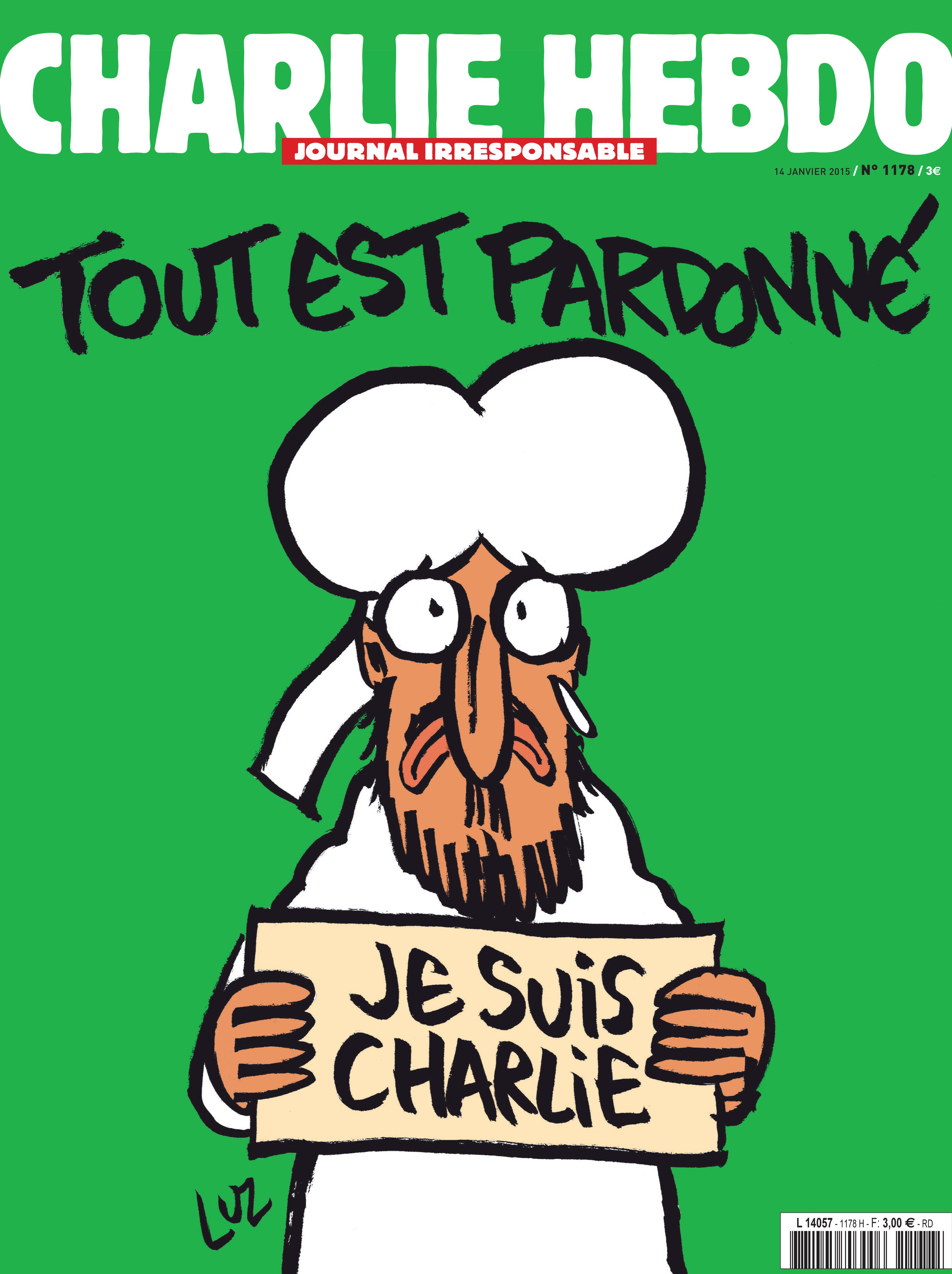
FRANCE-ATTACKS-CHARLIE-HEBDO-MEDIA-FRONTPAGE

Charlie Hebdo is a disgusting publication. I don’t mean primarily because it uses juvenile sexual crudity to deman people, although that’s pretty bad – don’t type “Charlie Hebdo cover” in Google Images unless you have a strong stomach. What’s primarily disgusting is not the sexual crudity used to demean people, but the fact that the publication seems to exist primarily to demean people.

Now, how do I make it clear that in spite of the fact that Charlie Hebdo is disgusting, I regard the right of Charlie Hebdo to be Charlie Hebdo as worthy of the highest protection? Is it still possible to say that Charlie Hebdo is disgusting but I am prepared to die for its right to be what it is? Or is there now only a choice between sentimental gas that condemns neither Charlie Hebdo nor attacks on free speech, and a sort of free speech idolatry that says we are not defending the right to be Charlie Hebdo if we are not celebrating the content of Charlie Hebdo?

Does “I Am Charlie Hebdo” imply I approve of the content of Charlie Hebdo? I can’t tell. A lot of people seem to think so.

You will have difficulty finding someone who enjoys the writing of Mark Steyn more than myself, but since the massacre, nobody’s stance on free speech seems to be strong enough for him. If you are anything less than celebratory of the content of Charlie Hebdo, or if you focus your response on affirming the power of ideas rather than on the (also important) imperative to hunt these terrorists down and kill them, your affirmations of free speech rights are somehow compromised in his eyes.

I think he’s particularly off base in suggesting that the cover of the new issue somehow reflects a decline in courage on the editors’ part:

When skilled persons who have never shied away from clarity produce a work whose meaning is unclear, then it is reasonable to assume the unclearness is itself the meaning.

No, it is not. The editors may be “skilled,” but think about what must have been involved in putting out a new issue under the conditions that now prevail at Charlie Hebdo. Publishing is a hectic world even when you haven’t just been blown up by a bomb. If the cover was unclear, a rushed production is the obvious culprit.

The editors profess that they intended the meaning of the cover to be clear. Gérard Biard, editor-in-chief, says:

“It is we who forgive, not Muhammad.”

I believe him. If even he has not established that he’s the kind of guy who says what he really thinks, who has?

Steyn is right that there is a temptation to say “I support free speech, but…” and then compromise free speech away. But there is an equal and opposite temptation to think that free speech has not been protected unless the speech itself achieves the highest possible level of unpleasantness, or if we then fail to celebrate its having done so.

Sign me up with Ahmed Aboutaleb, the mayor of Rotterdam. He identifies as Muslim and says to his coreligionists who don’t embrace religious freedom:

It’s incomprehensible that you turn against freedom like that, but if you don’t like this freedom, for heaven’s sake, get your suitcase, and leave. There might be a place where you belong, and be honest with yourself about that. Don’t kill innocent journalists. And if you don’t like it here because you don’t like the humorists who make a little newspaper — if I may dare say so — just f*** off.

I am Ahmed Aboutaleb!

Luck Is for Suckers!

IMG_0089-0.JPG

HT readers might be interested in my review of the new Annie movie over on JPGB:

There’s a real artistry to the way this movie does the Annie story without treacle. I think half my enjoyment of the movie was admiring how they pulled this off.

Consider how they handle “Tomorrow.” You can’t have Annie without “Tomorrow.” But audiences in the post-Seinfeld culture are not going to sit still for “Tomorrow.” Not unless you do something that forces them to. How to do it? By putting the song in an unhappy scene. Annie gets a major disappointment – life basically kicks her in the teeth. The sad moment just lingers on screen quietly for a bit. And then Annie half-says, half-sings to herself, quietly, “the sun will come out tomorrow.” And a moment later she’s singing “Tomorrow” and it’s slowly but surely building steam. And you’re rooting for her.

These people actually know how to make a frikkin’ movie. Can you believe it? Where have they been for the last twenty years?

I also contemplate the significance of the movie’s political, economic, racial and ethical views, which I think are deeper than they may appear to be.

The story of Annie has always been America’s ideal of itself at its best. I’m not sure a black Annie isn’t a greater sign of triumph over historic injustice than a black president.

Imagination Redeemed on TGC

Empty movie theater

Today, TGC carries my review of Gene Veith and Matthew Ristuccia’s book Imagination Redeemed. I loved the book:

Imagination was given to us so we could love each other. Imagination Redeemed showed me something I had never realized: practically every aspect of neighbor love involves imagination. We cannot do to others what we would have them do to us without first imagining what we would have them do to us. Or if we wish to obey God’s command to respect the “image of God” in all human beings, we must have a well-developed and disciplined power of grasping images. What is that but imagination? Paul commands us to bear one another’s burdens and consider the interests of others; how do we know what others’ burdens and interests are, except by using imagination to place ourselves in their shoes?

I did register one objection:

In several places, they talk as though imagination were not just coordinate with reason and will, but superior to them…If reason is subordinate to imagination rather than coordinate with it, there can be no valid reason to insist it’s right to follow a vision of the true God and wrong to follow a vision of false gods, or none. Veith and Ristuccia back up their claim by pointing out that companies spend millions on advertising that appeals to the imagination, but those same companies also spend millions on lawyers, lobbyists, spokespeople, and others whose job is to appeal to reason. We don’t want to jump out of the frying pan of Cartesian rationalism into the fire of Nietzschean relativism.

But that’s a minor flaw. It’s a wonderful little book. Check it out.

Religious Freedom Requires Rights

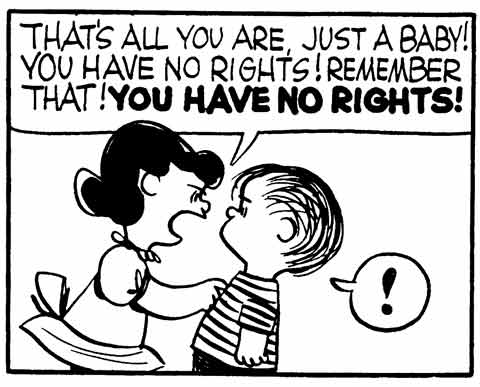
NoRights

Last month I gave a talk at the Evangelical Theological Society in which I defended the idea of human rights – not sham Rawlsian rights but real rights, grounded in objective claims about truth, justice and the nature of the human person. That is, rights as correlative to duties – I have a right to religious freedom because (and only because) I have a duty to worship God sincerely rather than insincerely.

I found that I was almost (not quite) the only supporter of rights in the room. I’ve been thinking about the discussion ever since, and I keep coming back to the following thought, which I think shows in a pretty solid way that religious freedom (by which I mean not mere toleration but a real openness to social pluralism) requires rights.

If more than one religion is present in the body politic, it seems to me there are only two options. One is to anoint one religion – either formally or informally – as the official religion of the body politic. Interestingly, this kind of politics is not only demanded by Christians who advocate the Christendom social model; it is also presupposed in reverse by Christians who advocate that the church ought to withdraw from the world’s political order (both the shallow, resentful types who want to withdraw because they lost the culture war, and the more profoundly world-hating fundamentalists of the Stanley Hauerwas variety). Whereas our Christendom friends want Christianity as the official religion of the body politic, the advocates of withdrawal want a non-Christian religion to be the official religion of the body politic. Of course they don’t “want” this in the sense that they agree it would not be so in an ideal world. But they do “want” it in the sense that they will adamantly oppose any effort to do anything against it here and now.

But suppose we don’t want one religion anointed as the official religion of the body politic? If so, we are going to need what Peter Berger calls (in his new book, which you should go read right now) a “formula of peace” – some sort of publicly acknowledged arrangement that regulates the social frontier between religions. The First Amendment is one example of such a formula, though an admittedly imperfect one.

And a publicly acknowledged formula of peace – any publicly acknowledged formula of peace, but I think especially one for regulating the social frontier between religions – implies rights. It must presuppose natural rights and it must create positive rights.

It must presuppose natural rights in the sense used by George Washington in his letter to the Hebrew Congregation at Newport, when he said that oppression of the Jews was not just unloving and bad policy but violated Jews’ natural rights. Without such a presupposition, the publicly acknowledged formula of peace has no moral basis that does not itself presuppose the truth of one religion. And the formula of peace between religions cannot presuppose the truth of one religion, or else it would be just a disguised (and therefore dishonest) way of anointing one religion to rule.

And it must create positive rights in the sense used by, say, Hobby Lobby when it claims to have a First Amendment right not to finance abortion drugs. Almost the only function of a publicly acknowledged formula of peace is to create such rights. We have the First Amendment precisely so Hobby Lobby (and the rest of us, of course, speaking on Hobby Lobby’s behalf) can shove a copy of the First Amendment in the president’s face and say, “wait a minute! You can’t just run roughshod over people and treat them like dirt! People have rights!”

I’d welcome any and all thoughts on this line of reasoning, but it seems pretty solid to me.

The Rape System

rotundauvafromthesoutheast

Today TPD carries my article on the campus rape debate: “Not Just a Rape Culture: The University’s Rape System.” I argue that our increasing tendency to think about all social problems through the lens of “culture,” while it can be the right approach in many contexts, can also be counterproductive, and has become extremely so in the case of campus rape. In particular, our talk about “culture” often represents a flight from politics. We chant that “politics is downstream from culture.” As a result, we miss the fact that politics is part of culture, and some of our cultural problems are political problems that require political solutions.

Let’s set aside for a moment our debates over “rape culture.” The transfer of responsibility for rape cases from police to universities, coupled with the universities’ fear of bad publicity and (even more) their fear of angering the Greek organizations that build their donation and student recruitment bases, has resulted in the creation of what I call in my article a “rape system” – a system, protected by a powerful coalition of forces, whose effect is to protect rapists and ensure they will not be prosecuted.

Once we think in terms of a “rape system,” we can move beyond fruitless debates over “culture” and develop tangible plans to do something. In my article I propose that the prosecutors’ office recruit someone with experience taking on organized crime to lead the creation of a special unit dedicated to handling rape cases. Such a latter-day Eliot Ness would have the credibility to change the political dynamic, putting the rape system on the defensive.

This solution is “cultural” in the sense that it is less about money and power than it is about credibility and plausibility. The goal is to make the dean with the frightened young woman in his office feel a sense of duty to urge her to go to the police; today, thanks to the structure of the rape system, he is more likely to feel a sense of duty not to do so. But this cultural solution is a political solution, in that it uses political action as the primary arena for reform. Law and justice are in this sense as “cultural” as arts and entertainment.