Russell George is an Honorable Man

irs-miller-congress

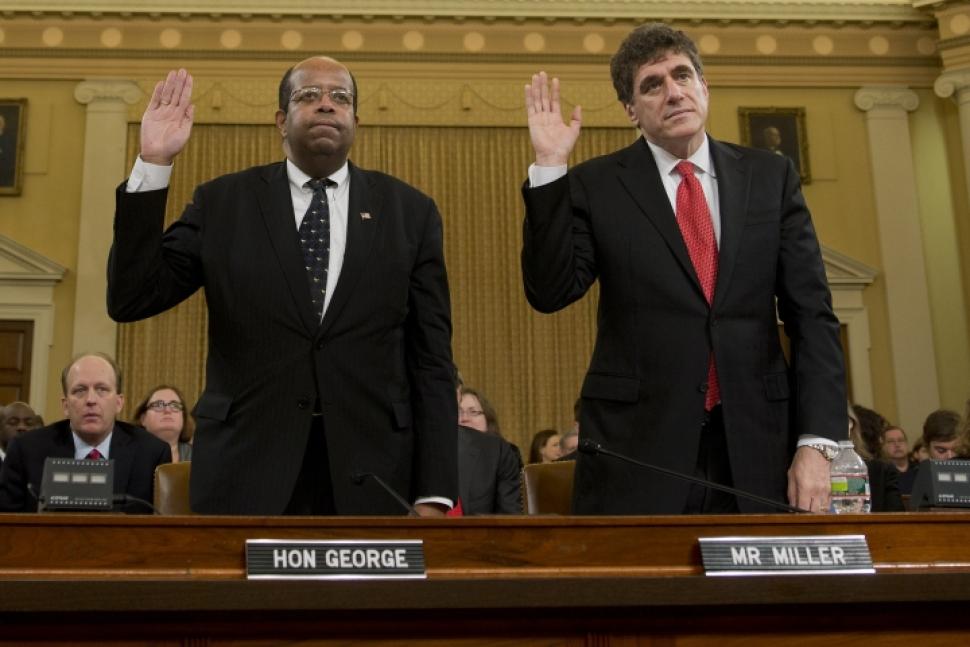
Above left: A man who has earned the prefix on his nameplate

I had what might or might not be considered an unusual thought when I first read this Journal story, posted on Thanksgiving Day, about how the supposedly “lost” IRS emails have been found after all. Up to now, the scandal has been that 1) the records were destroyed even though the law says they must not be, and 2) the man allegedly brought in to clean up the mess at the IRS withheld his knowledge that the emails were missing from Congress. Now it turns out that our rulers are so cynical, they apparently never even felt the need to destroy the emails. The emails were sitting there all the time, silently awaiting an honorable man who would come forward and state that they existed.

My thought upon reading this was: How delightful that the Treasury Department’s inspector general, Russell George, actually came forward with the emails! All the incentives are against it. He does not even seem to be receiving the public honor he is due for his act. He had, more or less, no reason in the world to announce the emails had been found – except that it was the right thing to do.

Let the record reflect that Russell George is an honorable man.

If this country does turn around, this is the kind of person who will do it. Woe to us if we allow our cynicism to blind us to the continued existence of such people, for that is a self-fulfilling prophecy. When Gimli declines to request a gift, Galadriel cries out: “Hear all ye Elves! Let none say again that Dwarves are grasping and ungracious!” It was a very great thing to say, and in its own way, a greater gift than the one Gimli finally named and received from her.

Image HT

“Then the Law’s Crazy”

Dirty Harry

I’m no lawyer, but I find very plausible William Galston’s argument in today’s Journal that the New-Deal-era Administrative Procedure Act purports to delegate to the executive branch sufficient authority for Obama to amnesty five million illegal immigrants – even granting them rights that legal immigrants don’t have.

As the title on Galston’s article says, “The Law Is With Obama on Immigration.”

To which I respond with the words of the noted legal philosopher Dirty Harry: “Then the law’s crazy.”

The out-of-control delegation of unaccountable authority to the administrative state is not a defense; it is the problem here.

I’d like to see high levels of legal immigration, but the rule of law is more important. Permitting high immigration legally says we are self-confident and hopeful, and view human beings as an asset rather than a liability. But it only says that if we permit it legally. On the other hand, permitting a large and regularized gap to exist between what the law says and what we actually do says we are cynical and selfish bastards. After that, it almost doesn’t matter how much immigration we permit. Whatever immigration level we allow, high or low, we will have set that level as the result of a cruelly selfish calculation of our own benefit. And, of course, any gap between what the law says and what we actually do is always a standing invitation to all forms of public and private corruption – bribes, slavery, you name it.

I’ll go out on a limb and say I’d accept a law setting any legal immigration level, even zero, if in exchange I could believe that the law would be enforced.

The New Sacred Canopy

Many Altars

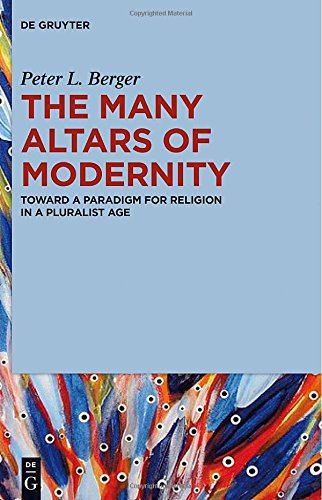
On Friday, TGC carried my review of Peter Berger’s new book, The Many Altars of Modernity. I really cannot overstate how important I think this book could be:

In his 1967 book The Sacred Canopy, Peter Berger more or less invented sociology of religion as we know it. It revolutionized the field not only because it was profound, but because it was short and did not assume much prior knowledge. It was not beach reading, but laypeople willing to make the effort could grasp the extraordinary vision Berger laid out for how we can understand the central role of religion in the structure of society.

Berger, professor emeritus of sociology at Boston University, has done it again. The Many Altars of Modernity is even shorter (93 pages) and more accessible to the layperson than The Sacred Canopy. Yet it has the potential to re-revolutionize the sociology of religion.

Berger has provided a concise statement of the sources, opportunities and challenges of modernity that I think surpasses anything we’ve seen so far – certainly anything we’ve seen written for general intellectual audiences. He identifies the multiple dimensions of the problem and shows where the prevailing approaches to the problem are inadequate.

The word we most need to hear, I think, is this:

Against Taylor and the dominant traditionalism of the Christian intellectual world, Berger argues that the real origins of modernity—and hence of the crises of modernity—are in the religions themselves, and the sociology of their encounter with one another. Once the world’s great civilizations made the transition from primordial mythology to mature religions, capable both of making truth claims and of accommodating economic and technological advances, it was inevitable that we would someday face the challenge of pluralism. We can denounce “modern ideas” until we are blue in the face, but once adherents of the world’s religions start interacting with each other on a daily basis, we cannot avoid the trauma of choice and doubt. The great historic encounter cannot be undone.

Unfortunately, the publisher has set the cover price high. Check with your local college library and make sure they plan to order this book; you won’t want to miss it.

What Is Sociology?

church in the city

I was fascinated by this review of Christian Smith’s new book, The Sacred Project of American Sociology (HT First Thoughts). Smith apparently argues that not only is sociology failing as a science – no surprise there – but that it is in fact a “sacred project”:

American sociology as a collective enterprise is at heart committed to the visionary project of realizing the emancipation, equality, and moral affirmation of all human beings as autonomous, self-directing, individual agents (who should be) out to live their lives as they personally so desire, by constructing their own favored identities, entering and exiting relationships as they choose, and equally enjoying the gratification of experimental, material, and bodily pleasures.

And I immediately thought: “Yes, but will this book tell us anything Allan Bloom hasn’t already told us in The Closing of The American Mind?” I’m re-reading that book now after a long absence, and was very surprised to be reminded of the central importance of Max Weber as one of the chief villains in Bloom’s narrative. It’s a very plausible version of events. At any rate, I hope I can find time to sit down with Smith’s book.

Meanwhile, in sociology news, I am very bullish on Peter Berger’s new book The Many Altars of Modernity. My review should be out soon. I think this book has the potential to be at least as revolutionary as The Sacred Canopy, and that’s saying a fair bit. Stay tuned.