Happy July 4, Egypt!

While the American media slept, the people of Egypt pulled off the Havel maneuver (mass protests bring down a dictator without firing a shot) for the second time in an amazingly short period. I wonder if anyone in the dinosaur media are embarrassed they ignored this story for days – presumably because there was no appealing ideological storyline, and they’re no longer interested in news for any other reason.

When the Mubarak regime fell, the smartest person I know said “it’s hard to see how the Muslim Brotherhood doesn’t wind up in charge.” He was proved right, and quicker than usual even for him. But to my knowledge he never predicted they’d also leave power just as quickly! Good riddance.

Naturally, the administration is once again lining up with the dictators against the community he terrorizes, on grounds that the dictator was elected. Because it turns out a naive belief that democracy alone is all-sufficient to ensure freedom and justice was not, after all, merely the idiosyncratic fixation of the previous administration. In fact, we have been making this mistake consistently for almost a quarter century, since the Berlin Wall fell and we prioritized democracy in Russia and Eastern Europe with no attention to other values like the rule of law, freedom of speech/religion, property rights, etc. We made the same mistake in Iraq and who knows how many other places in between. This is a long term, bipartisan problem; it’s discouraging that we haven’t even begun to learn.

What comes next after this revolution may well end up being worse than what came before. But one could have said the same on July 4, 1776, and that revolution would still have been as just and as wise as this one. The early signs are hopeful – the military spokesman announcing the revolution was flanked by the Coptic pope (that is, I gather, the man’s title) and the head of a Muslim university. Am I romantic for seeing resonances here of that unity in diversity achieved among such contrasting figures as Adams, Jefferson and Franklin?

God bless the people of Egypt. Today, Lord, please forget the wicked pharaoh; remember the good pharaoh who listened to Joseph and sheltered your people when they were in need. Send them another like him!

What Does It Mean to “Save” American Civilization?

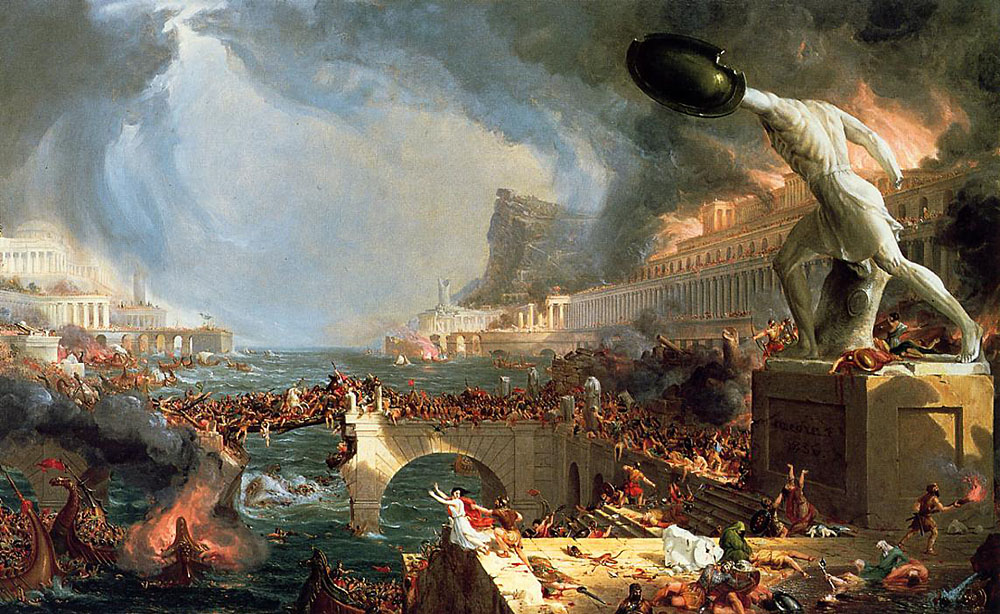
Cole_Thomas_The_Course_of_Empire_Destruction_1836

Over on NRO, Victor Davis Hansen points to the example of Rome to argue that after the central governing institutions of a civilization have lost their founding virtues, it can be held together for centuries merely by inertia in the outlying institutions and a common popular culture.

DC is no longer serious, just as Rome was no longer serious. But very little of the “Roman empire” was directly governed by Rome; similarly, much of American civilization is surprisingly insulated from the center:

About half of America and many of its institutions operate as they always have. Caltech and MIT are still serious. Neither interjects race, class, and gender studies into its engineering or physics curricula. Most in the IRS, unlike some of their bosses, are not corrupt. For the well driller, the power-plant operator, and the wheat farmer, the lies in Washington are still mostly an abstraction.

Get up at a.m. and you’ll see that your local freeways are jammed with hard-working commuters. They go to work every day, support their families, pay their taxes, and avoid arrest — so that millions of others do not have to do the same. The U.S. military still more closely resembles our heroes from World War II than it resembles the culture of the Kardashians.

To the extent that we need some kind of common language, pop culture may turn out to be surprisingly able to supply it:

Like diverse citizens of imperial Rome, we are united in some fashion by shared popular tastes and mass consumerism. The cell phones and cars of the poor offer more computing power and better transportation than the rich enjoyed just 20 years ago.

Youth of all races and backgrounds in lockstep fiddle with their cell phones as they walk about. Jeans are an unspoken American uniform — both for Wall Street grandees and for the homeless on the sidewalks. Left, right, liberal, conservative, professor, and ditch digger have similar-looking Facebook accounts.

If Rome quieted the people with public spectacles and cheap grain from the provinces, so too Americans of all classes keep glued to favorite video games and reality-TV shows. Fast food is both cheap and tasty. All that for now is preferable to rioting and revolt.

It is not, of course, a happy picture VDH is painting. Because the obvious question (which he does not raise in this column, but given what we know, he must be thinking it) is whether a civilization is even worth saving on these terms. What makes the history of Rome romantic and glorious for so many people is everything it accomplished before the state of corruption in those long, slow later years. Nobody looks back to sixth-century Rome with admiration. So suppose America does last several more centuries – what would it matter?

But of course it is far from clear that we could last that long, because VDH’s comparison is of limited application. History moves a lot faster these days; inertia wears down sooner. And the center has a much, much longer reach than it used to – as all those virtuous tech schools and businesses are going to be finding out in the coming decades.

On the other hand, VDH is giving us space for hope. The collapse of American civilization may not take as long as Rome’s, but it will also not happen overnight. What we need is not an eternal prolonging of the present moment – some sort of indefinite delay of the otherwise inevitable reckoning – but just enough time and space for a real cultural renewal. For real cultural renewals do happen, and that is our hope. What VDH is pointing out is that we may have a long enough runway for it after all.

Top Secret Tips on Talking Your Way into the Culture’s Bedroom!

Washington's Courtship

Oh, Martha – won’t you let me contribute to your conjugal virtue?

It’s every guy’s dilemma: a culture has caught your eye, she has so much to recommend her, and you just know that her bedroom is littered with disordered desires. She’s practically crying out for you to take her into your arms and undergird her social structures with your moral grounding. But how do you approach her? You don’t want to come off like one of those culture-warrior players, who don’t really care about her – those guys who just want to find a culture they can dominate to feed their own egos. You want her to know that you care about her needs, and you’re looking for a meaningful and fulfilling long-term integration of socio-cultural imperatives. She’s sick and tired of all the tired old pick-up lines. So what do you say?

Well, friends, the smooth-talking Eric Teetsel has you covered in today’s TPD:

In a 1972 article in Philosophy & Rhetoric, Wayne Brockriede describes the art of communication in terms of sexual conduct. Like sex, argument occurs between human beings who bring their whole selves to the conversation, including personal histories and philosophical presuppositions (whether they know it or not). And, as in sex, participants in conversation can be considerate of these facts and lovingly negotiate them as part of the act, or manipulate them to personal advantage, or ignore them completely and carry on without regard for the others’ welfare at all. The first is arguing as a lover; the second as a seducer; the third as a rapist.

Too often, conservatives—including me—fall into the third category with our derision and condemnation. Not only is this unbecoming of people aspiring to virtue, it is ineffective in winning others to our cause.

Arguing as a lover is better. It frees us to acknowledge our personal faults and the faults in our arguments while remaining committed to our position and allowing our interlocutor to save face in the majority of instances in which our case is superior. As we woo the person across from us (and—remember—the audience watching from home) we are funny, self-effacing, merciful, and confident.

Now that’s what I’ve been waiting for. Kudos to Eric for this great piece.

The Problem in Nine Minutes

TGC video Hansen Wax DeYoung

Check out this interesting short video from TGC. This exchange is a really good, clear, concise statement of the problem of moral consensus and Christian participation in politics in early 21st century America. They don’t have all the answers and neither do I, but it’s heartening to see that there’s increasing clarity about the problem. How do we help people accept moral authority from outside themselves and contribute to the structuring of society’s legal/political plausibility structures without imposing Christianity?

Al-Qaeda’s Complaint Department: Religion and Modernity

Complaint Department

No longer just a joke.

I am not the first to remark that modernity is not the absence or even decline of religion, but a change in the relationship between religion and the social order. One aspect of this change is pluralization, the expectation of religious diversity within society. I am inclined to think this aspect is the one that represents modernity in its fullest development, and with the most far-reaching ramifications. However, another aspect is what we might call reformism, the expectation that social institutions should be continually reformed to bring them into better alignment with our moral convictions. Reformism comes first, and when it achieves its ends in full (which does not always happen) the result is pluralization. It is noteworthy that Rodney Stark and Charles Taylor, who disagree about so much, agree that reformism was the prime mover of modernity.

One piece of evidence I would point to in favor of the description I have just given of the relationship between pluralization and reformism is that you sometimes find reformism without pluralism, but you never find pluralism without reformism. Iran and Saudi Arabia, for example, represent reformism taken to an extreme. Bernard Lewis has pointed out that the entire constitutional structure of Iran consists of recent inventions – there was no such thing as a “mullah” until the 1970s. Because Iran is a theocracy, this represents a far-reaching reform not only of government and society, but of Islam itself (at least as practiced in Iran). And while Saudi Arabia has revived the old names of tribal offices instead of inventing new ones, the reformist impulse is the same. For example, I have seen quite a few knowledgeable people point out that the severe restrictions on female dress in these and other countries are of recent origin.

All of which brings us to what might be the most eyebrow-raising story in some time: Al-Qaeda has instituted a complaint department.

Andrew Johnson at NRO, commenting on a story in the Telegraph:

“Any one who might have a complaint against any element of the Islamic state, whether the Emir or an ordinary solider, can come and submit their complaint in any headquarters building of the Islamic state,” the group’s operations in a northeastern part of Syria said in a notice. “Emir” refers to al-Qaeda’s sub-leaders, according to the Telegraph’s translation.

The Telegraph notes that al-Qaeda has an extensive bureaucratic structure. Last month, for example, the Associated Press discovered a letter from an al-Qaeda council that criticized Mokhtar Belmokhtar, a top leader, for not submitting his expenses, answering his phone, or carrying out attacks according to instructions.

Why is this humorous? Because we in pluralist societies are always surprised when we discover what we consider the less central distinguishing qualities of modern organizations – bureaucracy, offices, rules, complaint departments – without what we consider the most central distinguishing quality, pluralism.

And at the risk of being called ethnocentric, I would argue we are right to be amused, even if the realities of Al-Qaeda make it a dark amusement. The basic question here is: are we right that pluarlism is the central characteristic, and bureaucracy and all the rest of it is peripheral – that reformism ultimately ought to lead to pluralism? If so, as I believe is the case, we would not find it surprising if countries that aren’t very reformist are also not very pluralist. It doesn’t violate our expectations if tribal Hindus in rural India murder Christian converts. (“Nobody bats an eye, because it’s all part of the plan.”) But it’s funny when reformism is carried to a great extreme among those who have pledged by their God to lay down their lives in a murderous war to destroy pluralism. “Don’t they see the contradiction?” we want to ask.

Well, no, they don’t, and they’re not going to. But if we beat them, their next of kin may be prompted to think more clearly.