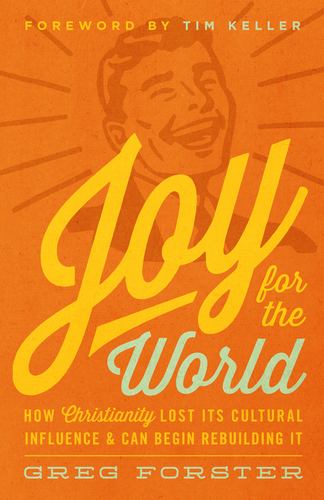
Thought some of our readers would like to know that the e-version of my new book Joy for the World is now on sale for 99 cents at Amazon. For a limited time!
Thought some of our readers would like to know that the e-version of my new book Joy for the World is now on sale for 99 cents at Amazon. For a limited time!

TGC has posted my article on why pastors should visit people in their workplaces:
Pastors are constantly visiting people in homes, hospitals, prisons—almost anywhere except the places where we actually spend most of our waking hours. To be sure, those other kinds of visits are important. But on a typical day I spend six waking hours at home and nine in my workplace—and I’m one of the relatively fortunate people in that regard.
Jesus did it, because he clearly wanted his teaching contextualized to the workplace:
Theologian R. Paul Stevens reports in his book Work Matters that 122 out of 132 public appearances of Jesus were in the marketplace. And think about what Jesus was doing his whole life before he started his public ministry. For more than 15 years, he was working in an ordinary job, doing exactly the same kind of work his sheep do.
Jesus got to know the workplace by experience. That’s important because it allowed him to contextualize his teaching to the workplace. Out of 52 parables, 45 are set in the marketplace: fields, sheepfolds, vineyards, kitchens, palaces, courts, fisheries, and more.

TGC just ran my review of Os Guinness’ new book. It’s a good book with two serious flaws that will limit its appeal and effectiveness. The more serious flaw is the book’s attitude problem:
Guinness writes like a man who passionately hates the world, and bitterly resents the Western church because it doesn’t hate the world as much as he does. He (very) occasionally affirms that Christians should love the world, but these abstract statements are never fleshed out with particulars, and thus fail to rise above the level of barren platitudes. His operational attitude toward the world, and even more toward the Western church, is always and everywhere law, law, law, and no gospel.
Guinness’s hatred of the world and resentment of the church reach their high point in a shocking passage where he compares religious movements he dislikes to cooperating with genocidal totalitarianism…
That “shocking passage” must be read to be believed . . . so I reprinted it in the review.
These days the church seems to be long on people who can diagnose everything wrong with the modern world, and short on people who demonstrate love and hope.

Here we go round the prickly pear
Prickly pear prickly pear
Here we go round the prickly pear
At five o’clock in the morning.Between the idea
And the reality
Between the motion
And the act
Falls the ShadowFor Thine is the Kingdom
Between the conception
And the creation
Between the emotion
And the response
Falls the ShadowLife is very long
Between the desire
And the spasm
Between the potency
And the existence
Between the essence
And the descent
Falls the ShadowFor Thine is the Kingdom
For Thine is
Life is
For Thine is theThis is the way the world ends
This is the way the world ends
This is the way the world ends
Not with a bang but a whimper.
(source: A Hypertext Version of T.S. Eliot’s “The Hollow Men”) Continue reading

Strange though it seems to have to point this out, shouldn’t someone notice that there is something more profound than irony in the following juxtaposition?
Under the law, a student who has been accused of sexual assault can’t defend himself by saying he thought the accuser was a willing partner. There has to have been “affirmative, conscious, and voluntary agreement to engage in sexual activity.” Consent, so defined, must be “ongoing throughout sexual activity.”
(source: California Sends in the Sex Police – Bloomberg View)
Conjugal love involves a totality, in which all the elements of the person enter – appeal of the body and instinct, power of feeling and affectivity, aspiration of the spirit and of will. It aims at a deeply personal unity, a unity that, beyond union in one flesh, leads to forming one heart and soul; it demands indissolubility and faithfulness in definitive mutual giving; and it is open to fertility. In a word it is a question of the normal characteristics of all natural conjugal love, but with a new significance which not only purifies and strengthens them, but raises them to the extent of making them the expression of specifically Christian values.
(source: Catechism of the Catholic Church – The sacrament of Matrimony)
Specifically, shouldn’t someone notice that the desired “liberation” of sexuality has–quite unsurprisingly to those who heed the experts in human nature–resulted in ever-more-detailed, ever-more-intrusive regulation of sexuality? That it has not resulted in greater capacity to enjoy the goods of conjugal union, but in raising the stakes in rationing those goods, so that practically every facet of our commercial and cultural life is dominated by efforts to consume as many “others” as possible? Continue reading