Americans Say “Yes” to New Life

Next exit new life

Image HT

I wrote not long ago that “American culture has a way of defying pessimistic expectations. We social scientists can never quite stop selecting on the dependent variable – we look for signs of hope or decline in the places where signs of decline are more visible than signs of hope….The signs of decline are always right where you expect to find them; the signs of hope spring up in the last places you expect.”

In his daily email, Jim Geraghty points out that the American birth rate just increased by the highest amount in five years, at a time when rates of teenage pregnancy, birth and abortions are hitting record lows.

Here at Hang Together we’re approaching our third July 4 (well, third if you count our inaugural post, in which Ray Charles did July 4 on Labor Day). I don’t know what the future will bring any more than anyone else, but I know that hope is a Christian virtue and I know that Scott McCloud was right: If there’s a 99% chance of total disaster, the only rational response is to concentrate all the more on the remaining 1%.

The Good of Politics at TGC

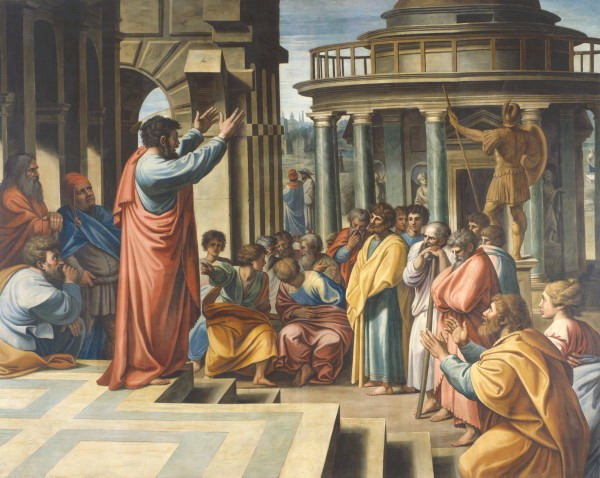
areopagus

TGC carries my review of James Skillen’s new book The Good of Politics today. I’m in sympathy with what Skillen is trying to do:

As American evangelicals have grown disappointed with politics, it has become commonplace to draw a strict separation between “politics” and “the culture.” People are starting to say that politics is ultimately about power, but culture is about meaning and purpose, and that’s where we find all the really important action.

Skillen gently rebukes this dualistic way of thinking. He reminds us of the critical truth that politics is always and everywhere a part of human culture, never separate from it. It is one essential element of our search for meaning and purpose. It is only one part, so we must resist the temptation to politicize everything. But separating politics from culture only encourages immorality and injustice. It gives aid and comfort to those who treat politics as a cynical power game. It also ensures that our apolitical “cultural” efforts will be neutered and incoherent, unable to give a full account of justice.

But I think Skillen has taken on more tasks than he can carry out well in the short space he has. For example:

Skillen’s deep desire to show that all things in God’s universe are ultimately made to be in harmony leads him to ignore the hard choices we face. To take only one from many examples, his chapter on economics says that society must “recognize and encourage entrepreneurial talent, production and commerce, free markets for the exchange of goods and services, and the creative development of economically qualified organizations of diverse kinds” (178). It also says that “the political community [should] agree from the start that any change in environmental conditions would trigger government’s action to protect the environment and its sustainability” (181). If Skillen sees any tension between these pronouncements, he’s not showing the slightest sign of it.

We can and must find ways of reconciling an entrepreneurial economy with environmental protection. But Skillen is not contributing anything useful or interesting when he simply proclaims that we can have our cake and eat it, too. He should have allowed himself to wrestle with more tensions.

Marriage and State at TGC

Marriage

Today TGC carries my column opposing a separation of marriage and state. For one thing, I argue, it won’t actually solve the problem:

To begin, a separation of marriage and state would not end the political battle over marriage. The vast legal and regulatory apparatus of the modern state does millions of things every day that require it to make assumptions about who is married. From divorce and child custody courts to health care policy to government employee benefits, any serious attempt to make government agnostic about marriage would require policymakers, bureaucrats, and lawyers to make literally millions of decisions about how each of these specific questions would now be handled under the new rules.

And even if it did, it would be counterproductive:

For all the important differences between ancient and modern views, they agree that the political community is not something we create because we want to get something for ourselves out of it; it’s something we create because we want life and justice to increase. A society that really practiced a separation of marriage and state would come to think—even more strongly than our culture already does—that politics is not about how a community can order its shared life for justice and flourishing. Politics would become, even more than it already is, all about how individuals can satisfy their desires. This is a major contributor to almost every public problem we have today, from the economic crisis to the breakdown of the family to the inability of government to perform even its most basic tasks.

I also discuss the secularization of the public square that “separation of marriage and state” would involve. As always, your comments are welcome!

Things I Tell My Students: Undercover Jonah

one of Rembrandt's many fascinating sketches

one of Rembrandt’s many fascinating sketches

When I have a class that I think can handle it appropriately, and a bit of time at the end of term when the teaching is almost all done, I like to do an exercise in honest peripatetic pedagogy.  I hand out brightly colored note cards, and ask each student to quickly write down one question they’d like me to answer for the whole class–any question, no matter how irrelevant–and then to flip it over and write one statement–any statement, no matter how deep or trivial–they’d like to share with the whole class.  I ask only that their question and statement seem to them to have similar “weight,” and that they be willing to have their statement read in order to get their question answered.

Sometimes it goes flat; sometimes it creates the kind of conversations we all too rarely enjoy with our students, these days.

I fielded questions about “Why don’t we read more poets who are still alive?” (too many of them, too hard to choose, free verse not the best introduction to verse, lack of public domain etexts) and “How do you make poetry matter when people are deaf to it?” (I quoted Dana Gioia on that one, of course).

Then imagine how my mind began to race when I flipped over the card that read “What is the meaning of life?” and “To give glory to Jesus.”  The student, for good measure, had drawn a line from his phrase back to the question, presumably to make sure I couldn’t miss that his sentence fragment would be unintelligible except as answering his question. Continue reading